
What You'll Learn
How on-site dry ice production controls critical food safety risks, including microbial growth, friction hot spots, and uncontrolled fermentation
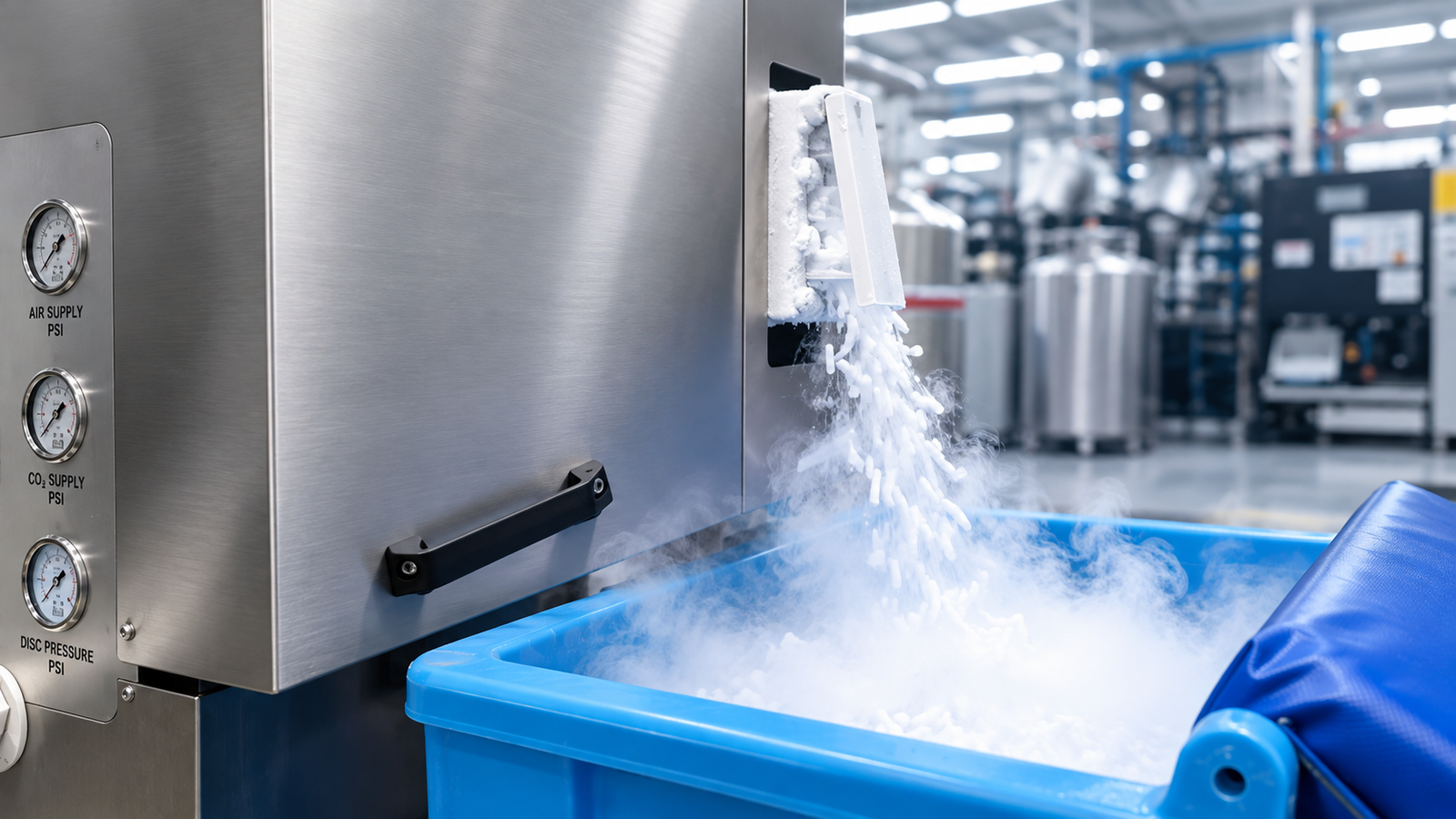
Why dry ice pellets use roughly 70% less liquid CO₂ than CO₂ snow horns while delivering colder, moisture-free cooling
Real-world applications in protein processing, industrial baking, and winemaking, with the measurable quality improvements each delivered
A proven ROI framework showing how facilities save more than $1 million annually by taking control of their cooling medium
How simply on-site production integrates into an existing operation, especially where CO₂ infrastructure is already in place

Who Should Watch
Quality assurance managers, food safety directors, operations managers, procurement teams, and facility engineers, along with anyone responsible for temperature control in a food processing operation.
Common roles & teams
Quality Assurance Managers
See the quality improvements processors measured after moving dry ice production on site.
Food Safety Directors
How constant, moisture-free cold controls microbial growth, hot spots, and premature fermentation risks.
Operations Managers
Where dry ice pellets beat CO₂ snow horns on efficiency, ergonomics, and safety.
Procurement Teams
An ROI framework for owning your cooling supply instead of buying it.
Facility Engineers
What integration takes, especially where CO₂ infrastructure is already in place.
- Quality Assurance Managers
- Food Safety Directors
- Operations Managers
- Procurement Teams
- Facility Engineers
Cooling Media Compared
How dry ice stacks up against traditional cooling media across food processing and cold chain shipping.
| Criteria | Dry Ice | Water Ice | Gel Packs & PCMs | CO₂ Snow Horns | Mechanical Refrigeration |
|---|---|---|---|---|---|
| Temperature | -109°F (-78.5°C) — constant until fully sublimated | 32°F (0°C) — rises as it melts | Limited range — warms steadily in transit | -109°F (-78.5°C) — with high vapor loss | Setpoint-limited — struggles with peak loads |
| Moisture & Residue | None — sublimates directly to gas | Melts into bacteria-friendly leachate | Leak and condensation risk near product | None | Condensation and defrost water |
| Weight in Transit | Lightest — and gets lighter as it sublimates | Heavy — and stays heavy | Up to 2–3x more coolant weight for the same payload | N/A — in-plant use only | N/A — requires refrigerated equipment |
| Media Efficiency & Cost | 2.2 lbs of LCO₂ per lb of dry ice(pelletizer) | Cheap media — costly consequences | High recurring pack costs | ~3.7 lbs of LCO₂ per lb — roughly 70% more than a pelletizer | High energy consumption |
| Food Safety | Inhibits microbial growth; EPA, FDA & USDA endorsed | Meltwater is a known Listeria vector | Safe if intact — puncture risk near product | Food-grade, but difficult to dose precisely | Safe, but cannot reach in-process hot spots |
| Infrastructure Required | Pelletizer + LCO₂ tank; fully passive in transit | Ice machines requiring constant sanitation | Freezer capacity to recharge packs | Snow horn + LCO₂(plug-and-play pelletizer upgrade path) | Major capex to add peak capacity |