
Summary
Onsite, just-in-time dry ice production lets third party logistics (3PL) providers take control of their clients' cold chain. Producing dry ice at the point of packout removes supplier allocation, pricing, and delivery-window risk, cuts coolant weight versus gel packs and PCMs by half or more, and supports food and pharma shipments with an EPA, FDA, and USDA approved cooling medium made from recycled CO₂.
What is onsite dry ice production for 3PLs?
Onsite dry ice production for 3PLs is a make-to-order cooling model in which a fulfillment facility converts liquid CO₂ into high density dry ice at the point of packout, rather than purchasing dry ice from a merchant supplier. Cold Jet pelletizers produce from 176 lbs (80 kg) to 3,306 lbs (1,500 kg) of dry ice per hour in pellet, nugget, and slice formats, and integrate with automated dosing and bagging systems that dispense the precise amount each package requires. Dry ice measures -109°F (-78.5°C) and delivers three times the refrigeration power of water ice, keeping frozen and refrigerated shipments at temperature across domestic and international lanes. Because dry ice begins sublimating the moment it is produced, ice made onsite arrives in the box at full density and freshness, so each shipment needs less of it. The result is a cold chain input the 3PL fully controls: no supplier shortages, no delivery windows, no over-ordering buffer, and no unused stock sublimating away in storage.

Why merchant dry ice supply puts client SLAs at risk
A 3PL's product is a promise: orders picked, packed, and delivered to spec, on time, at temperature. Buying dry ice from a merchant supplier builds three risks into that promise that the 3PL cannot control: allocation risk when CO₂ supply tightens, price escalation during seasonal demand spikes, and delivery-window risk on every replenishment. Each one transmits directly to a client SLA. Onsite, just-in-time production converts dry ice from a purchased commodity into a controlled, in-house utility that scales with order volume.
-109°F
Dry ice temperature
Frozen and refrigerated lanes, packout to delivery
-78.5°C
176-3306
lb per hour
lb per hour production range
80 - 1500
3x Water Ice
Refrigeration Power
EPA, FDA & USDA Approved
Cooling Medium
What Are the Benefits of Onsite Dry Ice Production for 3PLs?
Onsite production protects client SLAs, lowers cost per order, and scales with demand
Cold chain fulfillment is growing faster than most 3PLs' cooling infrastructure was designed for. Client rosters are expanding into direct-to-consumer meat, seafood, meal kits, pet food, and frozen desserts, while the merchant dry ice supply those operations depend on remains structurally volatile.
Onsite, just-in-time dry ice production converts dry ice from a purchased commodity with supply risk into a controlled, in-house utility. Dry ice is produced only when order volume requires it, at the moment of packout, at full density and freshness. The result: protected service levels, lower cost per order, less labor per package, a sustainability story clients can report, and in many operations, a new value-added services revenue line.
 Reliability
Take Control of Your Clients' Cold Chain
Onsite, just-in-time dry ice production eliminates the impact of supplier shortages. During tight CO₂ markets, merchant suppliers prioritize their largest contract holders, and delivery windows and allocations sit outside your control. Producing dry ice at the point of packout removes the most volatile input from cold chain fulfillment, so service levels are protected on every order, in every season.
 Cost Efficiency
Lower Cost Per Order
Onsite production removes the delivered dry ice markup, delivery fees, and the waste of over-ordered stock sublimating in storage. Freshly produced, high density dry ice performs better in transit, so each box needs less of it. And compared to gel packs and PCMs, dry ice cuts coolant weight by half or more, reducing billable shipping weight and improving cube utilization on every parcel.
 Throughput
Scale With Order Volume, Not Truck Schedules
Automated dosing and bagging systems align dry ice application with high volume pack lines, dispensing the precise weight each package's thermal profile requires. That replaces manual scoop-and-weigh workflows, reduces labor per order, and limits cold-contact handling for workers. When peak season order volume surges, production capacity scales with demand instead of a supplier's delivery schedule.
 Sustainability
 Your Clients Can Report
Dry ice is made from recycled CO₂, captured as a byproduct of existing industrial processes, so it repurposes CO₂ that already exists rather than generating new emissions. It sublimates completely, leaving no secondary waste, unlike gel packs that largely end up in landfills. Onsite production also removes recurring dry ice delivery truck trips, and lower coolant weight cuts outbound freight emissions while enabling the shift from EPS coolers to recyclable cardboard packaging.
 Revenue
Turn Cooling Into a Revenue Line
A 3PL with onsite production capacity can offer dry ice replenishment as a billable value-added service, supply regional overflow demand, and package branded dry ice slices as a white-label service for clients. Onsite production reframes cooling from a cost center into a margin generator.
What Can 3PLs Ship With Dry Ice?
Dry ice is a food approved cooling medium that ensures critical control points (CCPs) are met during the storage and transportation of chilled and frozen products. The same cooling power supports life sciences shipments, making dry ice the common denominator across mixed food and pharma books of business.
- EPA, FDA & USDA Approved
- Supports FSMA Requirements
- HACCP / CCP Compatible
- GDP Cold Chain Support (Pharma)
- Domestic & International Lanes
Deliver Temperature Sensitive Life Sciences Shipments With Confidence
Many cold chain 3PLs run mixed food and pharma books of business. Dry ice maintains the deep frozen temperatures that biologics, vaccines, and clinical samples require, with onsite production ensuring supply is never the constraint on a time-critical shipment.
Maintain viability at -78.5°C
Dry ice measures -109°F (-78.5°C), the temperature standard for shipping frozen biologics, vaccines, clinical trial samples, and cell and gene therapies. Consistent deep frozen conditions protect product viability from packout through final delivery.
Just-in-time supply for time-critical shipments
Life sciences shipments rarely wait. Onsite production puts fresh, full density dry ice at the pack station on demand, removing supplier delivery windows from the critical path and supporting the documentation and temperature assurance that pharma clients expect.
Proven at global scale
More than 5 billion vaccine doses have been kept at safe temperatures with dry ice since the onset of COVID-19. When merchant dry ice supply tightened during the global vaccine rollout, in-house production kept manufacturers and logistics providers shipping.


- Vaccines
- Biologics
- Cell & Gene Therapies
- Clinical Trial Samples
- Diagnostic Specimens
- Blood & Plasma Products
- Tissue Samples
- Active Pharmaceutical Ingredients (APIs)
- Laboratory Reagents
- Veterinary Biologics
Keep Your Clients' Food at Temperature All the Way to Their End Customer
Dry ice guarantees that food deliveries arrive fresh or frozen, even when packages are delayed outside the customer's door. Onsite production lets 3PLs apply exactly the cooling each order needs, at the moment of packout.
Prevent thaws and leakers
At -109°F (-78.5°C) with three times the refrigeration power of water ice, dry ice holds frozen and refrigerated products at temperature across the full delivery window. It sublimates directly to gas, so there is no meltwater, no leakers, and no damaged packaging at the doorstep.
Automate dosing on high volume pack lines
Integrated dosing and bagging systems dispense a pre-programmed amount of dry ice directly into parcels or individual bags, aligning cooling with pick-and-pack throughput. Precise dosing cuts coolant overuse, labor per order, and the safety hazards of manual dry ice handling.
Scale through peak season
Q4 is simultaneously the highest order volume period and the tightest dry ice market of the year. Onsite production scales with order volume, so holiday surges, promotions, and new client launches never wait on a supplier's truck.
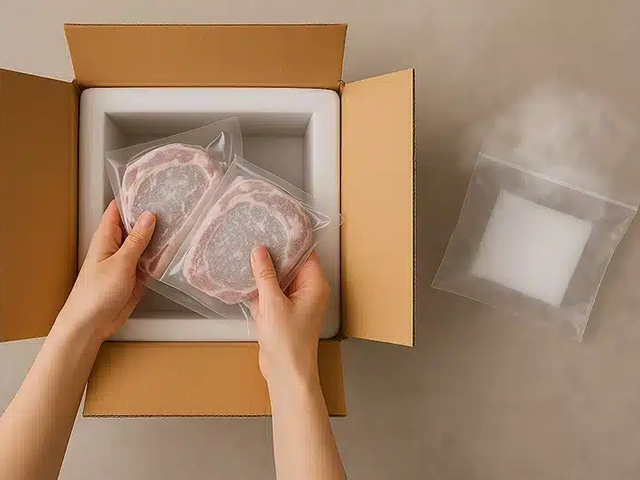


Dry ice supports the full range of perishable fulfillment, from frozen proteins and meal kits to groceries, pet food, and premium gifting, both domestically and internationally, throughout the year.
- Meat (Beef, Poultry, Pork)
- Seafood
- Meal Kits
- Groceries
- Pet Food
- Desserts & Smoothies
- Dairy
- Prepared Meals
- Frozen Baked Goods
- Specialty & Gourmet Foods
- Perishable Gifting
Ship More Seafood Per Pallet With Less Coolant Weight
Dry ice is crucial for maintaining stable temperatures during the export of fish and seafood from processing plants to other facilities. Lighter cooling means more product per box, pallet, and transport.
More product, less coolant
Because dry ice delivers three times the refrigeration power of water ice at a fraction of the weight, exporters can dedicate more of every shipment to product. That increases volume per box, pallet, and transport while reducing transportation costs and carbon emissions.
Stable temperatures on long lanes
Dry ice holds fish at consistent low temperatures across domestic and international lanes, inhibiting the microbial activity that accelerates above 40°F (4°C) and protecting quality and food safety from the processing plant to the receiving facility.
Automated slice dosing for export lines
Dry ice slices produced and dosed by automated systems integrate directly with packing lines, placing a uniform slice in every box. Automated slice dosing delivers consistent cooling at export line speeds while eliminating manual handling.

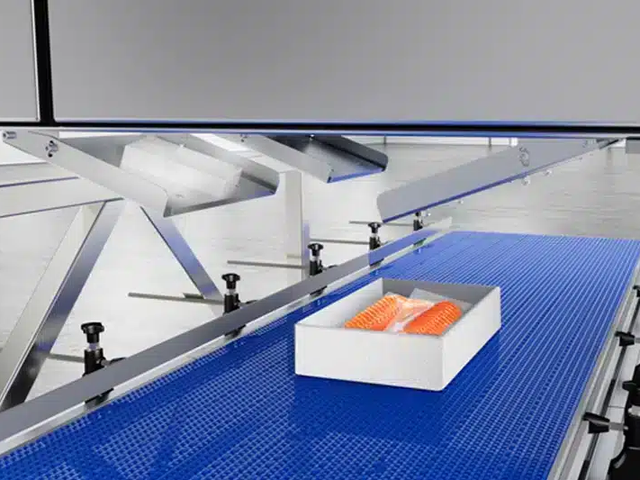

- Whole Fish
- Gutted Fish
- Fillets
- Fresh & Frozen Salmon
- Shellfish
- Crab & Lobster
- Roe & Caviar
- Other Seafood
What Do 3PLs Need for Onsite Dry Ice Production?
A complete onsite dry ice production system requires supporting infrastructure beyond the pelletizer itself. When implementing dry ice production in a fulfillment facility, the following components are essential for an effective setup:
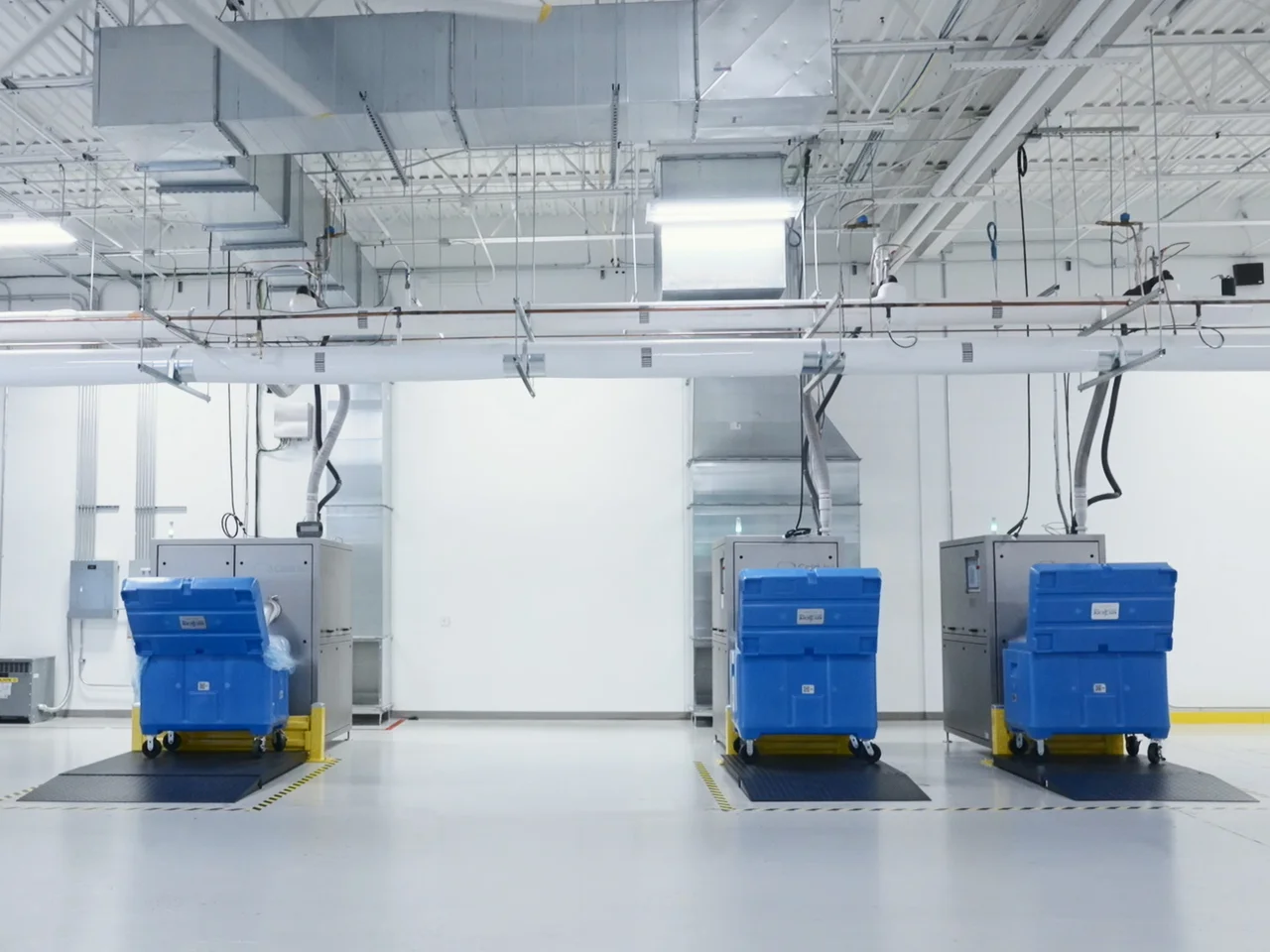
Step 01
80-750kg/hr Production Range
Dry Ice Production System
The foundation of onsite production is a reliable pelletizer matched to your order volume. Cold Jet systems produce from 176 lbs (80 kg) to 1,653 lbs (750 kg) of dry ice per hour in pellet and nugget formats, with slice production available for automated export lines. For facilities with limited floor space, the self-contained Dry Ice Production Hub offers a plug-and-play alternative to a dedicated production room.
- 01. Dry Ice Production System — The foundation of onsite production is a reliable pelletizer matched to your order volume. Cold Jet systems produce from 176 lbs (80 kg) to 1,653 lbs (750 kg) of dry ice per hour in pellet and nugget formats, with slice production available for automated export lines. For facilities with limited floor space, the self-contained Dry Ice Production Hub offers a plug-and-play alternative to a dedicated production room.
- 02. Liquid CO2 Supply & Storage — Dry ice production starts with liquid CO₂ (LCO₂), stored in an onsite reservoir and connected to the production system through insulated piping. Most LCO₂ is recovered CO₂, captured at industrial and biogas facilities and given a second life as a cooling medium. Cold Jet systems deliver 12–14% better LCO₂-to-dry ice conversion efficiency than the market standard, so more of your supply becomes sellable dry ice. If you don’t have an LCO₂ supply in place, Cold Jet can perform a site visit to determine what you need, what your investment would be, and what your payback looks like.
- 03. Facility Utilities & Foundation — Production equipment requires a three-phase electrical power supply, a compressed air line, and a stable base provided by a reinforced concrete foundation. The system should be located in a protected area with sufficient space; Cold Jet's site assessment confirms requirements for your specific facility.
- 04. Ventilation & CO2 Monitoring — Safety is paramount. The production area requires adequate ventilation and a CO₂ PPM monitor. Operators handling dry ice should wear proper protective equipment, including insulated gloves and eye protection. Automated dosing further reduces manual contact with -78.5°C material.
- 05. Insulated Storage & Automated Dosing — Insulated containers minimize natural sublimation for dry ice held between production and packout. For high throughput operations, integrated dosing systems and automated bagging equipment dispense pre-programmed amounts of dry ice directly into parcels, bags, or bulk containers, aligning production with the pack line.
- 06. Training & Support — Cold Jet provides installation, operator training, and ongoing service through regional technicians. Cold Jet CONNECT enables remote monitoring, diagnostics, and corrective action from any location, giving multi-site 3PL networks visibility into production uptime across every facility.
How Onsite Dry Ice Production
Compares to Alternatives
See how onsite dry ice production stacks up against purchased dry ice and alternative cooling media across the criteria that matter most in cold chain fulfillment.
| Criteria | Onsite Dry Ice Best | Purchased Dry Ice | Gel Packs | PCM | Water Ice |
|---|---|---|---|---|---|
| Coolant Weight | Lowest: 7.5 kg holds a frozen 72 hr US lane(EPS box) | Same medium, but density loss in storage increases usage | 2-3x dry ice weight on refrigerated lanes | About 2x dry ice weight on frozen lanes | Heaviest: 1/3 the refrigeration power of dry ice |
| Temperature Capability | -109°F (-78.5°C): frozen and refrigerated lanes | -109°F at production; sublimates before packout | Refrigerated lanes; not suited to deep frozen | Engineered set points; heavy for frozen lanes | 32°F melting point; refrigerated only |
| Supply Control | Full control: produced just-in-time at packout | Allocation, pricing, and delivery-window risk | Stockable, but bulky to store and pre-condition | Stockable; requires conditioning capacity | Requires onsite freezing capacity and lead time |
| Waste & Residue | Sublimates completely; no meltwater, no secondary waste | Sublimates; over-ordered stock is lost in storage | Plastic packs largely end up in landfills | Plastic bottles require disposal or reverse logistics | Meltwater creates leakers and bio pollution risk |
| Peak Season Scaling | Production scales with order volume | Supply is tightest exactly when demand peaks | Requires inventory forecasting and freezer space | Conditioning capacity limits surge response | Freezer capacity limits surge response |
| Sustainability | Made from recycled CO₂; enables recyclable cardboard packaging | Recycled CO₂, but adds recurring delivery truck miles | Virgin plastics and gels sent to landfill | Reusable only with reverse logistics programs | High water use and heaviest shipping weight |
What Is the Best Dry Ice Production Machine
for 3PL Operations?
Cold Jet offers dry ice production, dosing, and packaging systems built for fulfillment environments, from pelletizers with integrated dosing to fully automated bagging lines and slice reformers. Match the system to your order volume, packout process, and level of automation.
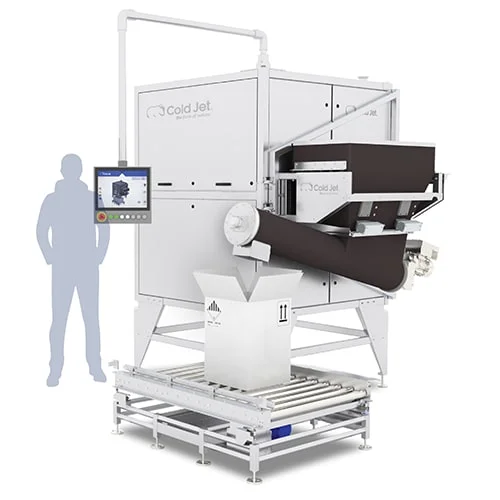
Integrated Dosing Systems
Integrated Dosing Systems pair a PR350H or PR750H pelletizer with a dosing unit that delivers a precise amount of dry ice directly into parcels or totes. A side-hinged frame lets operators switch between accurate parcel dosing and bulk tote filling, so one system can support both small-order fulfillment and mass production.
- Doses up to 81 lbs per minute
- Dosing accuracy up to ±5%
- Switch between parcels and totes
- Built on a PR350H or PR750H

Dry Ice Dosing & Bagging
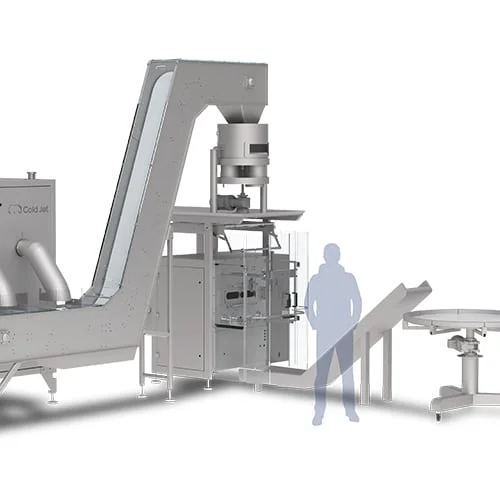
This fully automated system combines a PR750H pelletizer with an inlet conveyor, dosing unit, bagging unit, and rotary accumulation table. It produces dry ice and packages precise amounts in individual bags, ready to add to cold chain orders, with no manual handling between production and packout.
- Fully automated production to bagging
- Precise, consistent doses per bag
- Rotary accumulation table for packout
- Cold Jet CONNECT® remote monitoring
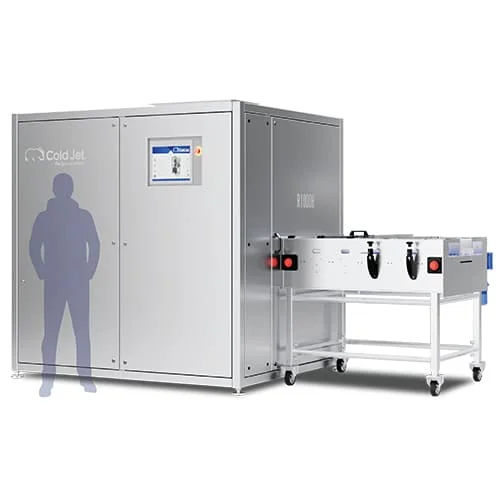
R1000H Dry Ice Slice Reformer
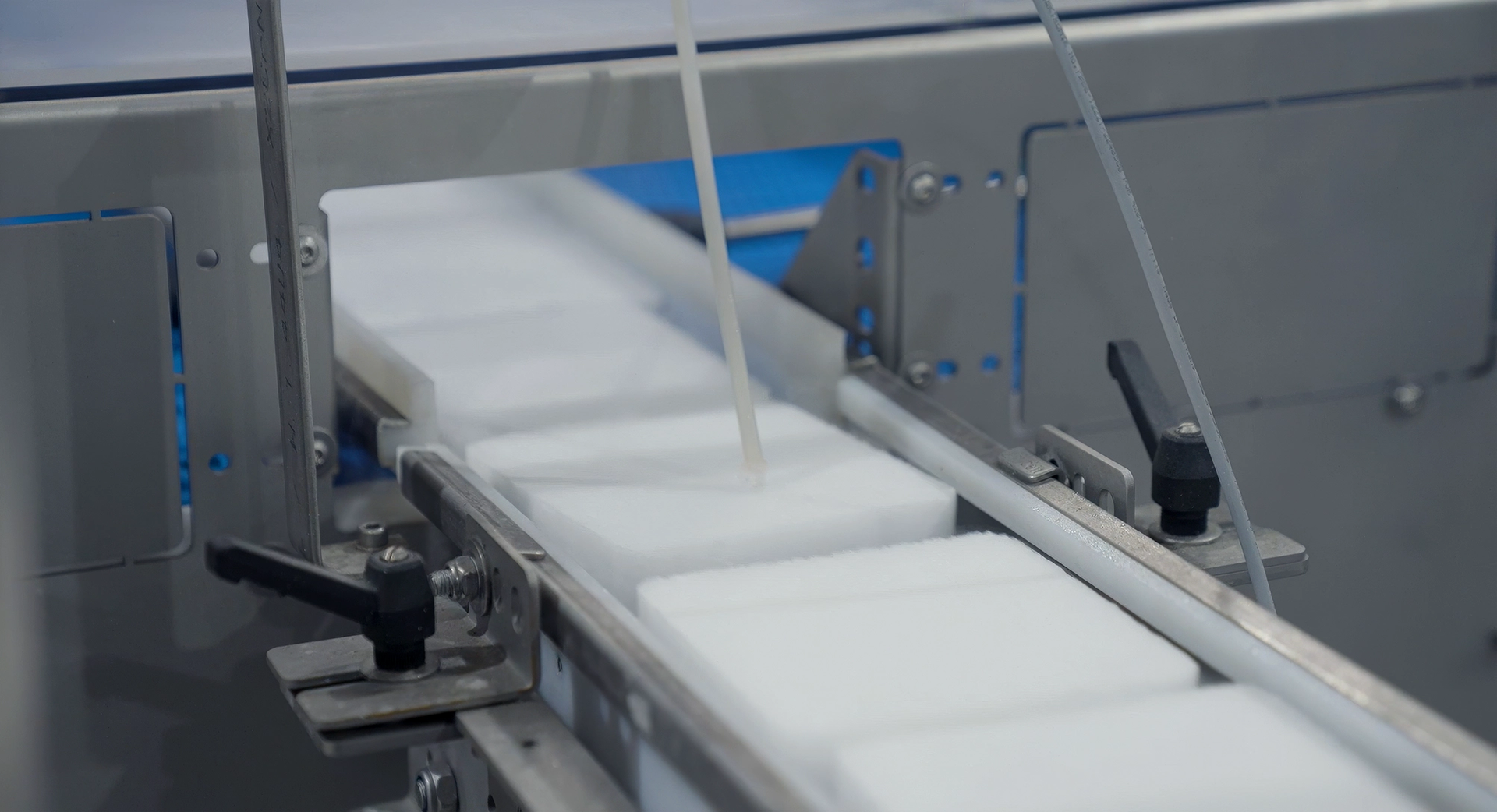
The R1000H reforms dry ice pellets into high-quality slices, giving 3PLs a clean, uniform format for shipping frozen and perishable goods. It accepts 3–16 mm pellets from your existing pelletizer and reforms up to 2,204 lbs/hr, depending on slice format and pellet supply.
- Up to 2,204 lbs (1,000 kg) per hour
- Slices from 0.55 to 6.6 lbs
- Format change in under 15 minutes
- Less than 1% slice breakage
How Do These Three Systems Compare?
Side-by-side specs for three Cold Jet systems built for fulfillment, so you can match dosing, packaging, and dry ice format to your 3PL operation’s order volume and packout process.
Dosing into parcels and totes
Fully automated bagging line
Pellet-to-slice reforming
| Specification | Integrated Dosing Systems | Dry Ice Dosing & Bagging | R1000H |
|---|---|---|---|
| System | |||
| What It Does | Produces pellets and doses them into parcels or totes | Produces pellets, then doses and bags them automatically | Reforms pellets into slices and mini blocks |
| Built On | PR350H or PR750H pelletizer | PR750H pelletizer, inlet conveyor, dosing unit, bagging unit, and rotary accumulation table | Standalone reformer, fed by a pelletizer |
| Input | Liquid CO₂ | Liquid CO₂ | Dry ice pellets, 3–16 mm |
| Production | |||
| Production Capacity | Up to 772 or 1,653 lbs/hr, depending on pelletizer | Not published | Up to 2,204 lbs/hr (1,000 kg/hr), depending on slice format and pellet supply |
| Dry Ice Output | 3, 6, 10, or 16 mm pellets, dosed into parcels or totes | 3, 6, 10, or 16 mm pellets in individual bags | Slices and mini blocks, 0.55–6.6 lbs; 5/8"–3½" thick |
| Dosing Speed & Accuracy | Up to 37 lbs/min at ±5% (PR350H); up to 81 lbs/min at ±7%(PR750H) | Not published | Not published |
| Format Change | Automatic extruder plate changer | Automatic extruder plate changer | Quick Change Press Head in under 15 min |
| Automation & Controls | |||
| Automation | Automated dosing; side-hinged frame switches between parcels and totes | Fully automated from production to bagging | Automated reforming; exit conveyor for line integration |
| Controls | 15" Beckhoff HMI with permission-based access | 15" Beckhoff HMI with permission-based access | Beckhoff Industrial PC with 15" touchscreen; recipe programs |
| Cold Jet CONNECT® | Available | Available | Available |
| Fit | |||
| Typical 3PL Fit | Mixed parcel and bulk tote packout | High-volume pack lines shipping bagged dry ice with orders | 3PLs adding slices for frozen and perishable shipments |
“—” indicates a spec Cold Jet has not published for this model. Contact a Cold Jet specialist to confirm fit for your operation.
Why Invest in Cold Jet Production Systems
for Third Party Logistics
If you are building or upgrading cold chain fulfillment capacity, investing in Cold Jet dry ice production equipment protects client service levels while lowering your cost per order.
When evaluating this capital investment, consider both the return on investment (ROI) and the operational benefits specific to your fulfillment network. Cold Jet systems deliver faster payback and greater value through:
Proven at Global Scale
Cold Jet dry ice production systems supplied the global COVID-19 vaccine distribution effort, with more than 8 billion doses kept at safe temperatures with dry ice. When supply chains were under the most pressure, in-house production delivered.
Lowest Cost Per Pound Produced
Cold Jet’s sub-cooling technology converts liquid CO₂ to dry ice 12–14% more efficiently than other systems, so every delivery makes more dry ice for your shipments. Low energy use, minimal downtime, and 24/7 support keep cost per pound down as volumes rise in peak season.
Highest Density Dry Ice
Cold Jet's patented production technology produces the highest quality and highest density dry ice available. Denser ice sublimates more slowly, lasts longer in the box, and delivers more cooling per pound on every shipment.
Built for Multi-Site Networks
Standardize production equipment across your fulfillment network and monitor it centrally with Cold Jet CONNECT. Remote monitoring, diagnostics, and corrective action from any location fit the uptime and data visibility culture 3PLs sell to their clients.
A Scientific, Consultative Approach
Cold Jet's process starts with site visits and exploratory analysis of your current cooling methods, then designs, tests, and validates a solution against your specific lanes, volumes, and facilities before you invest.
Industry Leading Support and Training
Regional technicians who understand fulfillment environments deliver installation, operator training, preventative maintenance, and 24/7 support, keeping production running through your highest volume weeks.
Third party logistics providers around the world rely on Cold Jet
When food safety and product viability are on the line, shippers and 3PLs trust Cold Jet. From perishable e-commerce fulfillment providers to global logistics companies, our production systems keep clients' cold chains under control.









Regulatory Standards
We Help You Meet
Dry ice simplifies compliance across food and pharma cold chains, with a cooling medium approved for use around food and the temperature control that regulated shipments require.
FDA Food Safety Modernization Act
FSMA shifts food safety from responding to contamination to preventing it, including requirements for maintaining temperature control during the storage and transportation of food.
Dry ice is a food approved cooling medium that holds chilled and frozen products at temperature throughout storage and transportation. Onsite, just-in-time production ensures cooling capacity is available for every shipment, supporting FSMA preventive controls.
Hazard Analysis and Critical Control Points: Cold Storage and Transport
HACCP programs require that critical control points (CCPs), including temperature, be identified, monitored, and maintained throughout the production, storage, and transportation of food.
Dry ice ensures CCPs are met during the storage and transportation of chilled and frozen products. At -109°F (-78.5°C), it inhibits the microbial activity that accelerates above 40°F (4°C), and automated dosing supports consistent, repeatable application.
Approved for Use Around Food
Cooling media used in direct proximity to food must meet the requirements of the agencies that regulate food safety and food contact in the United States.
Dry ice is approved by the EPA, FDA, and USDA for use around food. It sublimates directly to gas, leaving no residue, meltwater, or contaminants on products or packaging.
Good Distribution Practice: Temperature Assurance in Distribution
GDP guidelines require that medicinal products be stored and transported under the temperature conditions defined by the manufacturer, with documented temperature assurance throughout distribution.
Dry ice maintains the deep frozen conditions many biologics and vaccines require, and onsite production supports the consistent, documented dosing that pharma clients and their qualified shipping systems expect.
Air Transport of Dry Ice (UN 1845)
Dry ice is classified as UN 1845 for air transport and is permitted under the IATA Dangerous Goods Regulations, with requirements for packaging that vents CO₂ gas, proper labeling, and declaration of the dry ice weight per package.
Precise dosing systems dispense a pre-programmed amount of dry ice into each package, supporting accurate per-package weight declarations, while approved packaging and labeling practices keep air shipments compliant.