

Overview
Summary
Dry ice is a food-approved cooling medium that holds fresh and frozen product within specification across export lanes and last-mile delivery. At -109°F (-78.5°C) it carries three times the cooling power of water ice, sublimates to gas instead of melting, and requires roughly half to one third the coolant mass of gel packs or phase change materials. Producing it on-site with a Cold Jet pelletizer or slice system means high-density ice is made just in time, at a known cost per pound, with no supplier shortages and no bin storage.
What is dry ice used for in the food cold chain?
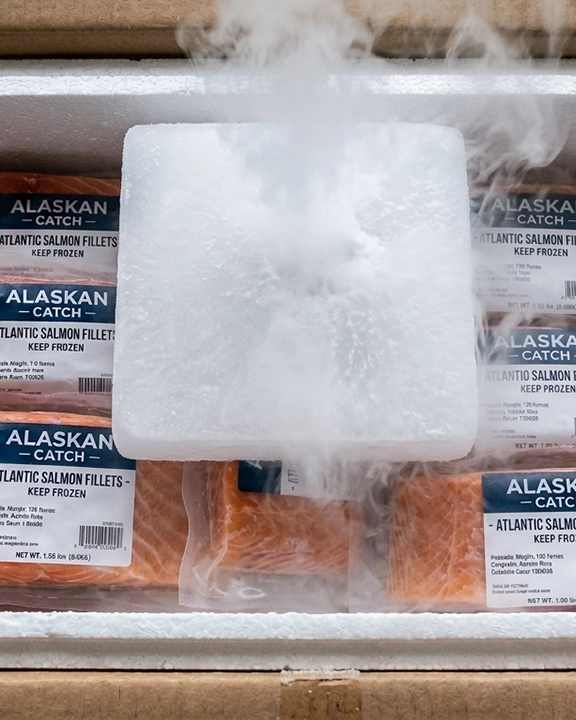
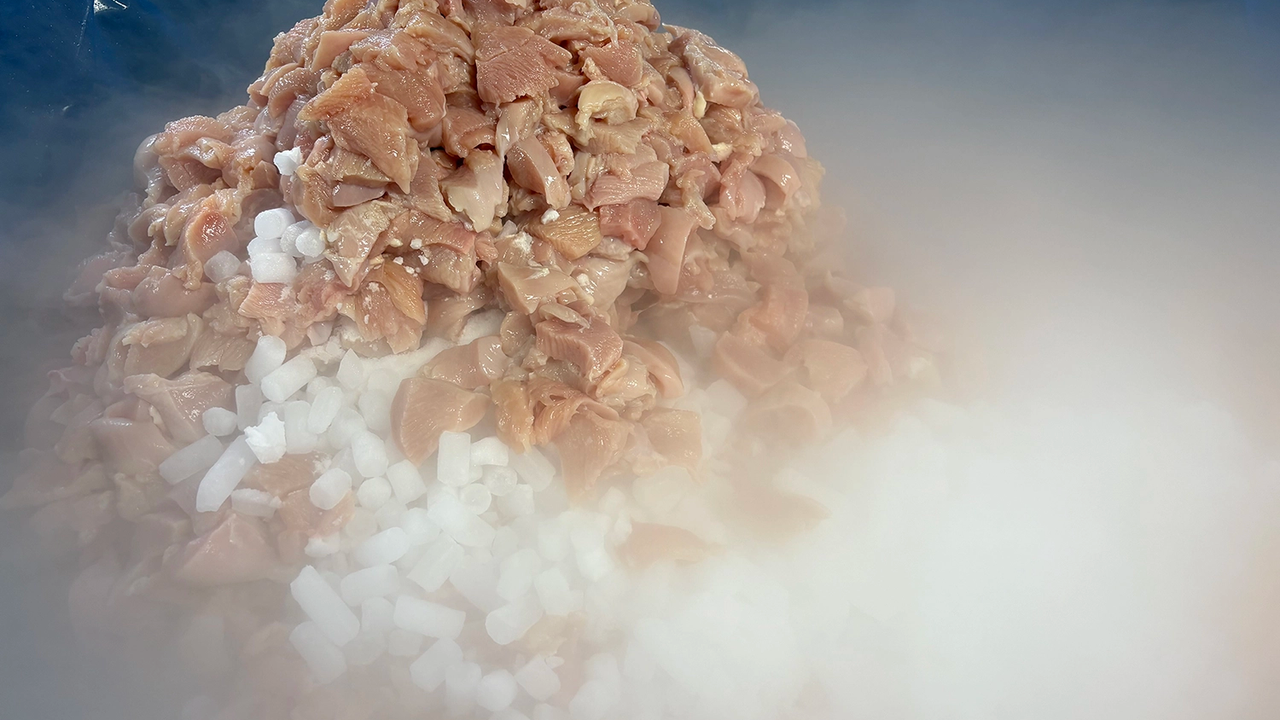
Dry ice is solid CO₂ used as a passive cooling medium inside shipping containers. Food processors and exporters use it to hold temperature when product moves between facilities and across intermodal and export lanes, whether that is chilled protein on a trim line heading to a further processing site or pallets bound for a port. Food delivery brands and third party logistics providers use it to hold proteins, prepared meals, desserts, smoothies, pet food, meal kits, and groceries at temperature through warehousing, road transport, and the last mile. Because it sublimates directly from solid to gas, it leaves no meltwater, no drip loss, and no residue on the product or the packaging, and it works in expanded polystyrene boxes as well as in folded cardboard. Microbial activity is inhibited below 40°F (4°C), and for most biological systems shelf life doubles for every 10°C reduction in temperature. Cold Jet manufactures the pelletizers, slice systems, dosing systems, and bagging systems that let shippers produce that ice on-site, on demand, at the density and form their packaging requires.
Challenge
Why food shippers and 3PLs are moving to dry ice
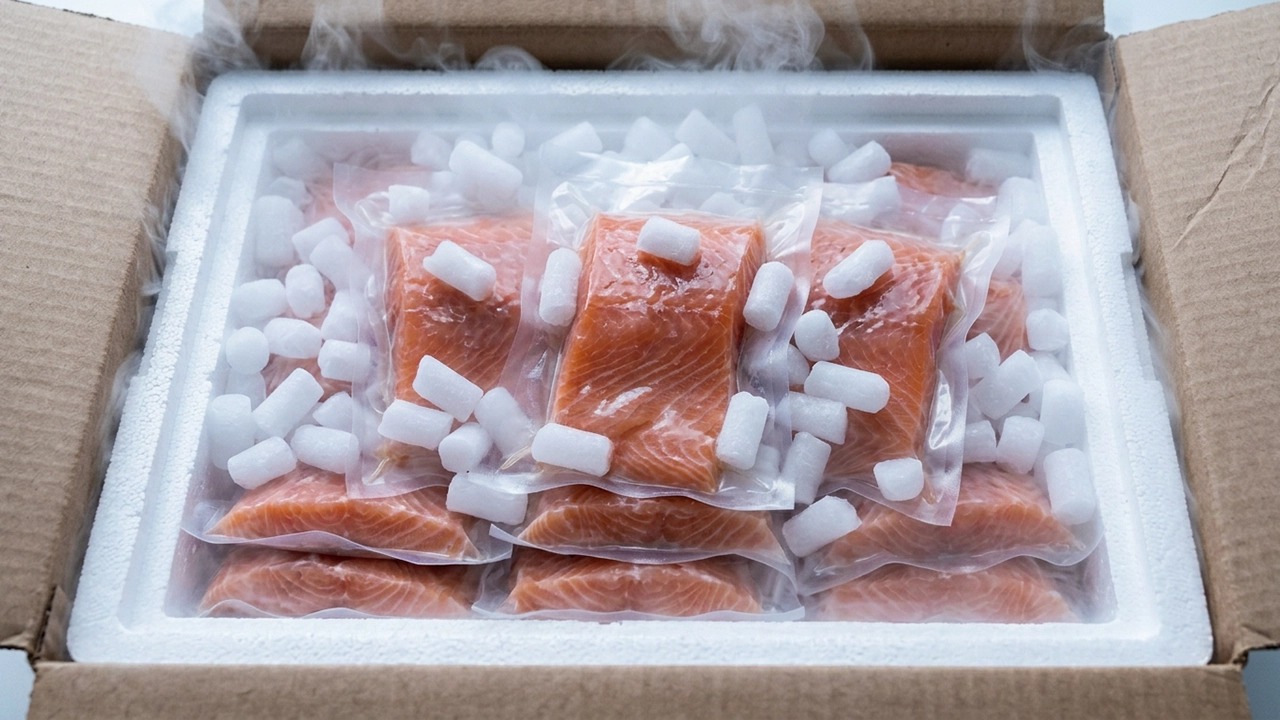
Direct-to-consumer and intermodal food shipments spend long stretches in passive packaging with no active refrigeration, and there is no chance to intervene once the box is sealed. Dry ice holds a lower temperature for longer at a smaller coolant mass than the alternatives, which means more product per box, per pallet, and per shipment. It also removes the meltwater that drives drip loss, spillage on the road, and microbial risk. Producing it on-site eliminates the supplier dependency that leaves shippers waiting on deliveries of ice that has already lost density in transit.
3x Water Ice
Cooling Power
-109°F / -78.5°C
Sublimation Temperature
Up to 70% Less
Coolant Mass vs PCM
None
Residue Left Behind
Benefits
What Are the Benefits of Dry Ice for Food Shipping and Home Delivery?
Dry ice holds temperature longer at a lower shipping weight than water ice, gel packs, or phase change materials
Food shippers face the same two pressures at once. Product has to arrive in specification after a multi-leg journey with no active refrigeration, and every pound of coolant in the box displaces product and adds freight cost. Water ice melts, drips, and adds weight for the hold time it delivers. Gel packs and phase change materials require two to three times the mass of dry ice to pass the same lane year-round.
Dry ice sublimates at -109°F (-78.5°C) and carries three times the cooling power of water ice, so a smaller mass holds product colder for longer. It turns directly into gas, leaving no meltwater, no drip loss, and no residue on the product or in the box. Producing it on-site with a Cold Jet pelletizer or slice system puts the supply under your control: high-density ice made just in time, at a known cost per pound, with no third-party deliveries arriving late or half sublimated.
 Food Safety
Hold Critical Temperatures End to End
Dry ice measures -109°F (-78.5°C) and holds product well below the 40°F (4°C) threshold at which microbial activity is inhibited. It gives shippers a temperature buffer that survives tarmac dwell, warehouse handoffs, and a parcel left in the sun outside a customer's door. Dry ice is recognized as safe for use around food by the EPA, FDA, and USDA.
 Cost
Ship Less Coolant and More Product
Dry ice achieves year-round reliability at a lower coolant mass than any alternative. In lane testing, 3.3 lb (1.5 kg) of dry ice passed every profile on both a UK ground lane and a US air lane, while phase change materials required 11.0 lb (5.0 kg) on the US lane and gel packs required 6.6 lb (3.0 kg). Less coolant weight means more product per box and lower freight spend on every shipment.
 Quality
Protect Texture, Color, and Shelf Life
Spoilage rates double for every 10°C rise in temperature, and shelf life doubles for every 10°C reduction. Dry ice sublimates instead of melting, so there is no meltwater to drive drip loss, no ice slurry leaking onto the road, and no water sitting against the product as a microbial vector.
 Sustainability
Recycled CO₂ With No Secondary Waste
Dry ice is recycled CO₂ in solid form, captured at industrial, biogas, or direct air capture facilities and given a second life as a cooling medium. Because transport emissions scale with shipment weight, the lower coolant mass also reduces the carbon footprint of every lane you run.
 On-Demand Supply
Fresh Dry Ice When Your Line Needs It
On-site production removes the risk of late deliveries, shortages, and ice that has already sublimated before it reaches your packing line. You produce what you need, when you need it, at a known cost per pound, and you free the floor space currently occupied by storage bins.
Applications
What Can Be Shipped With Dry Ice?
Dry ice is used across the food cold chain, from pallets moving between processing facilities to meal kits sitting on a doorstep. It keeps fresh product chilled and frozen product frozen, in expanded polystyrene boxes and in sustainable cardboard.
Validated For
- Frozen Payloads
- Refrigerated Payloads, 32°F to 41°F
- EPS & Cardboard Boxes
- Air, Road & Ocean Lanes
- Last-Mile Parcels
Move Food Between Facilities and Across Export Lanes Without Losing the Cold Chain
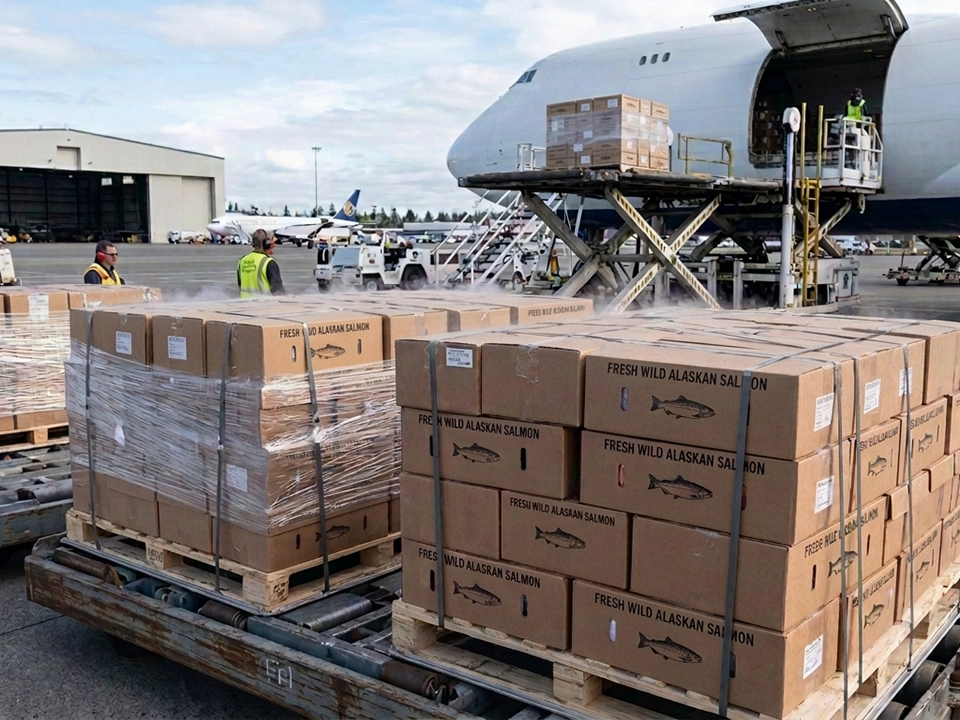
Dry ice is the final safeguard when product leaves a processing facility. It holds temperature through the whole journey, cuts the weight the shipment carries, and removes the meltwater that causes drip loss and spillage on the road.
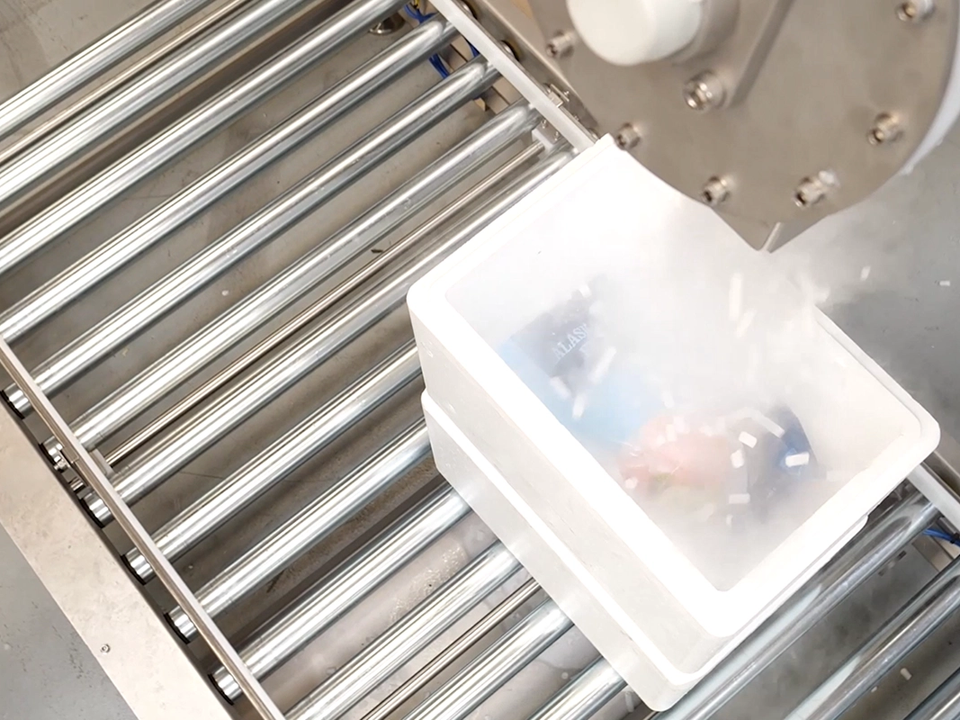
Dose slices directly into the box
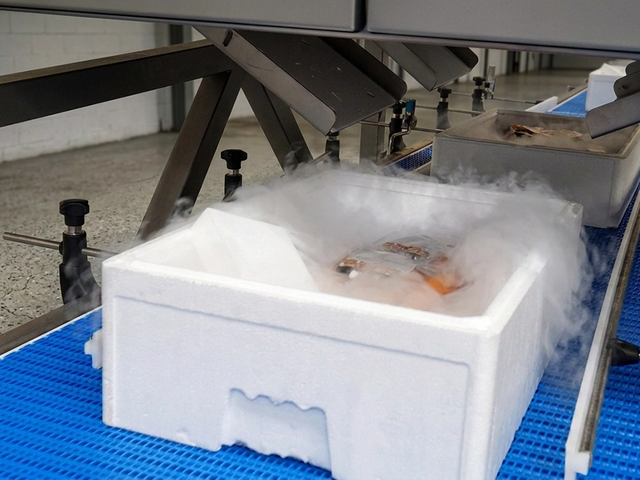
Direct slice systems produce and dose dry ice slices straight into your packaging on the line, with slice weights set from 0.5 to 2.2 lb (0.25 to 1 kg) on the HMI. Slices interface with conveyor belts and integrate into a fully automated packing process, so the ice is made and placed in the same step.
Ship more product per pallet
Dry ice delivers the same hold time at a fraction of the coolant mass of water ice, gel packs, or phase change materials. Shippers use that reclaimed weight and volume for product, increasing the amount moved per box, per pallet, and per aircraft or trailer while reducing freight cost and carbon per shipment.
No meltwater, drip loss, or spillage
Dry ice sublimates to gas rather than melting, so there is no ice slurry leaking in transit and no water sitting against the product. It also works in folded cardboard as well as expanded polystyrene, which cuts the storage space empty boxes occupy in your facility.
Products We Keep Cold
- Beef
- Poultry
- Pork
- Value-Added, Marinated & Smoked Products
- Prepared & Frozen Meals
- Dairy
- Baked Goods
- Produce
- Pet Food
Deliver Frozen and Refrigerated Orders That Arrive in Specification, Even When Nobody Answers the Door
Direct-to-consumer food shipments spend long stretches in passive packaging with no active refrigeration. The payload arrives in specification or it does not, and there is no intervention point in between.
Prevent thaws and leakers
Dry ice gives the parcel a deep temperature buffer that absorbs delays, tarmac exposure, and a box left on a doorstep in the sun. A single failed shipment costs a replacement, a service contact, and a retention risk that compounds across a subscription base, so the buffer is worth more than the coolant it replaces.
Produce just in time and remove supplier risk
On-site production lets food delivery brands and 3PLs make ice the morning it ships instead of ordering ahead and absorbing sublimation loss in storage. Dosing and bagging systems deliver a consistent, pre-measured amount into every parcel, which reduces manual labor and improves operator safety.
Cut parcel weight and freight spend
Transportation cost and carbon both scale with total shipment weight. Across 6,000 annual shipments on a US air lane, the compliant dry ice configuration moved roughly 56,878 lb (25,800 kg) less total payload than the compliant phase change material configuration.


Dry ice production systems support the full range of direct-to-consumer food categories, from subscription protein boxes to grocery and pet food fulfillment. The process is effective across:
Products We Ship
- Meal Kits
- Groceries
- Frozen Meat (Beef, Poultry, Pork)
- Ice Cream & Frozen Desserts
- Smoothies
- Pet Food
- Prepared & Frozen Meals
- Baked Goods
- Dairy
- Specialty & Gourmet Foods
- Perishable Samples
Industries
Who Relies on Dry Ice for the Food Cold Chain?
Food manufacturers and the logistics providers that ship their products depend on dry ice to keep perishable and frozen goods at temperature from production to delivery. See how Cold Jet production systems help food processors and 3PLs produce the dry ice they need onsite, on their own schedule.
Comparison
How Dry Ice
Compares to Other Cooling Mediums
See how dry ice compares to water ice, gel packs, phase change materials, and refrigerated transport across the criteria that decide whether a shipment arrives in specification.
| Criteria | Dry Ice Best | Water Ice | Gel Packs | Phase Change Material | Refrigerated Transport |
|---|---|---|---|---|---|
| Cooling Temperature | -109°F (-78.5°C), 3x the power of water ice | 32°F (0°C) melting point | Approximately 32°F (0°C) phase change | Formulated set point, commonly +35.6°F(+2°C) | Set point of the reefer unit |
| Coolant Mass for a 24-Hour Lane | 3.3 lb (1.5 kg), lowest compliant mass tested | Highest mass per hour of hold time | 6.6 lb (3.0 kg) on the US lane | 11.0 lb (5.0 kg) on the US lane | Not applicable, active system |
| Effect on Freight Cost | Lightest shipment, most product per box | Heavy, and adds meltwater weight | Adds 3.3 lb (1.5 kg) per box versus dry ice | Adds 7.7 lb (3.5 kg) per box versus dry ice | High fixed cost per lane and per stop |
| Residue and Drip Loss | None, sublimates directly to gas | Meltwater, drip loss, and spillage on the road | Condensation and soggy packaging | Minimal, but packs must be returned or discarded | None, but product is exposed at every door opening |
| Food Safety | Food-approved, holds product below 40°F(4°C) | Water is a microbial vector | Not a food contact medium, needs containment | Not a food contact medium, needs containment | Depends on dwell time and door discipline |
| Sustainability | Recycled CO₂, no secondary waste, lightest payload | Water use and wastewater handling | Single-use plastic or return logistics | High embodied carbon and heaviest payload | Continuous fuel and refrigerant use |
What You Need
What Do Food Shippers Need to Produce Dry Ice On-Site?
Making your own dry ice is simpler than most shippers expect. A Cold Jet system, a liquid CO₂ supply, and standard plant utilities cover the majority of installations. The following components make up a complete on-site production setup:
Step 01
CoreProduction System
Dry Ice Pelletizer or Slice System
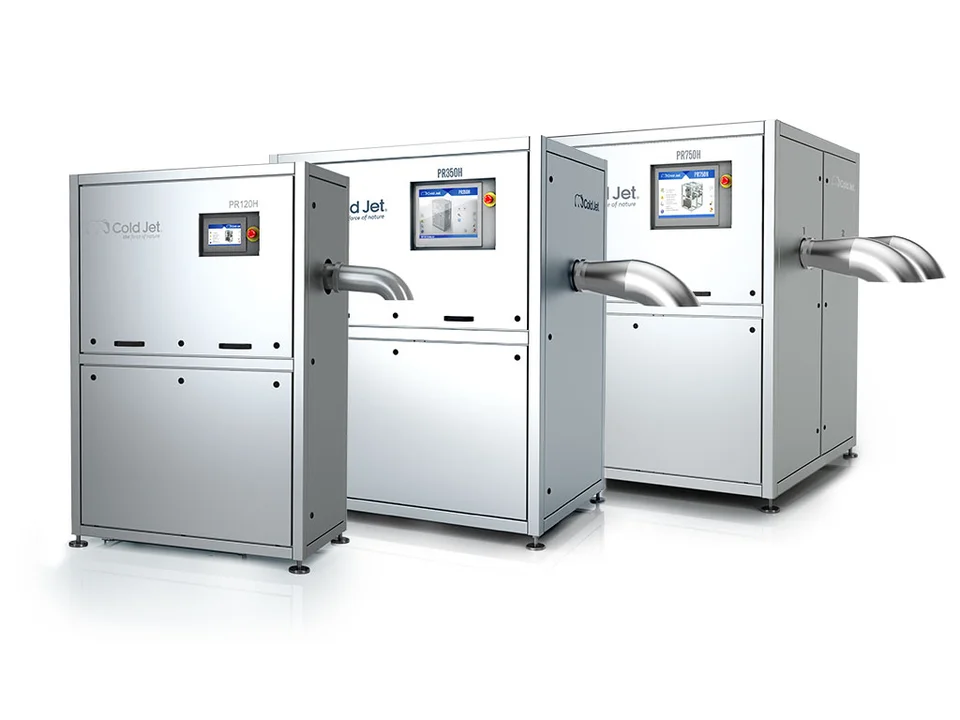
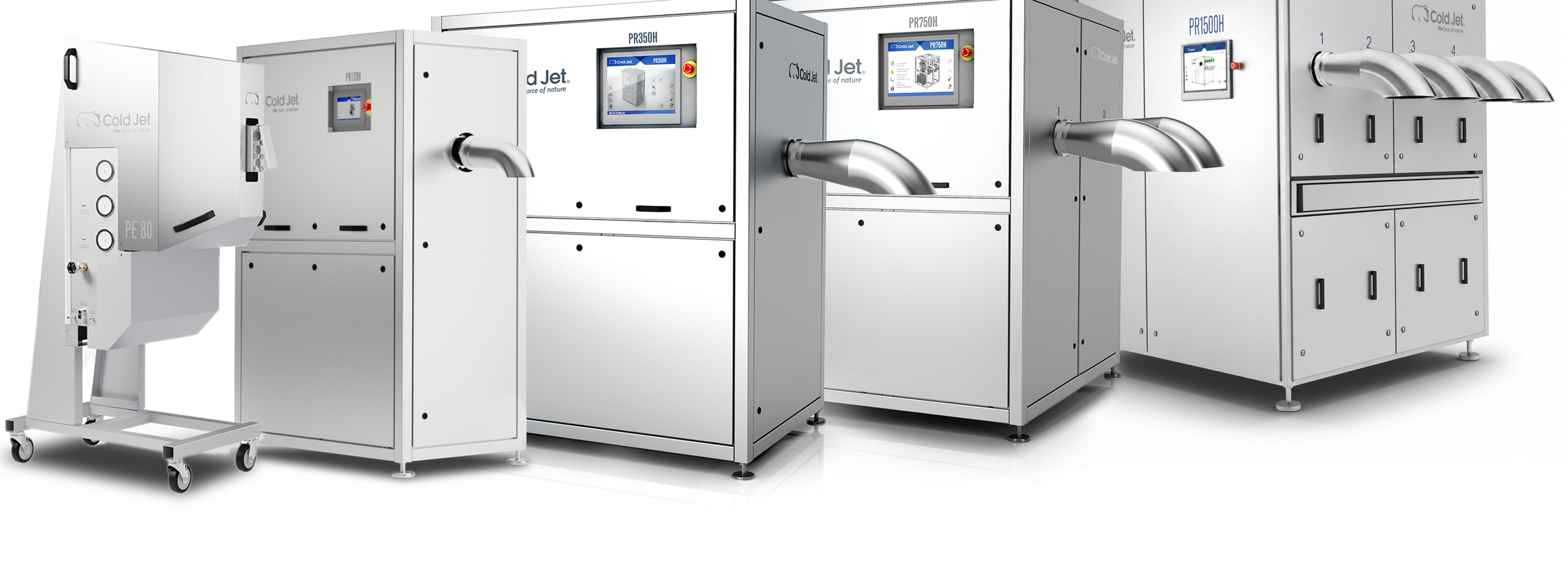
The foundation of on-site production is a Cold Jet pelletizer or direct slice system sized to your consumption. Models range from 176 lb (80 kg) per hour up to 3,307 lb (1,500 kg) per hour of pellets and nuggets, and up to 2,204 lb (1,000 kg) per hour of slices. Match the machine to the form your packaging needs and the volume you currently purchase, rather than over-buying capacity.
- 01. Dry Ice Pelletizer or Slice System — The foundation of on-site production is a Cold Jet pelletizer or direct slice system sized to your consumption. Models range from 176 lb (80 kg) per hour up to 3,307 lb (1,500 kg) per hour of pellets and nuggets, and up to 2,204 lb (1,000 kg) per hour of slices. Match the machine to the form your packaging needs and the volume you currently purchase, rather than over-buying capacity.
- 02. Liquid CO₂ Supply and Storage Tank — You need a local source of liquid CO₂ and an onsite bulk storage tank, ideally positioned outdoors and connected to the machine with insulated piping. Inlet pressure runs 189 to 262 psi (13 to 18 bar). Cold Jet sub-cooling technology delivers 12–14% better LCO₂-to-dry ice conversion efficiency than the market standard. For food contact, source beverage or food-grade liquid CO₂.
- 03. Power, Compressed Air, and Foundation — Installation calls for a three-phase electrical supply, a compressed air line at 116 to 145 psi (8 to 10 bar) meeting ISO 8573-1 Class 3 or better, and a stable reinforced concrete base. The machine belongs in a protected, well-ventilated indoor space with room to work around it.
- 04. Ventilation and CO₂ Monitoring — Dry ice production and storage areas need adequate artificial ventilation and a CO₂ ppm monitor. The OSHA permissible exposure limit for carbon dioxide is 5,000 ppm as an eight-hour time-weighted average. Exhaust gas is routed out of the production space through dedicated piping.
- 05. Dry Ice Storage and Handling — Insulated containers hold produced ice with minimal sublimation loss between production and packing. Producing closer to the time of shipment reduces how much storage you need, and high-density pellets and slices sublimate more slowly than low-density ice, which extends usable hold time in the box.
- 06. Dosing, Bagging, and CO₂ Recovery (Optional) — Integrated dosing systems dispense a preset amount of dry ice onto a conveyor or directly into packaging at ±7.5% accuracy, and bagging systems deliver sealed, pre-measured bags for parcel fulfillment. Adding a Cold Jet RE-CO₂ recovery system recycles exhaust gas back into the pelletizer and can reduce dry ice production costs by up to 40%.
Equipment
What Is the Best Dry Ice Production System
for Food Cold Chain and Home Delivery?
Cold Jet manufactures dry ice production, reforming, dosing, and bagging systems for food shippers. Match the system to the form of ice your packaging needs, the volume you consume, and how much of the process you want automated.
Dry Ice Dosing & Bagging System
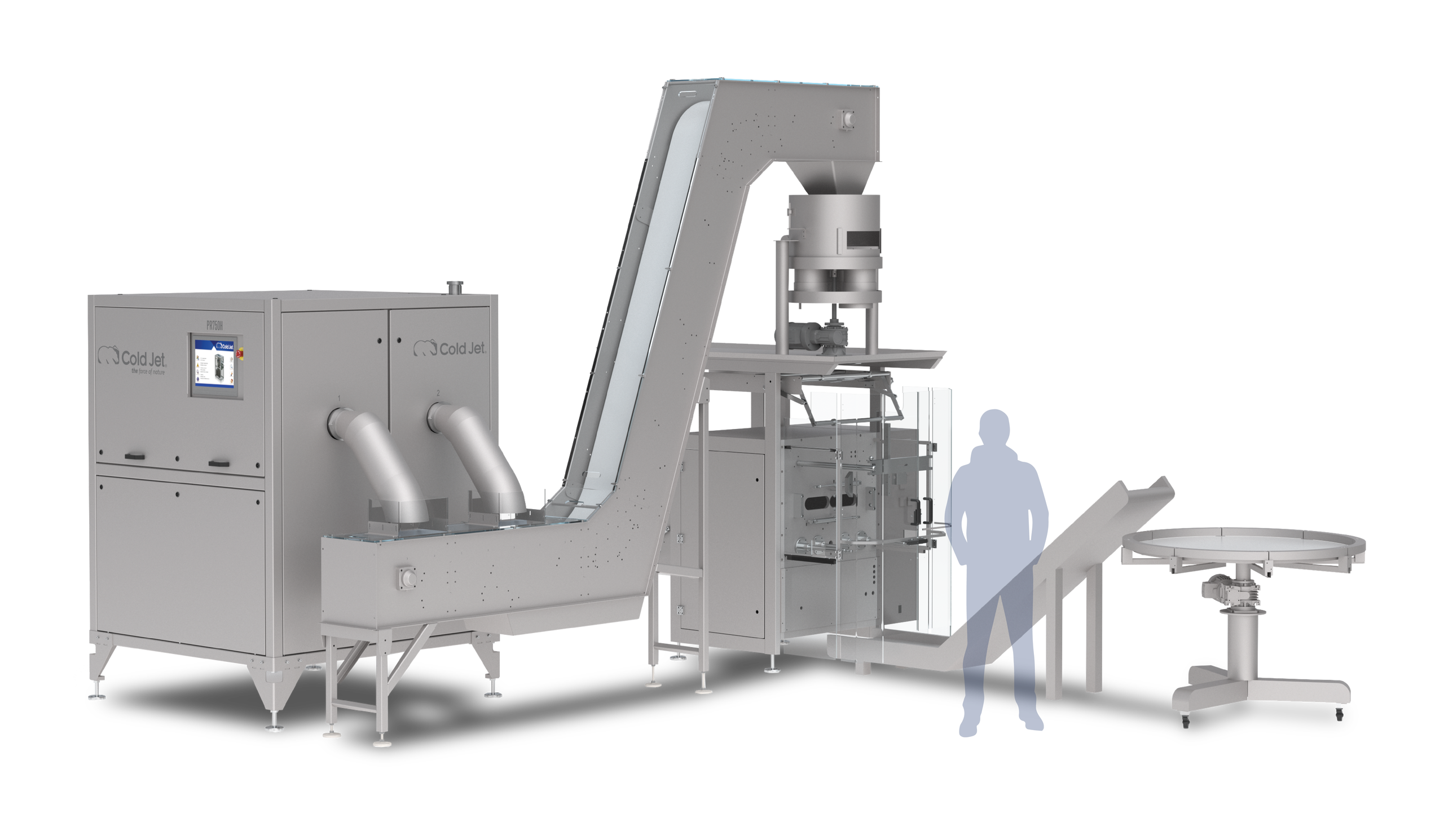
A fully automated system that combines a PR750H pelletizer with an inlet conveyor, dosing unit, bagging unit, and rotary accumulation table. It packages a precise amount of dry ice in individual bags, built for food home delivery and 3PL fulfillment operations that need a consistent dose in every parcel.
- Fully automated production to bagging
- Consistent dose in every bag
- Rotary accumulation table for packout
- Cold Jet CONNECT® remote monitoring
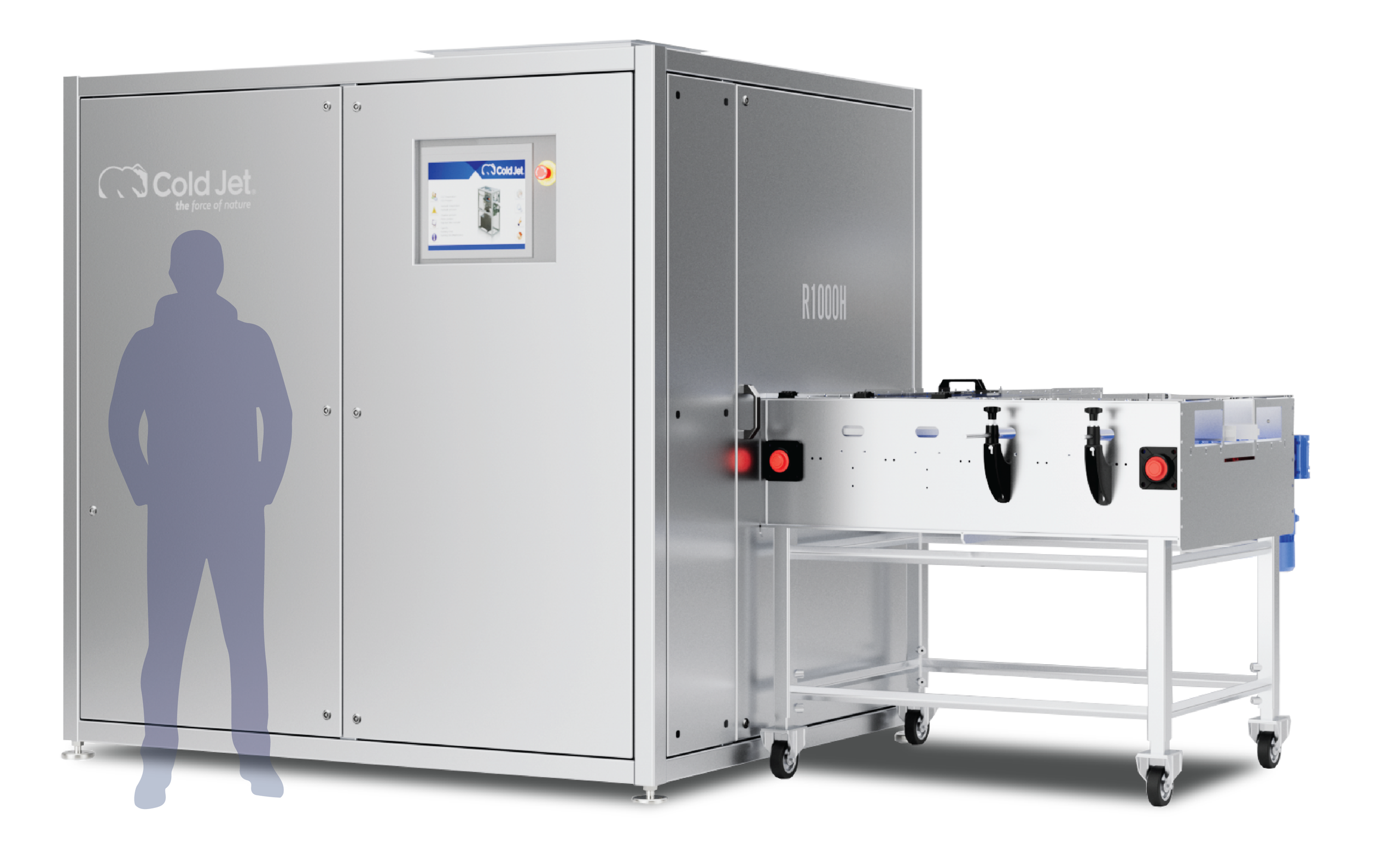
R1000H Reformer
The R1000H reforms dry ice pellets into uniform slices and mini blocks, a clean, consistent format for food shipping boxes. It accepts the full 3–16 mm pellet range from the PR750H, and an exit conveyor makes it easy to add to an existing packing line.
- Up to 2,204 lb/hr (1,000 kg/hr), depending on slice format and pellet supply
- Slices from 0.55 to 6.6 lb
- Format change in under 15 minutes
- Less than 1% slice breakage
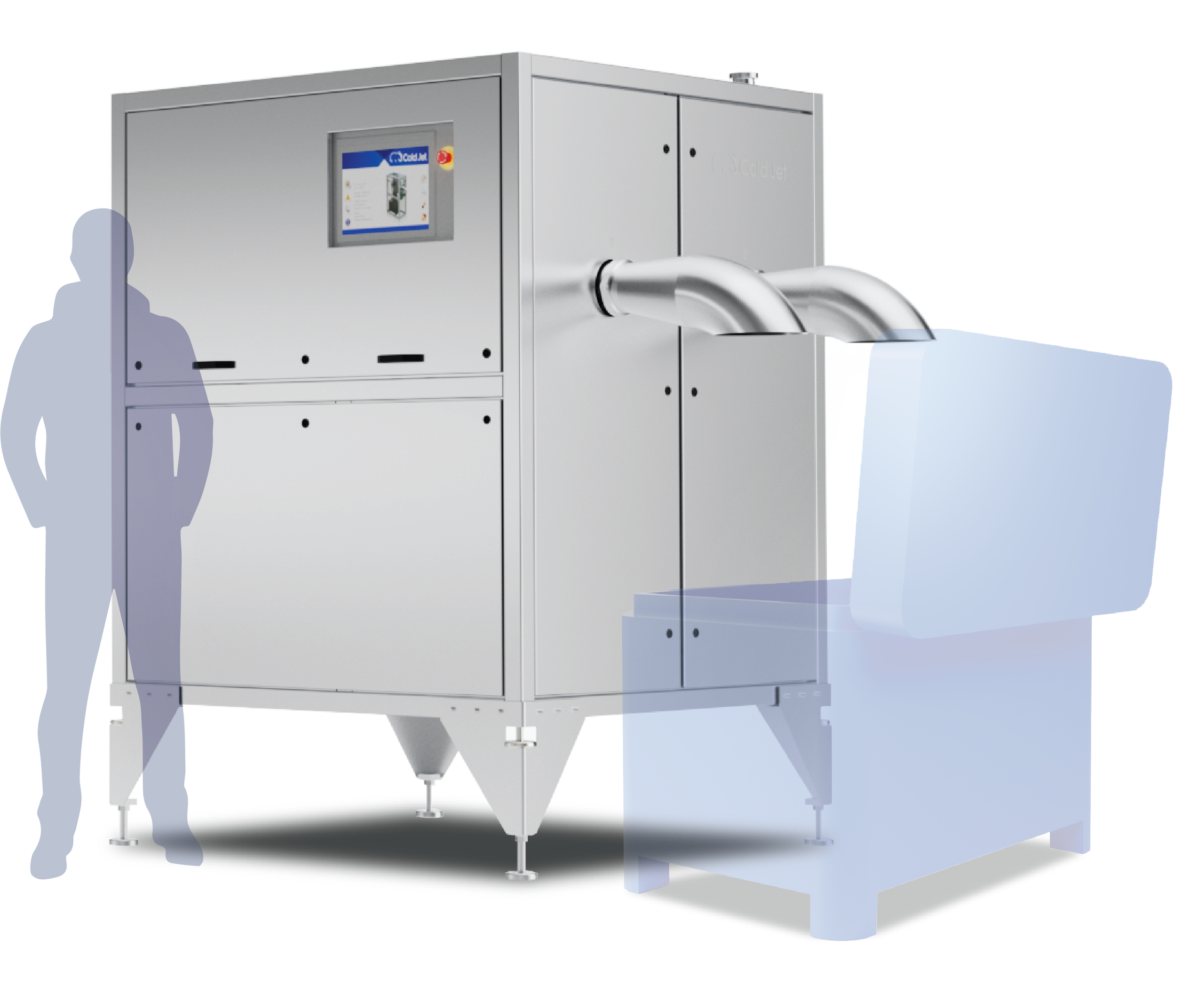
PR750H Pelletizer
A high-volume pelletizer for processors and shippers moving large volumes of food through the cold chain. The PR750H produces up to 1,653 lb of pellets per hour, and the complete version makes two pellet sizes at once. It can also be paired with an integrated dosing system to dispense preset amounts into bulk containers.
- Up to 1,653 lb/hr (750 kg/hr)
- 3, 6, 10, or 16 mm via automatic die change
- Start-up in under 3 minutes
- 12–14% better LCO₂ conversion
Compare Systems
How Do These Three Systems Compare?
Side-by-side specs for the Cold Jet systems most often specified for food shipping and home delivery, so you can match the machine to the form of ice your packaging needs and the volume you consume.

Dry Ice Dosing & Bagging
Pre-bagged doses for last-mile parcels
R1000H
Produce and dose slices straight into the box
PR750H
High-volume pellets and nuggets
| Specification | Dry Ice Dosing & Bagging | R1000H | PR750H |
|---|---|---|---|
| Machine Controls | |||
| HMI Display | 15 in Beckhoff color touchscreen | 15 in touchscreen with recipe programs | 15 in color touchscreen |
| Cold Jet CONNECT® Remote Monitoring | Yes | Yes | Yes |
| Output | |||
| Input | Liquid CO₂ | Dry ice pellets, 3–16 mm | Liquid CO₂ |
| Form of Dry Ice Produced | Pellets (3, 6, 10, 16 mm), bagged | Slices, 0.55–6.6 lb | Pellets: 3, 6, 10, 16 mm |
| Rated Output | Not published | Up to 2,204 lb/hr (1,000 kg/hr), depending on slice format and pellet supply | Up to 1,653 lb/hr(750 kg/hr) |
| Dose / Format Range | Precise, consistent dose per bag | Slice thickness 5/8 to 3½ in | 2 to 200 lb per dose with Integrated Dosing |
| Production | |||
| LCO₂ Conversion (Sub-Cooling) | 12–14% better than market standard | —(reforms existing pellets) | 12–14% better than market standard |
| Integration | |||
| Doses Directly Into Packaging | Yes, as individual bags | No, slices exit onto conveyor | Yes, with Integrated Dosing(onto conveyor or into containers) |
| Conveyor Integration | Yes, inlet conveyor and rotary accumulation table | Yes, exit conveyor | Yes, with Integrated Dosing |
| Best Fit | Direct-to-consumer parcels and meal kits | Food shipping boxes that need slices | High-volume pellet supply and bulk transfers |
“—” indicates a spec Cold Jet has not published for this system, or one that does not apply. Contact a Cold Jet specialist to confirm fit for your application.
Why Cold Jet
Why Invest in a Cold Jet Dry Ice Production System
for Food Cold Chain and Home Delivery
If you are moving proteins, prepared foods, or direct-to-consumer orders, on-site dry ice production changes both your cost structure and your risk profile. You stop paying for delivered ice that has already begun to sublimate, and you stop building shipping schedules around someone else's delivery truck.
When evaluating this capital investment, weigh the cost per pound of ice you produce against your current delivered cost, and factor in the freight savings that come from shipping less coolant mass. Cold Jet systems deliver faster ROI and greater value through:
Highest Density Dry Ice
Cold Jet extrudes high-density pellets, nuggets, and slices that sublimate more slowly, which means longer hold time in the box and less ice consumed per shipment.
More Efficient LCO₂ Conversion
Sub-cooling technology delivers 12–14% better LCO₂-to-dry ice conversion efficiency than the market standard, so you spend less on liquid CO₂ for every pound of dry ice you make.
Just-in-Time Production
Produce what you need when you need it, at one-button startup in under three minutes on most models. No supplier lead times, no over-ordering, no sublimation loss sitting in storage.
CO₂ Recovery for Maximum Savings
RE-CO₂ recovery systems capture revert gas during production and recycle it back into the pelletizer, which can reduce dry ice production costs by up to 40%.
Dosing, Bagging, and Slice Automation
Cold Jet manufactures the dosing, bagging, and direct slice systems that put the right mass of ice into every box and parcel automatically, reducing labor and improving operator safety.
Global Service and Cold Jet CONNECT®
A service organization of more than 70 people across the Americas, EMEA, and APAC supports 24,000+ installations, with remote monitoring, diagnostics, and corrective action through Cold Jet CONNECT®.
Our Customers & What They Say About Us
Food processors, shippers, and 3PLs around the world rely on Cold Jet
With more than 1,000 dry ice production systems installed in over 70 countries, Cold Jet equipment keeps product in specification for food processors, shippers, and logistics providers of every size.





Compliance
Regulatory Standards
We Help You Meet
Dry ice is a food-approved cooling medium that helps shippers document critical control points across production, storage, and transportation.
FSMA
Sanitary Transportation of Human and Animal Food
The FDA Food Safety Modernization Act requires shippers, loaders, carriers, and receivers to use practices that prevent temperature abuse and contamination during transportation.
How We Comply
Dry ice holds product below the 40°F (4°C) threshold across the full lane, and on-site production gives you a documented, repeatable dose per box with a known production time rather than an unknown delivery age.
HACCP
Hazard Analysis and Critical Control Points: Measurable Dosing Accuracy
HACCP plans require that critical control points, including temperature during storage and transport, are monitored, documented, and verifiable.
How We Comply
Dry ice is a food-approved cooling medium that helps ensure critical control points are met during production, storage, and transportation of chilled and frozen products. Dosing systems apply a consistent, preset mass at ±7.5% accuracy, which makes the control point measurable.
EPA, FDA & USDA
Recognized Safe for Use Around Food
Cooling media used in contact with or in proximity to food must be safe, non-toxic, and free of contaminants that could transfer to the product.
How We Comply
Dry ice is colorless, tasteless, odorless, non-toxic, and non-flammable, and it sublimates to gas leaving no water or residue. Producing on-site from beverage or food-grade liquid CO₂ keeps the input specification under your control.
IATA DGR / UN 1845
Air Shipment of Dry Ice
Dry ice is classified as UN 1845, a Class 9 miscellaneous dangerous good, when shipped by air. Packaging must vent CO₂ gas, and the net quantity per package must be declared and labeled.
How We Comply
Automated dosing and bagging systems apply a known, repeatable mass per parcel, which makes net weight declaration straightforward and prevents the overfilling that complicates air export documentation.
OSHA 29 CFR 1910.1000
CO₂ Exposure Limits in the Workplace
Carbon dioxide carries an OSHA permissible exposure limit of 5,000 ppm as an eight-hour time-weighted average, which applies to production, storage, and packing areas.
How We Comply
Cold Jet systems are built for well-ventilated production spaces with dedicated exhaust gas piping, and installation guidance covers artificial ventilation and CO₂ ppm monitoring for the room.