Summary
In-house dry ice production gives manufacturers a just-in-time supply of fresh, high-density dry ice for blasting. Cold Jet pelletizers produce 176 to 3,306+ lbs per hour at the push of a button, eliminating delivery costs, sublimation waste, and supply disruptions while improving cleaning performance across the facility.
What is in-house dry ice production for manufacturing?
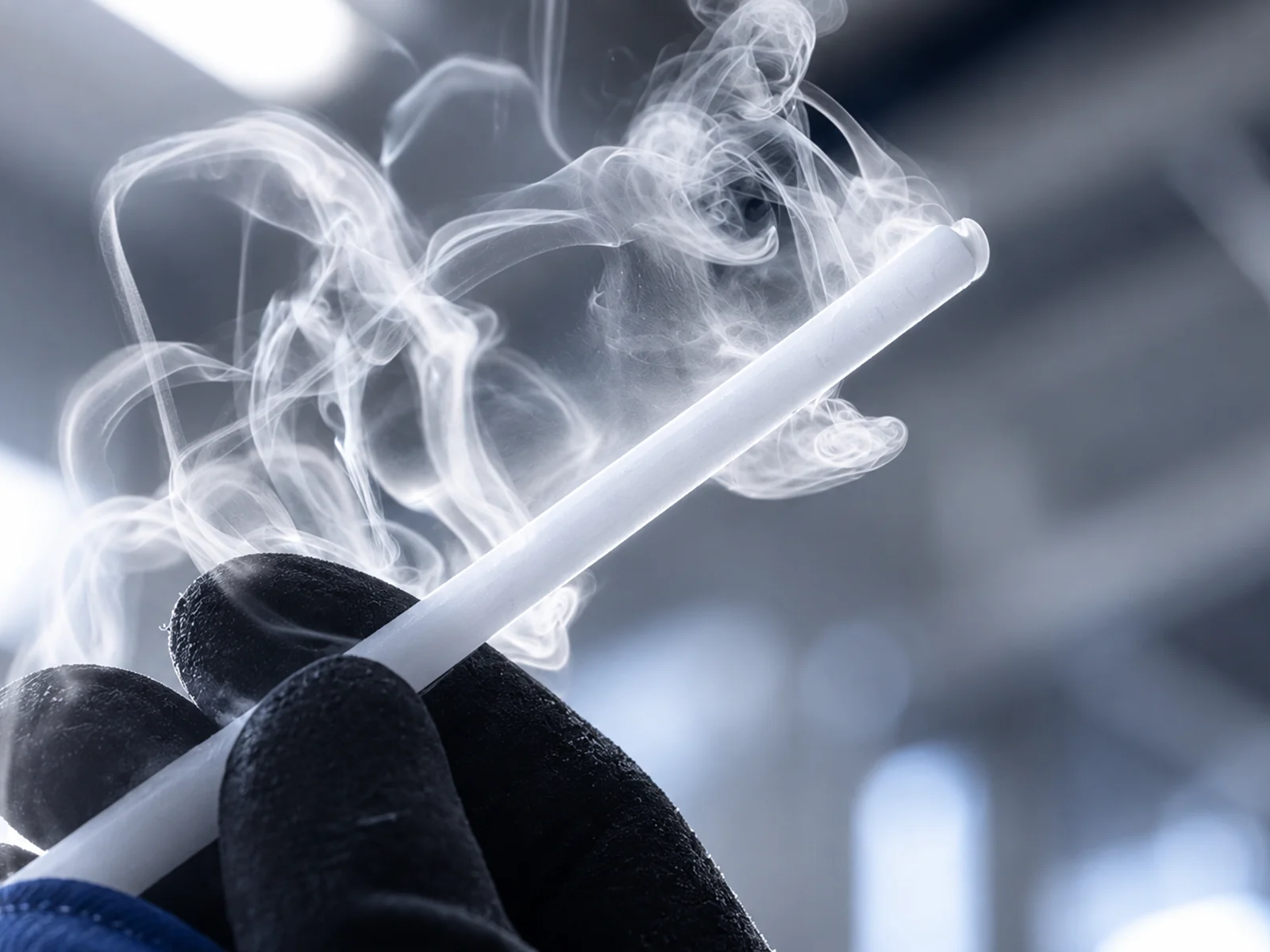
In-house dry ice production is the process of making dry ice on-site with a pelletizer, which converts liquid CO₂ (LCO₂) into solid, high-density dry ice pellets on demand. Instead of ordering dry ice from an outside supplier — and losing a portion of every delivery to sublimation in transit and storage — manufacturers connect a Cold Jet pelletizer to a liquid CO₂ tank and produce the exact amount of fresh 3 mm blasting pellets they need, right before they blast. Fresh, dense pellets carry more kinetic energy (KE = ½mv²), which means more effective cleaning of molds, tooling, and equipment. Cold Jet production systems are fully automated with one-button operation, start up in minutes, and range from the compact PE 80 (up to 176 lbs/hr) to high-volume systems producing 3,306+ lbs per hour. Facilities running multiple dry ice blasters — in plastics, rubber and tire, automotive, foundry, and aerospace manufacturing — typically see the fastest payback, and optional CO₂ recovery systems can cut liquid CO₂ consumption by nearly half.
Why manufacturers are moving to on-demand, on-site dry ice production
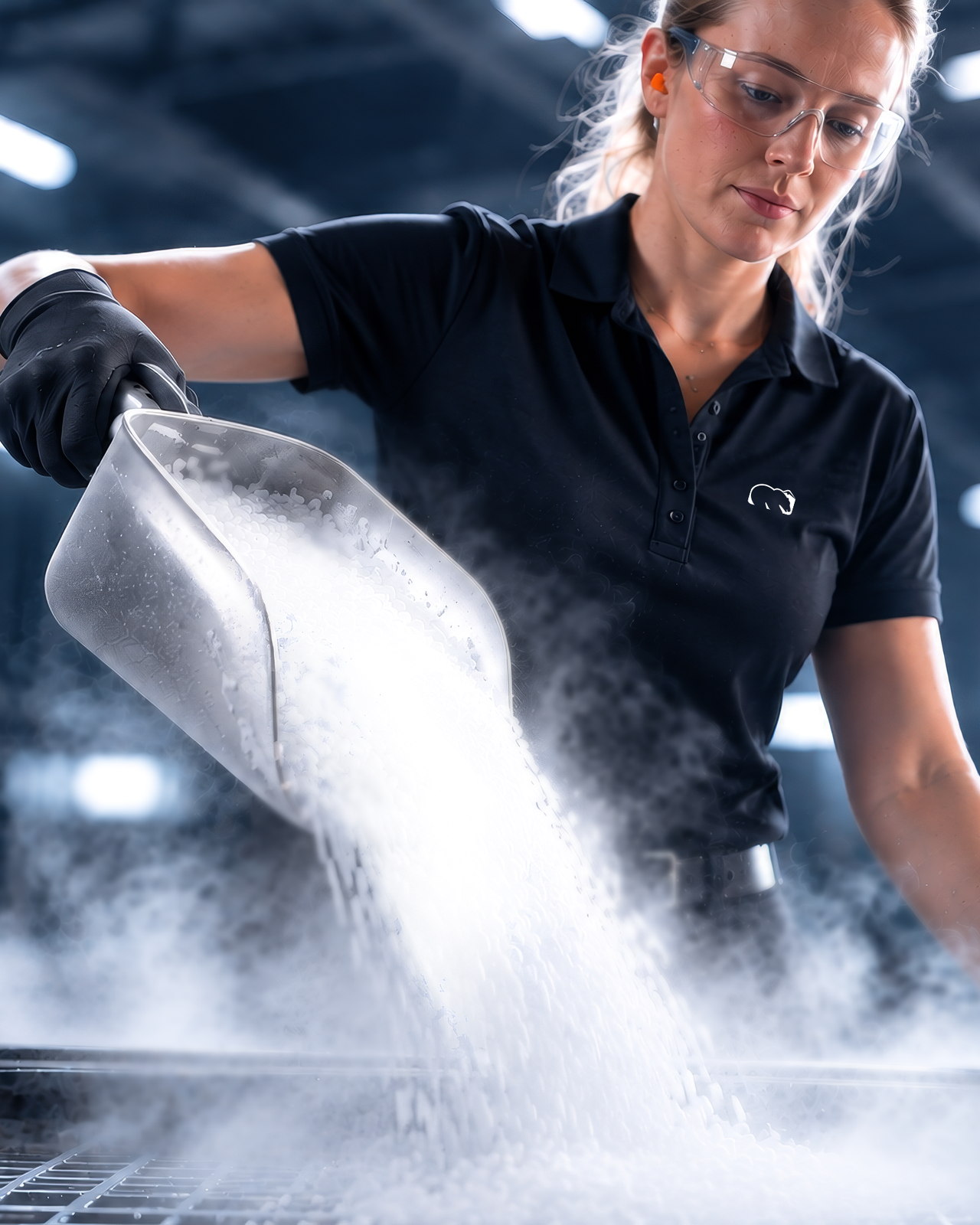
Dry ice is a time-sensitive product — it begins sublimating the moment it is produced. Facilities that buy dry ice pay for product that disappears before use, absorb delivery costs, and blast with aged, lower-density media that lacks the kinetic energy of fresh pellets. Producing dry ice in-house eliminates the waste, cuts costs, and ensures every cleaning cycle runs on fresh, high-density dry ice.
24,000+
Machines installed Globally
Zero
Conversion ratio
Secondary Waste
3 mm High-Density
Blasting Pellets
What Are the Benefits of In-House Dry Ice Production for Manufacturers?
In-house production delivers fresher, denser dry ice at a lower cost per pound — exactly when you need it
Dry ice begins sublimating the moment it is produced. When manufacturers buy dry ice from an outside supplier, a portion of every delivery disappears in transit and storage before it ever reaches the blaster — and the pellets that remain are less dense, with less of the kinetic energy that drives cleaning performance. Facilities compensate by over-ordering, paying delivery fees, and building cleaning schedules around someone else's truck.
Producing dry ice on-site with a Cold Jet pelletizer flips that equation. You make the exact amount of fresh, high-density dry ice you need, right before you blast — eliminating waste, delivery costs, and supply risk while improving cleaning results across your facility.
 Performance
Fresher, Denser Dry Ice Cleans Better
Cleaning performance depends on kinetic energy — and kinetic energy depends on mass. Aged dry ice loses mass and density to sublimation, so it hits with less energy and cleans less effectively. Producing dry ice on-site means every blasting cycle runs on fresh, high-density pellets at peak performance, delivering faster, more consistent cleaning of molds, tooling, and equipment.
 On-Demand Supply
Eliminate Sublimation Waste and Over-Ordering
When dry ice is delivered, a portion of every order sublimates in transit and storage before it is ever used — you pay for product that disappears. In-house production ends the cycle of over-ordering to compensate. Produce the exact amount you need, when you need it, and stop paying for dry ice you never blast.
 Reliability
Operational Independence from Delivery Schedules
A missed or delayed dry ice delivery can idle an entire cleaning schedule. On-site production removes the dependency — your maintenance and mold cleaning schedules run on your timeline, not your supplier's. Fully automated, one-button operation means any trained operator on any shift can produce dry ice in minutes.
 Cost
Lower Cost Per Pound of Dry Ice
In-house production eliminates delivery fees, minimum-order charges, and the cost of wasted product. Cold Jet's proprietary Sub-Cooling Technology delivers the lowest liquid CO₂-to-dry ice conversion factor on the market, so you make more dry ice from every pound of LCO₂ — and facilities running multiple blasters see the savings compound quickly.
 Sustainability
A More Sustainable Cleaning Program
Dry ice blasting is already a clean process — no chemicals, no wastewater, no secondary waste. In-house production makes it more sustainable by cutting delivery truck miles, and optional CO₂ recovery systems capture revert gas during production and recycle it into more dry ice, reducing liquid CO₂ consumption by nearly half.
How Do Manufacturers Use In-House Dry Ice Production?
Fresh dry ice powers dry ice blasting applications across the plant floor — from mold and tooling cleaning to surface preparation and facility maintenance — in plastics, rubber and tire, automotive, foundry, and aerospace operations.
- Plastics & Composites
- Rubber & Tires
- Automotive Manufacturing
- Foundry
- Aerospace & Aviation
Produce Fresh, High-Density Dry Ice On Demand — Right Where You Blast
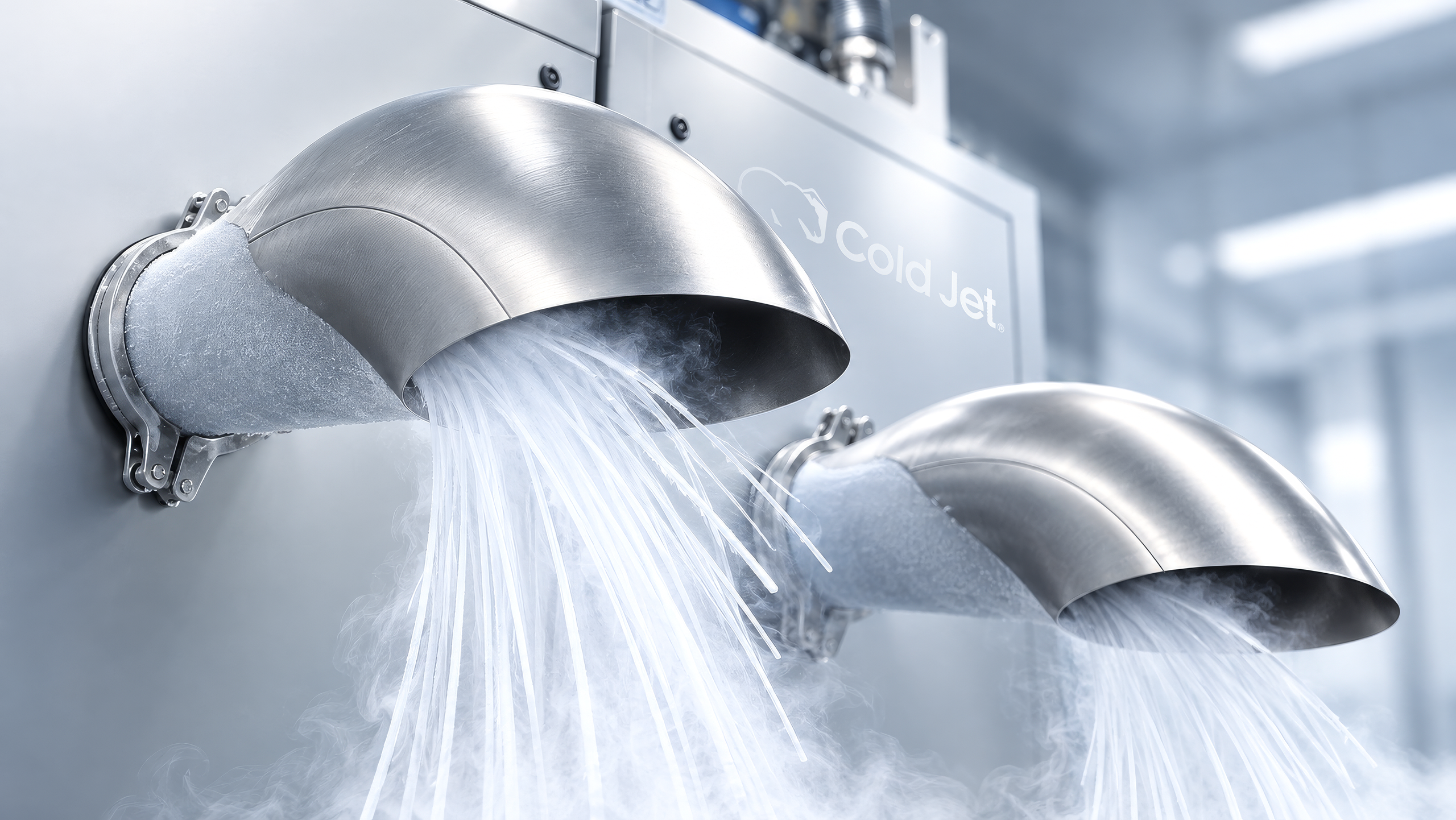
Cold Jet pelletizers give manufacturers a just-in-time supply of premium blasting media. Connect the machine to a liquid CO₂ source, press one button, and produce fresh 3 mm pellets in minutes.
Just-in-time production
Produce the exact amount of dry ice your cleaning schedule requires, right before you blast. This eliminates the guesswork of ordering days in advance, the waste of over-ordering, and the risk of running short mid-job. Fully automated operation with start-up in minutes means dry ice is ready whenever a blaster is.
Peak blasting performance
Cleaning energy follows the physics of KE = ½mv² — the more mass a pellet retains, the harder it works. Dry ice that has spent days in transit and storage loses density and cleans noticeably slower. Freshly produced, high-density pellets deliver maximum kinetic energy for faster cycle times and a more consistent clean.
Eliminate waste and delivery dependence
Purchased dry ice sublimates from the moment it leaves the production plant — you pay for pounds that never reach the blaster. On-site production ends sublimation waste, delivery fees, and reliance on a supplier's schedule, while an on-site LCO₂ tank keeps your raw material stable and ready.
- Plastics & Composites
- Rubber & Tire Molding
- Automotive Manufacturing
- Foundries
- Aerospace & Aviation
- Food & Beverage
- Packaging & Printing
- Contract Cleaners
- Multi-Blaster Facilities
- Multi-Shift Operations
Power Every Dry Ice Blasting Application in Your Facility with Fresh Media
A steady supply of fresh dry ice turns dry ice blasting from a scheduled event into an everyday tool — available to every shift, for every application.
Mold and tooling cleaning
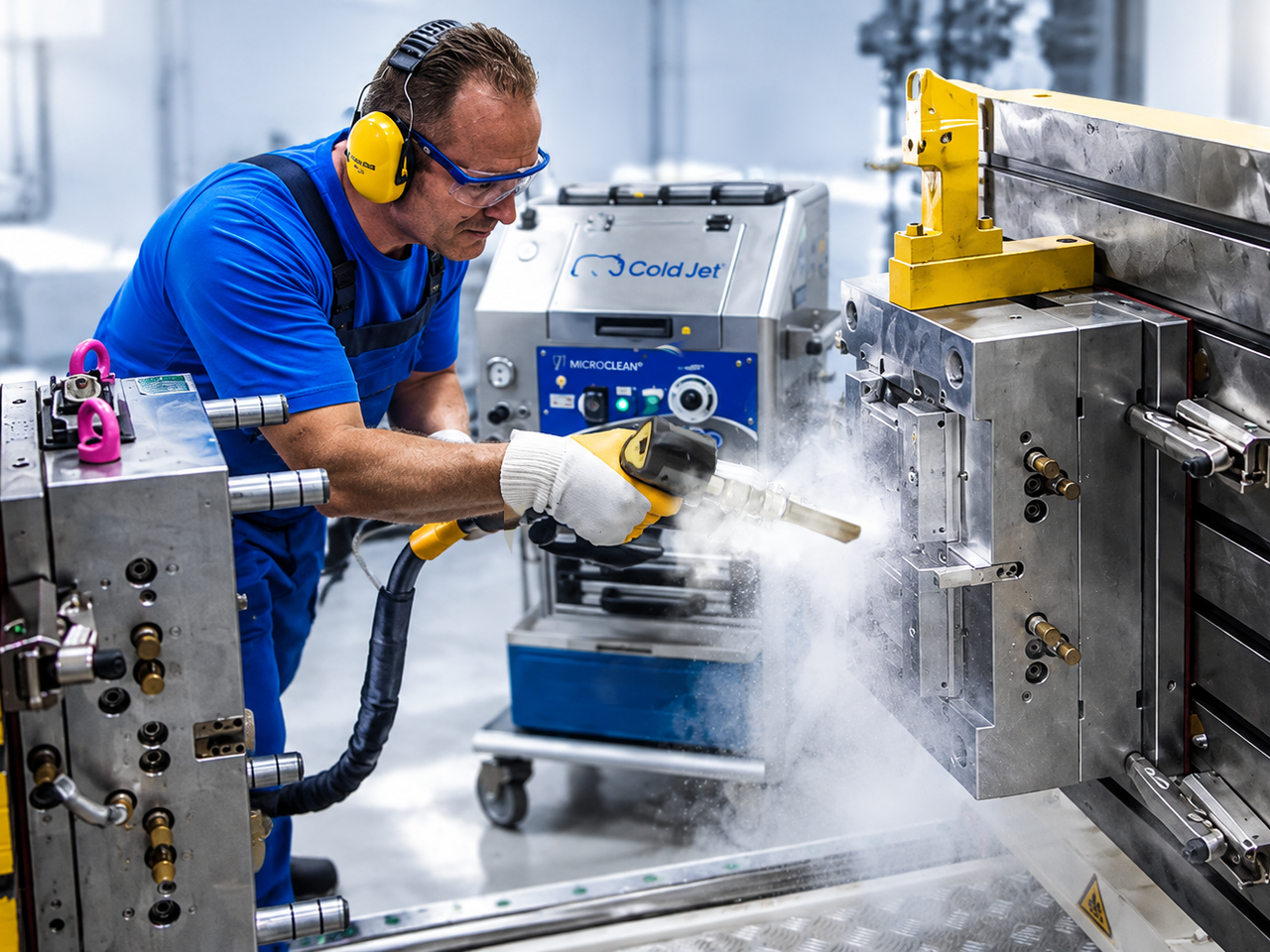
Dry ice blasting cleans injection molds, tire molds, compression molds, core boxes, and extrusion dies in place — hot and online — without abrasive damage to surfaces, vents, or parting lines. Cleaning more frequently with fresh media reduces scrap rates and extends tooling life.
Surface preparation and residue removal
From release agents and adhesives to weld slag, paint overspray, and carbon buildup, dry ice blasting removes production residue from equipment and surfaces without chemicals, water, or media entrapment — keeping lines running and finish quality consistent.
Preventative and facility maintenance
Because dry ice is non-abrasive, non-conductive, and leaves no secondary waste, maintenance teams can clean electrical cabinets, motors, chains, conveyors, and production equipment in place — often without disassembly or extended downtime. With dry ice made in-house, there is always fresh media on hand for unplanned cleaning needs.
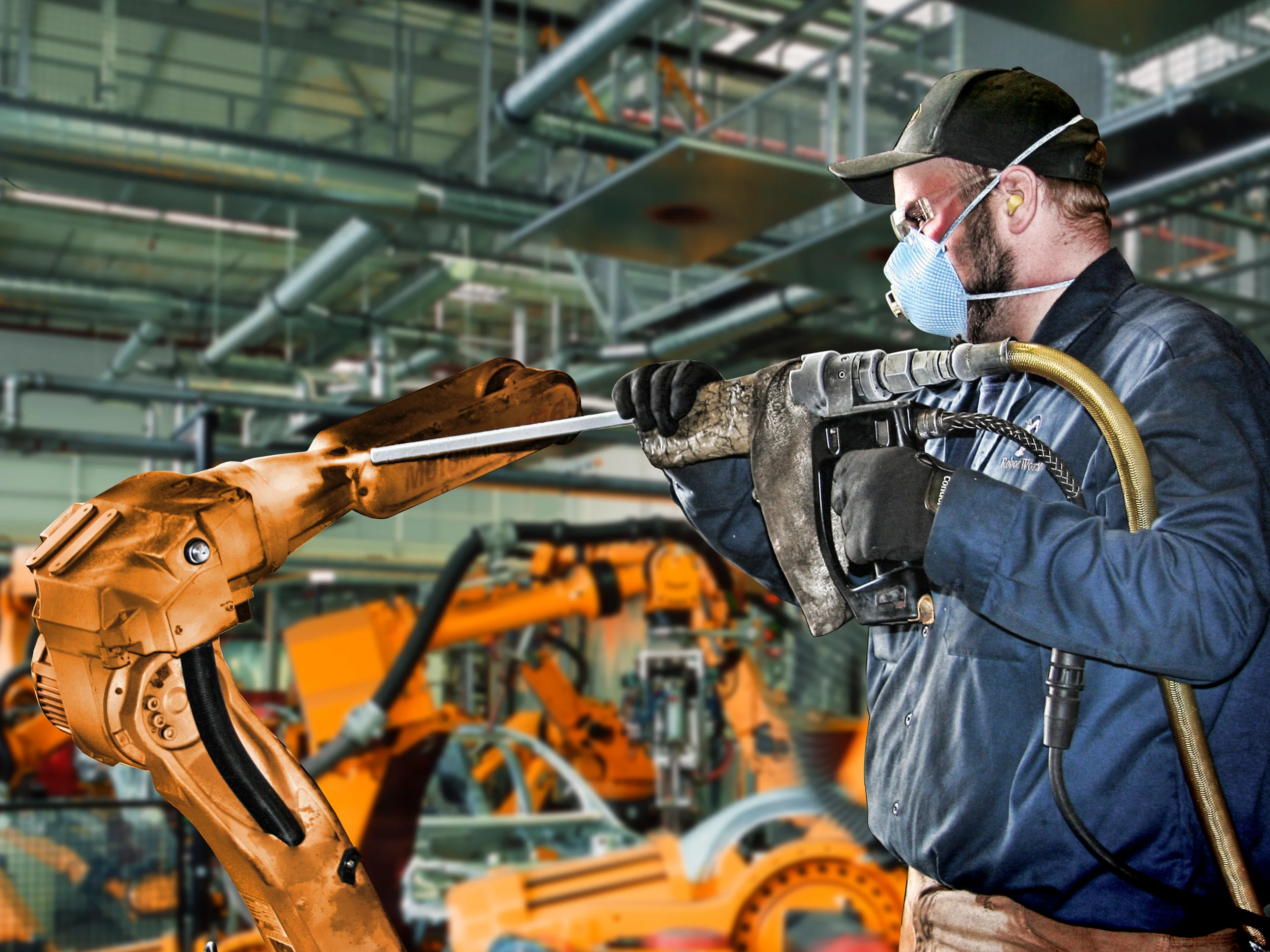
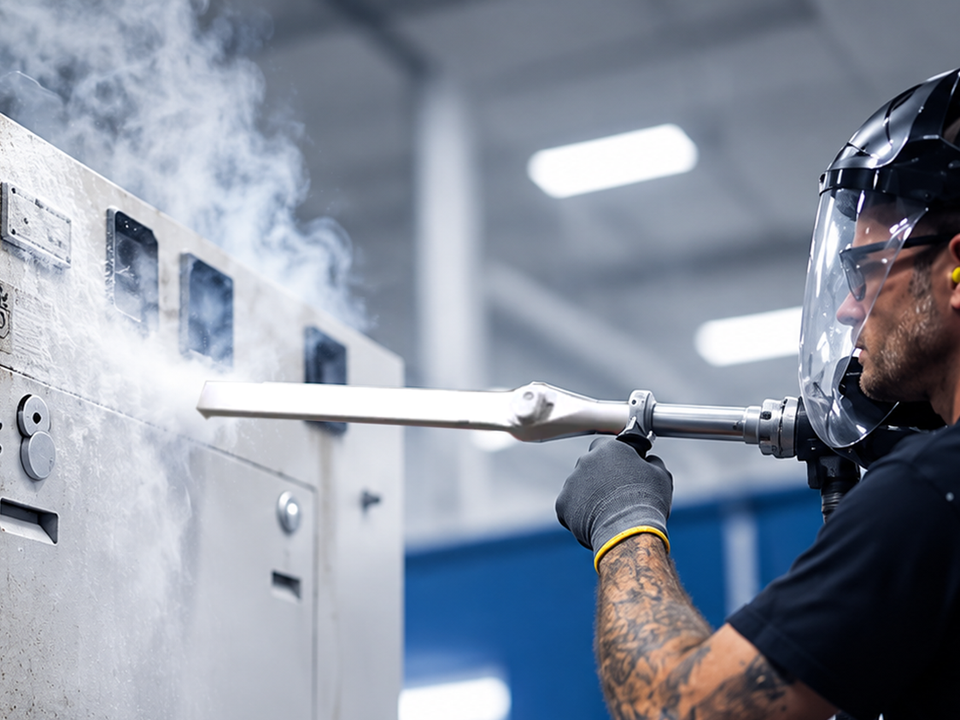
Fresh dry ice supports blasting applications across the entire facility — mold cleaning, part finishing, weld line cleaning, paint booth maintenance, core box cleaning, and general equipment maintenance. Common contaminants removed include:
- Release Agents
- Rubber & Plastic Residue
- Adhesives & Sealants
- Weld Slag & Spatter
- Paint & Powder Coat Overspray
- Oils & Grease
- Carbon & Soot Buildup
- Core Sand & Resin
- Dust & Process Debris
- Ink & Coating Residue
- Food & Packaging Residue
What Do You Need to Produce Dry Ice In-House?
In-house dry ice production requires less infrastructure than most manufacturers expect. When implementing on-site production for your dry ice blasting program, the following components make up a complete setup:
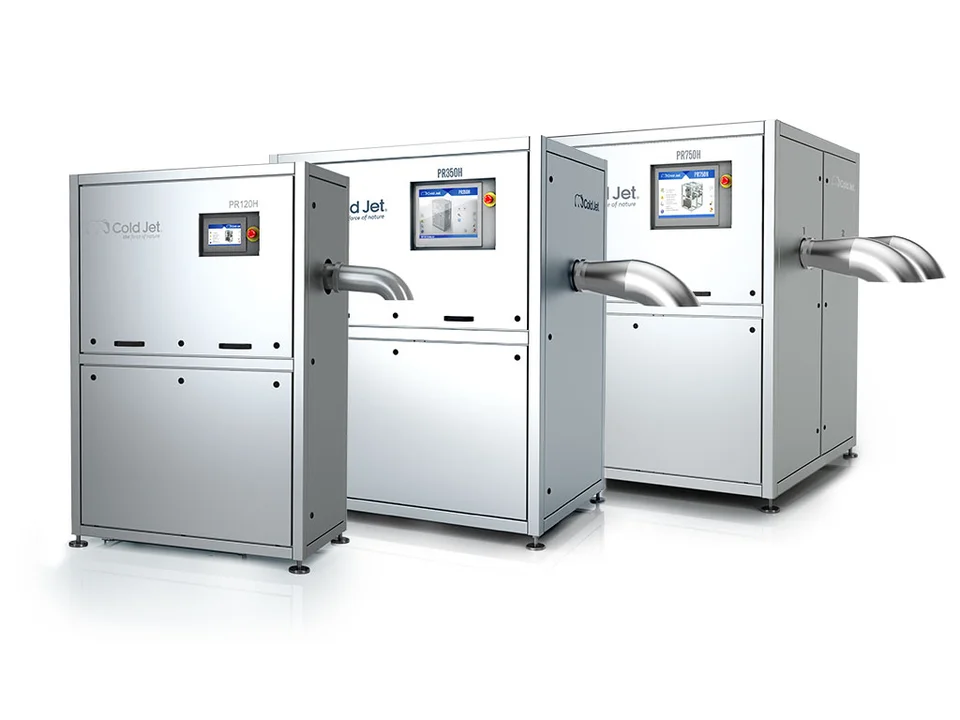
Step 01
CoreProduction System
Dry Ice Pelletizer
The heart of in-house production is a reliable, easy-to-use dry ice pelletizer. Cold Jet offers the widest range on the market — from the compact PE 80 (up to 176 lbs/hr) to high-volume systems producing 3,300+ lbs/hr — so you can match capacity to your facility's actual consumption. Fully automated, one-button operation means any trained operator can produce dry ice, and machines start up in minutes.
- 01. Dry Ice Pelletizer — The heart of in-house production is a reliable, easy-to-use dry ice pelletizer. Cold Jet offers the widest range on the market — from the compact PE 80 (up to 176 lbs/hr) to high-volume systems producing 3,300+ lbs/hr — so you can match capacity to your facility's actual consumption. Fully automated, one-button operation means any trained operator can produce dry ice, and machines start up in minutes.
- 02. Liquid CO₂ Supply & Storage — Pelletizers convert pressurized liquid CO₂ (LCO₂) into dry ice. Depending on your production volume, supply options range from transportable dewars and micro bulk tanks to fixed bulk LCO₂ tanks with scheduled refills. Unlike dry ice, liquid CO₂ stores indefinitely without loss — your raw material waits for you, not the other way around. Cold Jet can assist with tank sizing, piping, and supplier coordination.
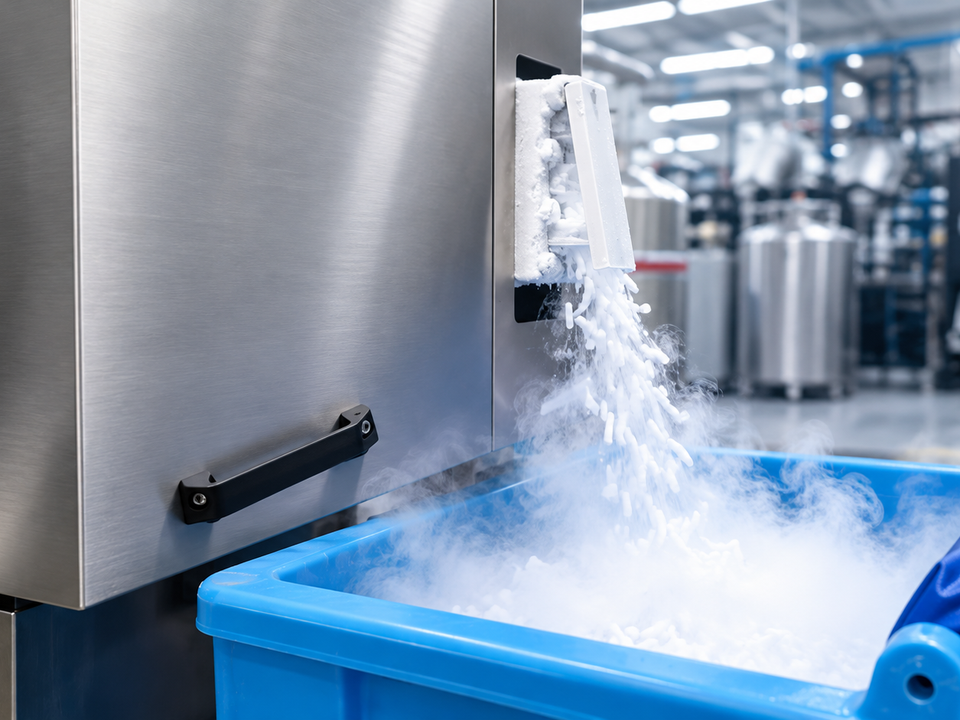
- 03. Insulated Dry Ice Containers — Freshly produced pellets dispense into insulated containers that preserve density between production and blasting. Because dry ice is made on demand and used quickly, storage needs are minimal — most facilities produce in the morning and blast the same day, keeping media at peak freshness.
- 04. Ventilation & CO₂ Monitoring — Sublimating dry ice releases CO₂ gas, so production and storage areas need adequate ventilation. CO₂ sensors provide continuous monitoring and are recommended anywhere dry ice is produced, stored, or used in enclosed spaces. Cold Jet provides CO₂ safety guidance and can supply monitoring equipment as part of a complete solution.
- 05. Machine and Operator Training — Cold Jet machines are designed for multi-shift, multi-operator environments — one-button operation makes training fast and operator error rare. Cold Jet provides new operator training, assistance with installation, preventative maintenance programs, and remote monitoring and diagnostics through Cold Jet CONNECT®.
- 06. CO₂ Recovery System (Optional) — During dry ice production, a portion of the liquid CO₂ reverts to gas. Cold Jet's RE-CO2 Recovery Systems capture that revert gas and recycle it back into production — cutting liquid CO₂ consumption by nearly half, increasing dry ice yield, reducing supply deliveries, and lowering the carbon footprint of your cleaning program.
How Dry Ice Blasting
Compares to Alternatives
See how dry ice blasting stacks up against traditional industrial cleaning methods across the criteria that matter most on the plant floor.
| Criteria | Dry Ice Blasting Best | Sand / Media Blasting | Chemical / Solvent Cleaning | Manual Cleaning | Pressure Washing |
|---|---|---|---|---|---|
| Secondary Waste | None — CO₂ sublimates completely | Spent media requires containment and disposal | Hazardous chemical waste stream | Rags, brushes, and consumables | Wastewater and runoff |
| Speed | Fast — clean in place, no disassembly | Moderate — masking plus media cleanup | Slow — apply, dwell, wipe, rinse | Slow — labor-intensive scrubbing | Moderate — plus dry-out time |
| Equipment Damage | None — non-abrasive, non-conductive | Abrasive — erodes surfaces and tolerances | Corrosion risk on some substrates | Scratching from brushes and scrapers | Water intrusion in motors and electronics |
| Worker Safety | No chemicals or fumes — standard PPE | Dust and particulate exposure | VOC exposure and chemical handling | Repetitive strain, confined-space work | Slip hazards, high-pressure injury risk |
| Downtime | Minimal — equipment cleaned online | High — masking, containment, cleanup | High — dwell time and re-rinsing | High — disassembly often required | High — drying before restart |
| Environmental Impact | Zero waste — CO₂ can even be recycled | Contaminated media to landfill | Hazardous waste disposal and permits | Consumables to landfill | Wastewater treatment required |
What Is the Best Dry Ice Production Machine
for a Manufacturing Facility?
Cold Jet offers the widest selection of dry ice production machines on the market, from compact low-volume pelletizers to high-capacity systems. Match your machine to your facility's dry ice consumption rather than over-buying.

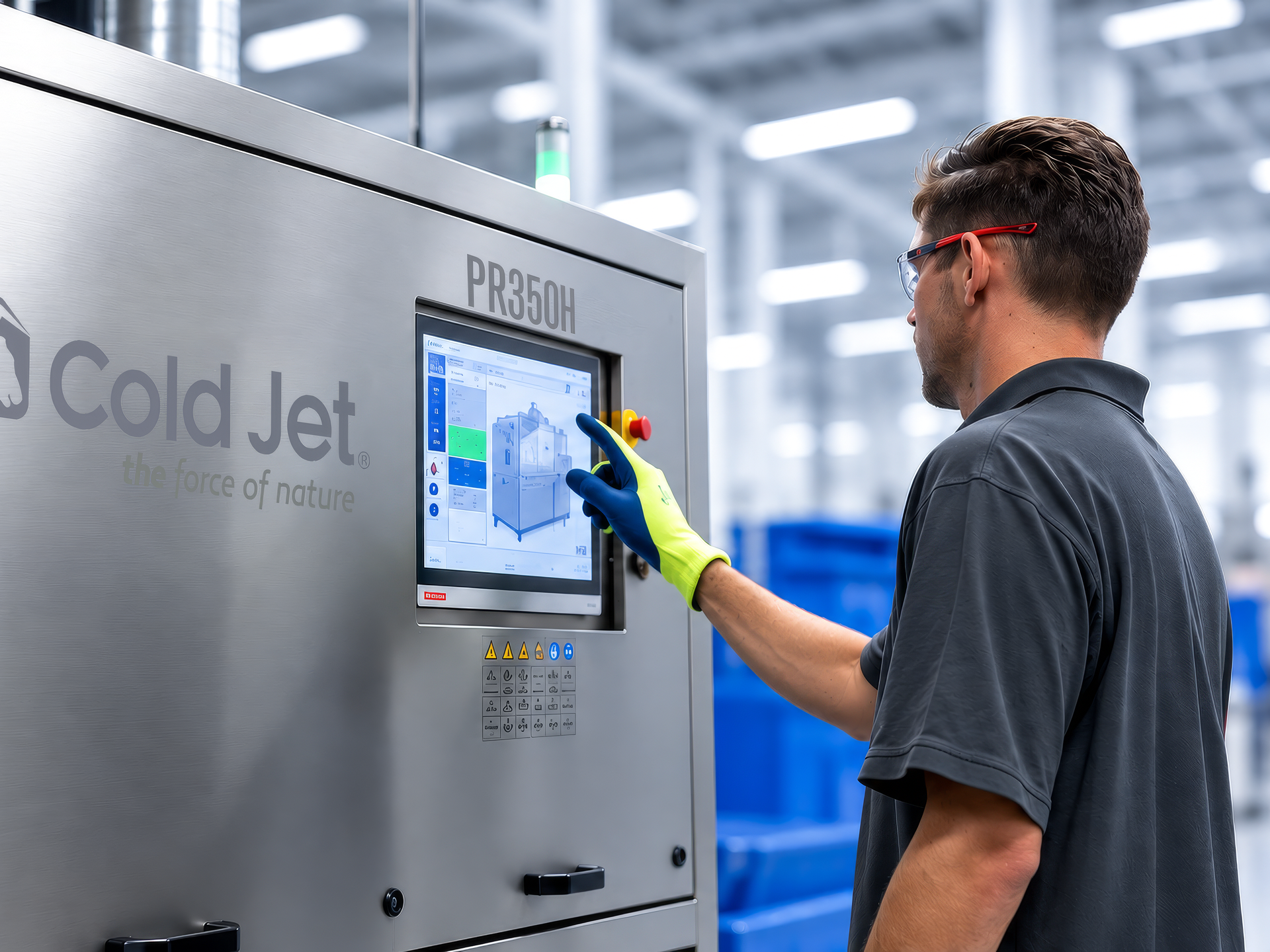
PR350H
The PR350H is a high-capacity pelletizer for facilities with heavy dry ice consumption — multiple blasters, multiple shifts, or high-frequency cleaning schedules. It produces up to 772 lbs (350 kg) of high-density dry ice per hour and pairs with Cold Jet's RE-CO2 recovery systems to maximize yield from every pound of liquid CO₂.
- Up to 772 lbs (350 kg) per hour
- Built for multi-blaster facilities
- High-density, premium dry ice
- Pairs with RE-CO2 recovery systems

PR120H
The PR120H is the answer for producing quality dry ice pellets on demand with minimal space requirements. It produces up to 265 lbs (120 kg) per hour with one-button, fully automated operation, starts up in under 5 minutes, and features Cold Jet's proprietary Sub-Cooling Technology for the lowest LCO₂ conversion factor available.
- Up to 265 lbs (120 kg) per hour
- Fully automated — one-button operation
- Start-up in less than 5 minutes
- Sub-Cooling Technology — 2.2 conversion factor
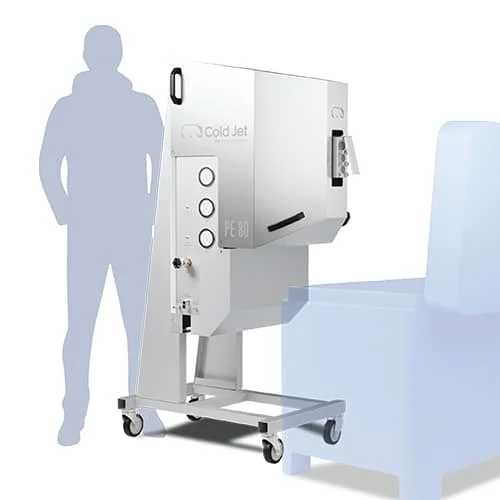
PE 80
The PE 80 is a compact, low-volume pelletizer that is ideal for manufacturers taking control of their dry ice supply for the first time. It produces up to 176 lbs (80 kg) of dry ice per hour, requires minimal infrastructure, moves easily on caster wheels, and works with fixed tanks, dewars, and micro bulk LCO₂ supply.
- Up to 176 lbs (80 kg) per hour
- Pellet sizes from 1.7 to 16 mm
- Compact and mobile — minimal infrastructure
- Flexible LCO₂ supply options
How Do These Three Machines Compare?
Side-by-side specs for the Cold Jet pelletizers best suited to in-house production for blasting — so you can match the right system to your dry ice consumption, space, and LCO₂ supply.
High-capacity, multi-blaster facilities
On-demand production, fully automated
Compact, low-volume production
| Specification | PR350H | PR120H | PE 80 |
|---|---|---|---|
| Production | |||
| Dry Ice Production Capacity | Up to 772 lbs/hr(350 kg/hr) | Up to 265 lbs/hr(120 kg/hr) | Up to 176 lbs/hr(80 kg/hr) |
| Dry Ice Pellet Sizes | 3, 6, 10, or 16 mm via automatic quick die change | 3, 10, or 16 mm(others on request) | 1.7, 2.2, 3.0, 8.0, and 16.0 mm |
| LCO₂ Conversion (Sub-Cooling Technology) | 12–14% better than market standard | 12–14% better than market standard | Not published |
| Machine Controls | |||
| Operation | Fully automated — one button, 15" touchscreen | Fully automated — one button, 7" touchscreen | Simple, user-friendly controls |
| Start-Up Time | Less than 3 minutes | Less than 5 minutes | Minutes |
| Cold Jet CONNECT® Remote Monitoring | Yes | Yes | Not published |
| Installation | |||
| LCO₂ Supply Options | Bulk LCO₂ tank | Bulk LCO₂ tank | Fixed tanks, or micro bulk(15–18 bar) |
| Dimensions (L x W x H) | 23.6" x 39.3" x 61.4" | 45.3" x 25.6" x 68.4" | 23.6" x 39.3" x 61.4" |
| Weight | 3,340 lbs(1,515 kg) | 1,552 lbs(704 kg) | 447.5 lbs(203 kg) |
| Mobility | Stationary | Stationary | Caster wheels or wall-fixed installation |
“—” indicates a spec Cold Jet has not published for this model — contact a Cold Jet specialist to confirm fit for your production needs.
Why Invest in Cold Jet Machines
for In-House Dry Ice Production
If your facility runs dry ice blasters on a regular basis, investing in a Cold Jet dry ice pelletizer puts your supply, your schedule, and your cleaning performance back under your control.
When evaluating this capital investment, consider both the return on investment (ROI) and the operational benefits specific to your facility — delivery fees eliminated, sublimation waste recovered, and blasting performance improved. Cold Jet machines deliver faster ROI and greater value through:
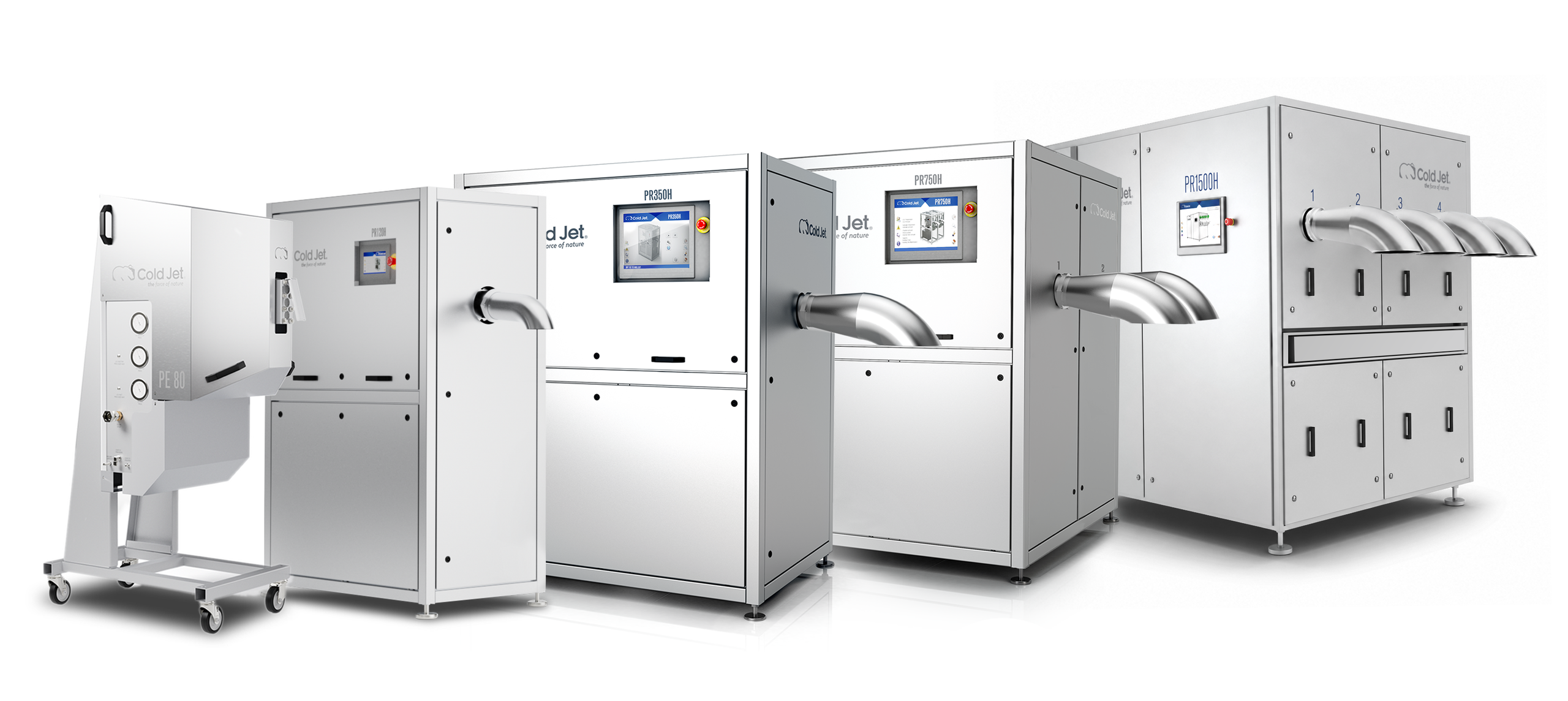
One Partner for Blasting and Production
Cold Jet is the only global leader in both dry ice blasting and dry ice production technology — your blasters, pelletizer, and support all come from one partner who understands the complete process.
Trusted Across Manufacturing
With more than 24,000 machines installed globally across plastics, rubber, automotive, foundry, and aerospace operations, Cold Jet is the established leader in dry ice technology for manufacturers.
Highest Density Dry Ice
Cold Jet's patented production technology makes the highest quality, highest density dry ice available — which means better blasting performance, less scrap ice, and a longer shelf life.
Lowest Cost of Ownership
Proprietary Sub-Cooling Technology delivers the lowest liquid CO₂-to-dry ice conversion factor on the market, and optional RE-CO2 recovery cuts LCO₂ consumption by nearly half — minimizing your cost per pound of dry ice.
Industry Leading Support and Training
More than 70 people in our customer service organization, 13 service centers across 10 countries, full regional spare parts inventory, and 24/7 availability — plus remote monitoring and diagnostics through Cold Jet CONNECT®.
Complete Solution Design
Cold Jet assists with liquid CO₂ supply, storage tank solutions, piping, dry ice containers, CO₂ sensors, and extruder plates — designing, delivering, and deploying a complete production solution for your facility.
Manufacturers around the world rely on Cold Jet for dry ice production
With a global install base of 24,000+ machines across companies large and small, Cold Jet delivers real value to manufacturers that produce their own dry ice for blasting.

Standards and Requirements
We Help You Meet
In-house dry ice production and dry ice blasting support safety, quality, and environmental programs across manufacturing operations.
Occupational Safety & Health Standards
OSHA sets permissible exposure limits for CO₂ and requires employers to control workplace hazards where dry ice is produced, stored, and used.
Cold Jet provides CO₂ safety guidance, recommends monitoring and ventilation practices for production and storage areas, and offers operator training — while dry ice blasting itself eliminates the chemical exposure hazards of solvent-based cleaning.
Quality Management Systems
ISO 9001 requires consistent, documented, repeatable processes — including the maintenance and cleaning procedures that protect product quality.
Fully automated dry ice production delivers consistent media quality every cycle, and dry ice cleaning parameters are repeatable and documentable — supporting standardized work instructions and audit-ready cleaning records.
Environmental Management Systems
ISO 14001 asks manufacturers to reduce waste streams, resource consumption, and the environmental impact of their operations.
Dry ice blasting generates zero secondary waste and replaces chemical cleaning processes. In-house production cuts delivery transportation, and optional CO₂ recovery recycles revert gas — reducing liquid CO₂ consumption by nearly half.
Occupational Health & Safety Management
ISO 45001 requires organizations to systematically identify and reduce occupational health and safety risks in their processes.
Replacing solvents, abrasive media, and manual scrubbing with dry ice blasting removes chemical exposure, dust, and repetitive-strain hazards — and one-button production machines minimize operator risk with straightforward, well-documented safety practices.
Hazardous Waste Regulations
EPA regulations under RCRA govern the generation, handling, and disposal of hazardous waste from industrial cleaning processes.
Dry ice sublimates on contact, leaving only the removed contaminant for simple collection — no solvent waste, no contaminated blast media, and no wastewater. Facilities can shrink or eliminate hazardous waste streams tied to cleaning.