
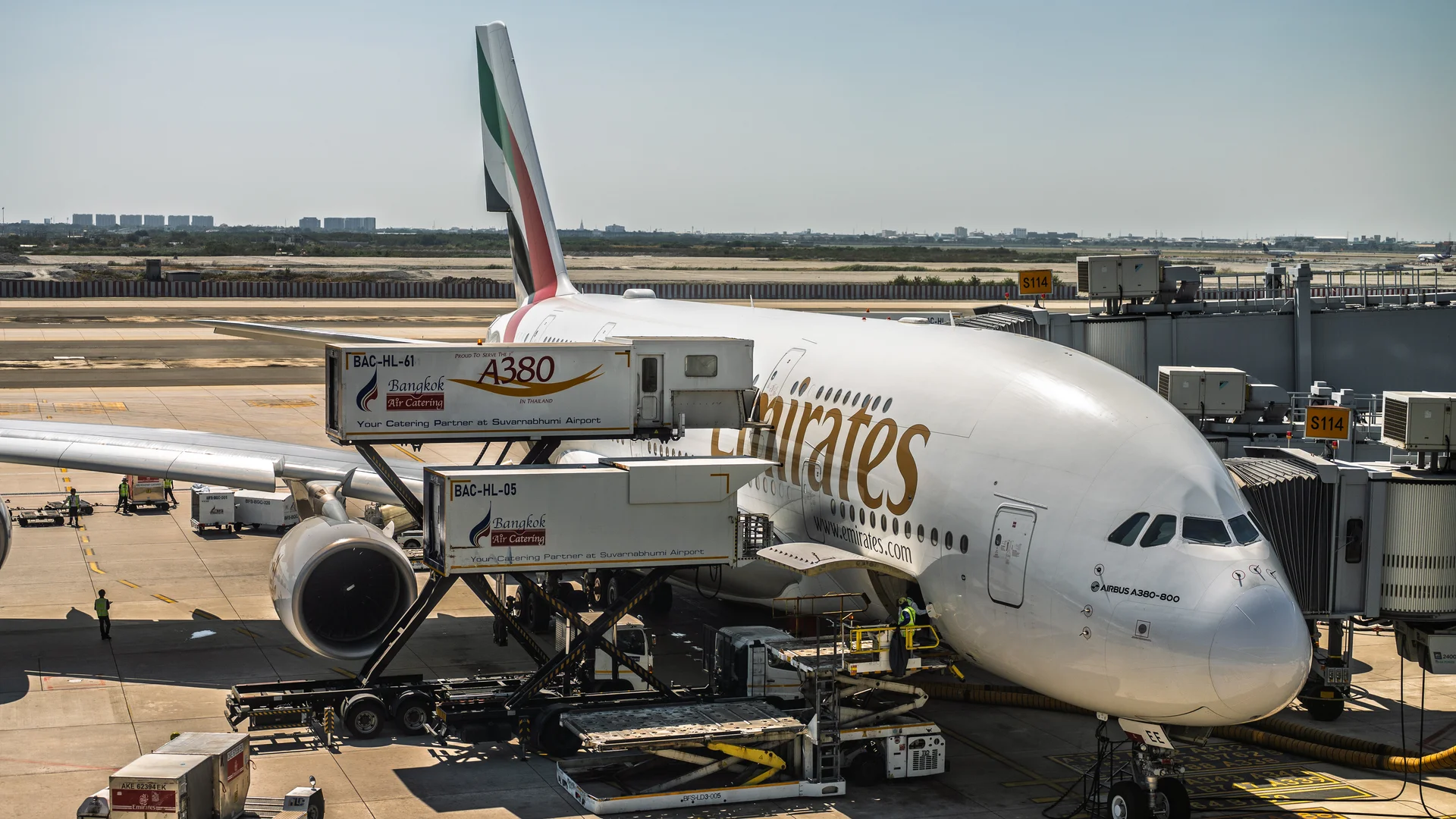
Overview
Summary
Onsite dry ice production gives airline caterers direct control over the availability, format, quality, and cost of the dry ice that keeps in-flight meals at temperature. Cold Jet production systems convert liquid CO₂ into fresh 3 to 16 mm pellets or high-density slices on demand, with 12–14% better conversion efficiency than the market standard. That means no more delivery windows, fewer storage losses, and less waste from ordering against a schedule that keeps changing.
What is onsite dry ice production for airline catering?
Onsite dry ice production is the practice of manufacturing dry ice at the flight kitchen instead of buying it from a third-party supplier. Liquid CO₂ is delivered to a reservoir on your site, piped into a Cold Jet production system, and released to atmospheric pressure, where it forms CO₂ snow that the machine compresses into 3 mm pellets, 10 to 16 mm nuggets, or high-density slices. Airline caterers use slices most often, because they load flat into the thermal cassette or drawer at the top of a catering trolley, where cold air falls through the cart and blankets the meals and beverages stored below. Producing onsite means the dry ice reaching your trolleys is hours old rather than days old, which matters because dry ice sublimates continuously from the moment it is made. It also means format changes, volume changes, and schedule changes are handled at the push of a button instead of a purchase order. Dry ice is made from recycled CO₂ captured at industrial and biogas facilities, is approved by the EPA, FDA, and USDA for use around food, and sublimates directly from solid to gas, leaving no water, no residue, and nothing to drain from a galley at altitude.
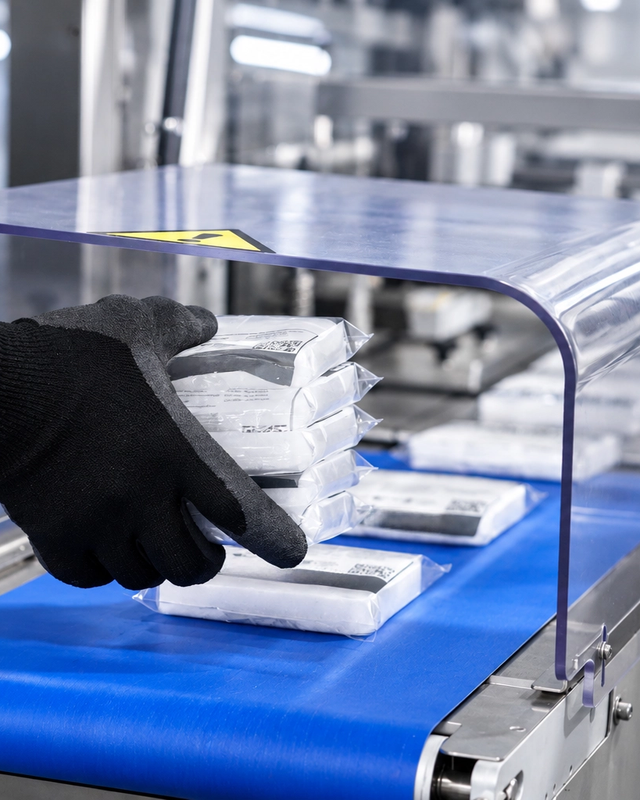
Challenge
Why flight kitchens need control of their own dry ice supply
Airline caterers use large quantities of dry ice on a daily basis, and dry ice represents a large percentage of non-food consumable costs. Complex scheduling often leads to dry ice waste and inefficiency. A delayed flight, an aircraft swap, or an unexpected load change can leave a kitchen short on cooling or sitting on surplus that sublimates away before it is used. By producing your own dry ice, airline caterers have complete control over dry ice availability, quality, and cost.
3x Water Ice
Cooling Power
12–14% Better
LCO₂ Conversion vs. Market Standard
None
Residue Left Behind
On Demand
Production Schedule
Benefits
What Are the Benefits of Onsite Dry Ice Production for Airline Caterers?
Onsite production gives caterers control over dry ice availability, quality, and cost
Airline caterers use large quantities of dry ice every day, and it represents a large percentage of non-food consumable costs. Buying that dry ice from a third party means paying for delivery, paying for storage, and absorbing the sublimation loss that happens between the supplier's plant and your loading dock. Complex scheduling makes the problem worse. Order too little and a trolley goes out warm. Order too much and the surplus disappears into the air.
Onsite dry ice production removes the guesswork. You make what you need, when you need it, in the format your trolleys and thermal cassettes are built for. Fresh dry ice is denser and lasts longer, delivery and storage costs go away, and a schedule change at 2 a.m. becomes a production run instead of an emergency phone call.
 Flexibility
Meet Schedule Changes Without a Delivery Window
Flight schedules move. Loads change, aircraft swap, and departures slip. When you produce dry ice onsite, you respond in minutes instead of waiting on a supplier's next run. Cold Jet systems start up in under five minutes and are designed for continuous operation, so a kitchen can produce a second batch for an unexpected wide-body just as easily as it runs the morning shift.
 Quality
Fresher, Denser Dry Ice That Lasts Longer
Dry ice sublimates from the moment it is made, so every hour spent in a delivery truck or a holding container is cooling you paid for and did not get. Cold Jet's patented production technology produces the highest density dry ice available, and producing it onsite means it reaches the trolley hours after it was made rather than days.
 Efficiency
Eliminate Over-Ordering and Sublimation Loss
Standing orders force a flight kitchen to guess at demand days in advance. Producing onsite removes the guess along with the delivery and storage costs attached to it. You hold hours of supply instead of days, and the risk of over or under ordering goes away.
 Food Safety
Food-Safe Cooling With No Water and No Residue
Dry ice is approved by the EPA, FDA, and USDA for use around food. It is non-toxic, non-flammable, tasteless, and odorless, and it sublimates directly to gas rather than melting. There is no meltwater to make packaging soggy, no spill risk during turbulence, and nothing transferred to a meal tray.
 Recycled CO₂
Sustainable Cooling From Captured Carbon
Dry ice is the product of a carbon capture and utilization process. CO₂ that would otherwise have been discarded as waste at an industrial or biogas facility is captured, recycled, and converted into a cooling medium, so it does not add to emissions. It also replaces gel packs and their waste stream, and because it sublimates in transit, loads get lighter as they travel.
Applications
Where Do Airline Caterers Use Dry Ice?
Dry ice does the cooling work that an aircraft galley has no power or space to do. It holds meals, beverages, and frozen items at temperature from the flight kitchen through loading, taxi, and service.
Validated For
- EPA, FDA, and USDA Approved for Use Around Food
- IATA Dangerous Goods Regulations (UN 1845)
- ICAO Technical Instructions
- HACCP Food Safety Programs
- Made From Recycled CO₂
Hold In-Flight Meals at Temperature From the Flight Kitchen to the Aisle
Aircraft galleys are constrained by weight, space, and available power, which is why the industry cools catering trolleys with dry ice rather than compressors.
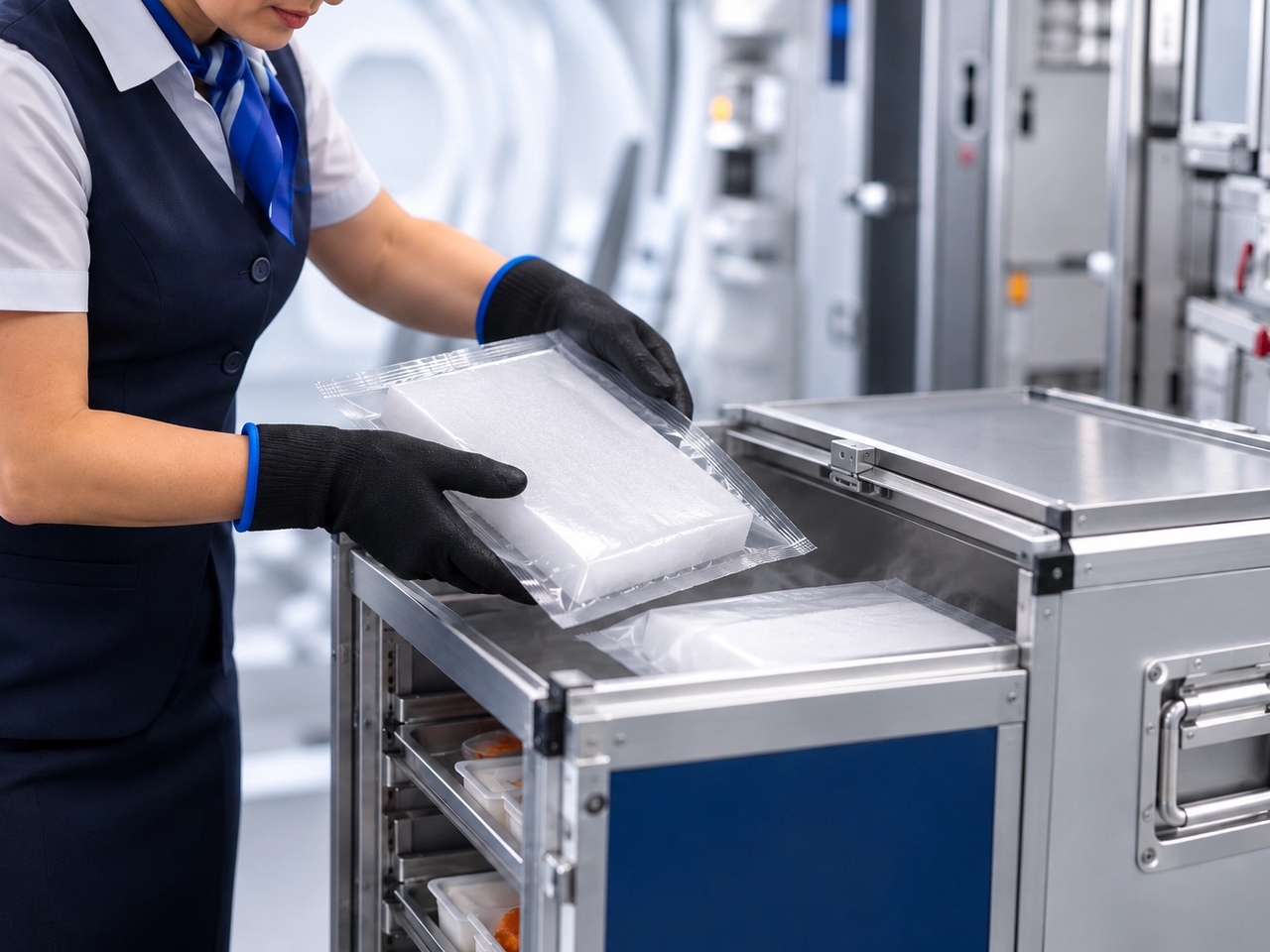
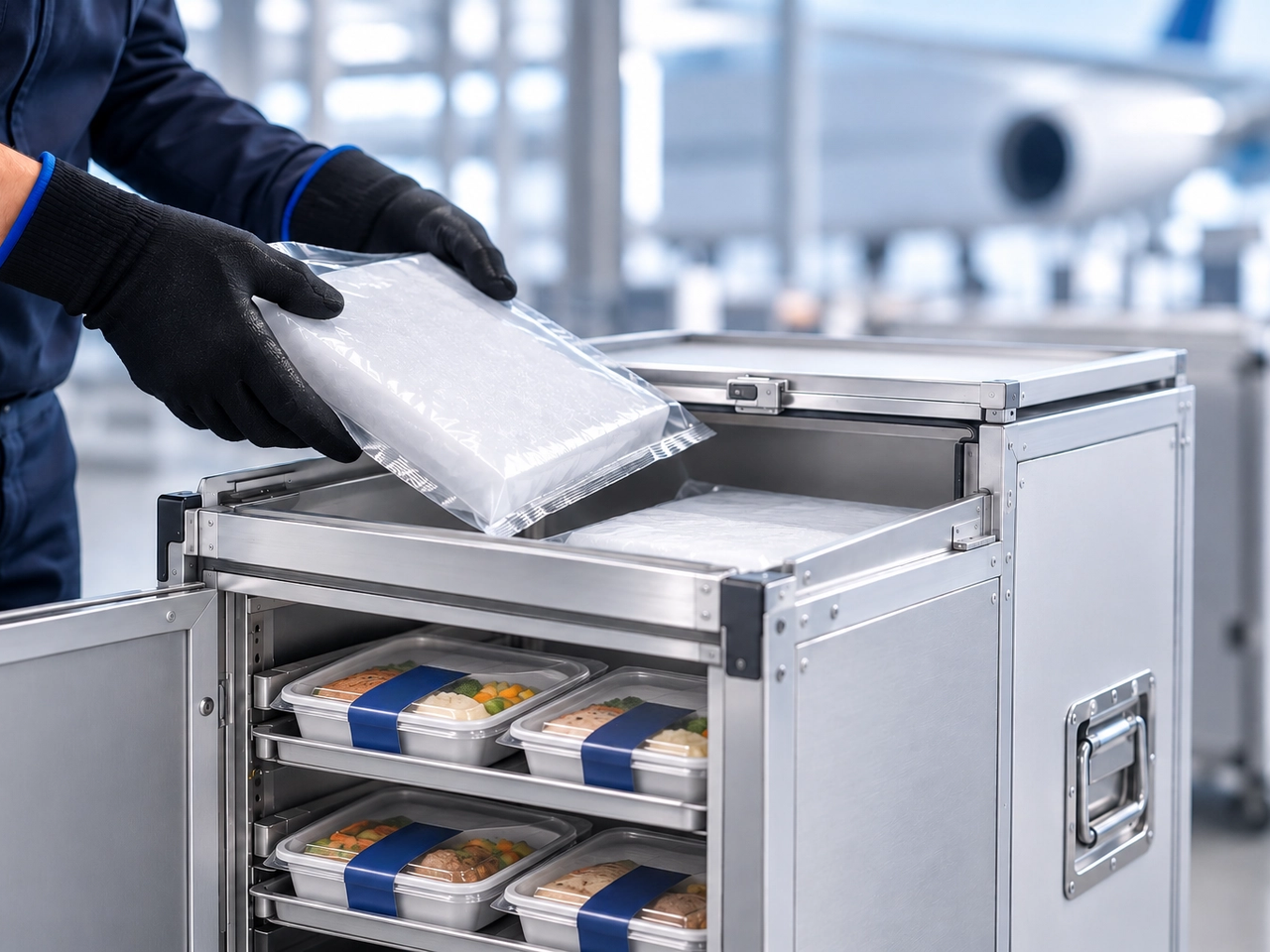
Cold air falls, so the ice goes on top
Dry ice slices, blocks, or nuggets sit in a flat drawer or thermal cassette at the top of the trolley. Because cold air is denser than warm air, it cascades down through the cart and blankets the meals and beverages stored below. No fans, no compressor, and no electrical load.
Cooling that lasts the whole rotation
Advanced trolley configurations that combine thermal cassettes with insulated covers can hold chilled contents for 20 to 23 hours without using a single watt of electricity. That covers ground-side staging, the loading window, taxi and cruise, and the delays no schedule accounts for.
No meltwater in the cabin
Dry ice sublimates directly from solid to gas. There is no pooling water to make packaging soggy, no spill hazard during turbulence, and no drain to manage in a galley at 35,000 feet.

Dry Ice Formats for Airline Catering
- High-Density Dry Ice Slices
- 3 mm Dry Ice Pellets
- 10 mm Dry Ice Nuggets
- 16 mm Dry Ice Nuggets
- Slice Weights 0.5 to 2.2 lbs (0.25 to 1 kg)
- Slice Thickness 0.5 to 2.3 in (15 to 60 mm)
- 5 x 5 in (125 x 125 mm) Slice Format
- 10 x 10 in (25 x 25 cm) Slice Format
- Bagged Pellets and Nuggets
- Automated Slice Dosing
Produce the Exact Format and Volume Your Trolleys Need, When You Need It
Dry ice represents a large percentage of non-food consumable costs in airline catering, and complex scheduling often leads to waste and inefficiency.
Match the format to the trolley
Cold Jet pelletizers change extruder die plates at the push of a button, so one machine can produce 3 mm pellets, 10 mm nuggets, or 16 mm nuggets. Reformers and direct slice systems press that ice into high-density slices sized for your cassettes, with programmable slice weights from 0.5 to 2.2 lbs (0.25 to 1 kg).
Produce to the flight schedule, not the delivery schedule
Fully automated one-button operation and start-up in under five minutes mean a kitchen can run production against the day's actual departures. An unexpected aircraft change stops being a supply problem and becomes a production run.
Stop sawing blocks by hand
Direct slice systems produce and dose slices in one machine, letting operators program slice size and dosing frequency. That removes the need, and the danger, of manually sawing dry ice blocks down to the size your trolleys take.


Cold Jet dry ice production systems are used by flight kitchens, inflight caterers, and catering groups worldwide. The right system depends on your daily volume, the format your trolleys use, and whether you want to dose slices directly into a packing line. Cold Jet production capacities include:
Production Systems for Flight Kitchens
- PR350H Pelletizer: up to 772 lbs/hr (350 kg/hr)
- PR750H Pelletizer: up to 1,653 lbs/hr (750 kg/hr)
- PR1500H Pelletizer: up to 3,307 lbs/hr (1,500 kg/hr)
- R500H Reformer: up to 1,322 lbs/hr (600 kg/hr)
- R1000H Reformer: up to 2,204 lbs/hr (1,000 kg/hr)
- R2000H Reformer: up to 5,511 lbs/hr (2,500 kg/hr)
- RE-CO2 Recovery Systems
Industries
Who Relies on Dry Ice for In-Flight Catering?
Airline caterers depend on dry ice to keep meals and beverages chilled from the kitchen to the cabin, often across tight turnaround times and long-haul routes. See how Cold Jet production systems help catering operations produce the pellets and slices they need onsite, on schedule.
Comparison
How Onsite Dry Ice Production
Compares to Alternatives
See how producing your own dry ice compares to purchased dry ice, water ice, gel packs, and active refrigeration across the criteria that matter in a flight kitchen.
| Criteria | Onsite Dry Ice Production best | Purchased Dry Ice | Water Ice | Gel Packs | Active Refrigeration |
|---|---|---|---|---|---|
| Supply Control | Produce on demand, any volume, any format | Fixed delivery windows and minimum orders | Widely available but heavy to handle | Purchased, plus a refreeze cycle before reuse | Fixed to installed capacity |
| Cooling Power | 3x water ice at -109.3°F(-78.5°C) | Same ice, less of it left on arrival | Baseline, 32°F(0°C) | Weaker than water ice at frozen temperatures | Precise, but only while powered |
| Residue | None, sublimates directly to gas | None, sublimates directly to gas | Meltwater pooling and spill risk | Reusable, but must be cleaned and refrozen | Condensate management required |
| Cost Profile | Capital investment, low consumable cost | Ongoing purchase, delivery, and storage costs | Low unit cost, high weight and handling cost | Ongoing purchase plus reverse logistics | High capital cost plus continuous energy cost |
| Waste | Produce to demand, minimal sublimation loss | Sublimation loss in transit and storage | Meltwater and disposal | Damaged packs and return shipping | Low material waste, high energy use |
| Weight in Service | Loses weight in flight as it sublimates | Loses weight in flight as it sublimates | Weight stays onboard as meltwater | Weight stays onboard for the whole rotation | Unit weight plus power draw stays onboard |
What You Need
What Does a Flight Kitchen Need to Produce Dry Ice Onsite?
A dry ice production system is one part of a complete onsite setup. Before your first production run, a flight kitchen needs the following components in place:
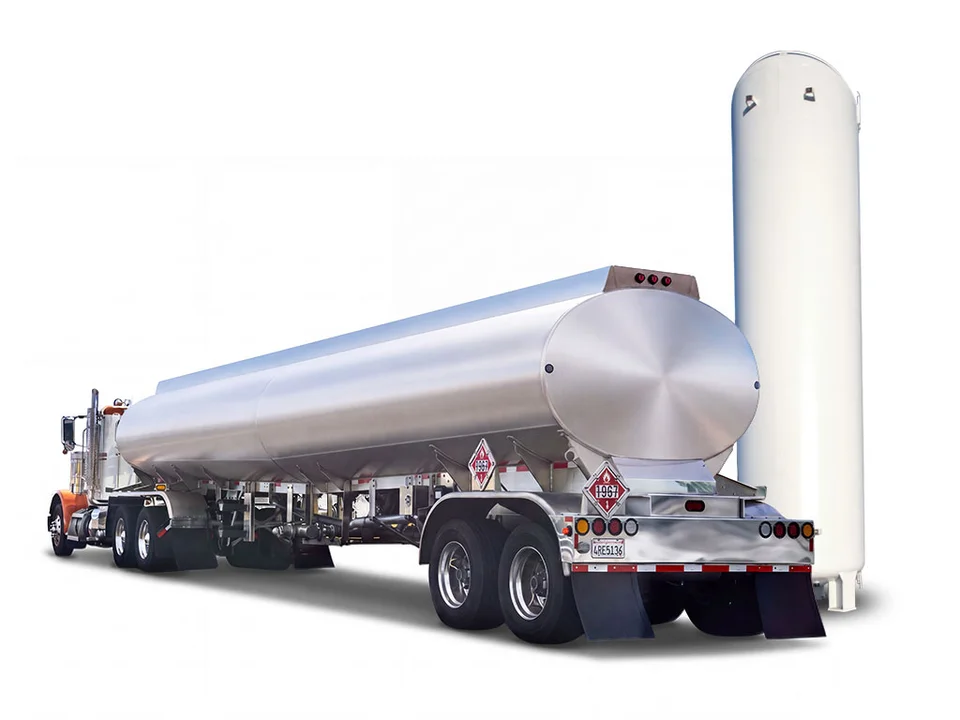
Step 01
LiquidCO₂ Supply
Liquid CO₂ Supply and Storage Tank
Dry ice starts as liquid CO₂. You need a reliable supply in your region, an onsite reservoir sized to your daily production, and insulated pipe work running from the tank to the production system. If you do not have a liquid CO₂ supply in place, Cold Jet can perform a site visit to determine what you would need, what the investment looks like, and what the payback would be, then arrange installation and leasing through trusted affiliates.
- 01. Liquid CO₂ Supply and Storage Tank — Dry ice starts as liquid CO₂. You need a reliable supply in your region, an onsite reservoir sized to your daily production, and insulated pipe work running from the tank to the production system. If you do not have a liquid CO₂ supply in place, Cold Jet can perform a site visit to determine what you would need, what the investment looks like, and what the payback would be, then arrange installation and leasing through trusted affiliates.
- 02. Dry Ice Production System — The production system is the core of the setup. Cold Jet pelletizers press CO₂ snow into pellets from 3 to 16 mm, reformers compress pellets into high-density slices, and direct slice systems like the DS1000E go straight from liquid CO₂ to slices in one machine. Sub-cooling technology in Cold Jet pelletizers delivers 12–14% better LCO₂-to-dry ice conversion efficiency than the market standard.
- 03. Power, Compressed Air, and Foundation — Production systems require a three-phase electric power source, a compressed air line, and a reinforced concrete foundation for stability. The machine should sit indoors, protected from moisture and the elements, with room around it for production and material handling.
- 04. Ventilation, Monitoring, and PPE — CO₂ displaces oxygen, so any dry ice production or storage area needs artificial ventilation to maintain airflow and a CO₂ PPM monitor to alarm on buildup. Operators handling liquid or solid CO₂ need insulated gloves and eye protection. These are the same controls a flight kitchen already applies to bulk dry ice storage.
- 05. Insulated Dry Ice Storage — Dry ice sublimates continuously, so it should be held in insulated containers sized to your production run rather than stockpiled. One advantage of onsite production is that storage requirements drop, because you are holding hours of supply instead of days.
- 06. Installation, Training, and Remote Support — Cold Jet handles installation and operator training, and every system is built for one-button operation so it can be run across shifts without specialist staff. Cold Jet CONNECT® lets technicians remotely monitor the machine, diagnose issues, and implement corrective action from any location.
Equipment
What Is the Best Dry Ice Production Machine
for Airline Catering?
Cold Jet offers the widest selection of dry ice production machines on the market, from compact pelletizers to fully automated slice production and dosing systems. The right system depends on your daily volume, the format your trolleys use, and whether you want to dose slices directly into a packing line.
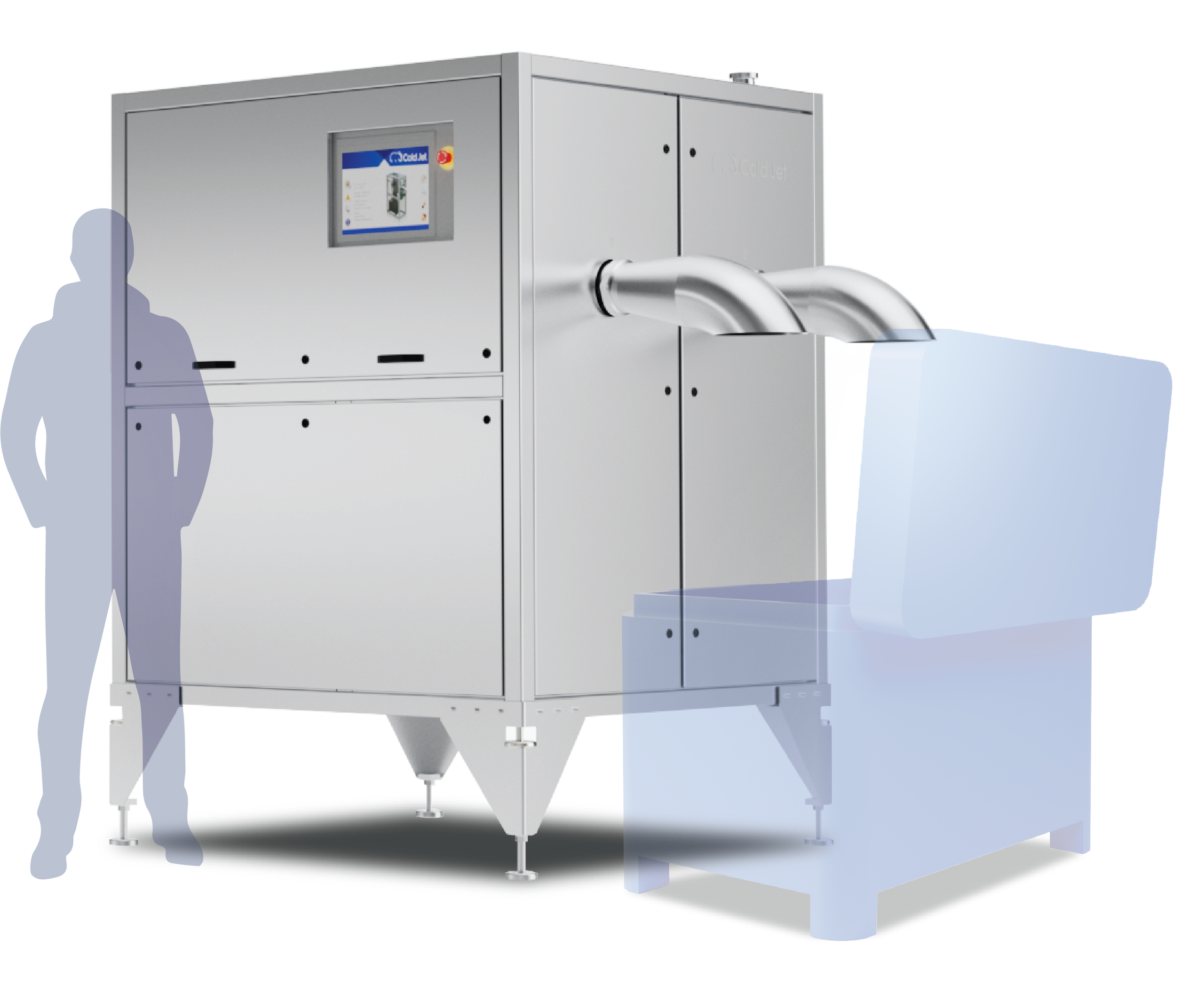
PR750H Dry Ice Pelletizer
The high-volume pelletizer for hub flight kitchens serving full daily flight schedules. The PR750H produces up to 1,653 lbs of pellets per hour, and the complete version makes two pellet sizes at once. Start-up takes under 3 minutes, so production can keep pace with schedule changes.
- Up to 1,653 lbs/hr (750 kg/hr)
- Two pellet sizes at once
- Start-up in under 3 minutes
- Cold Jet CONNECT® remote monitoring
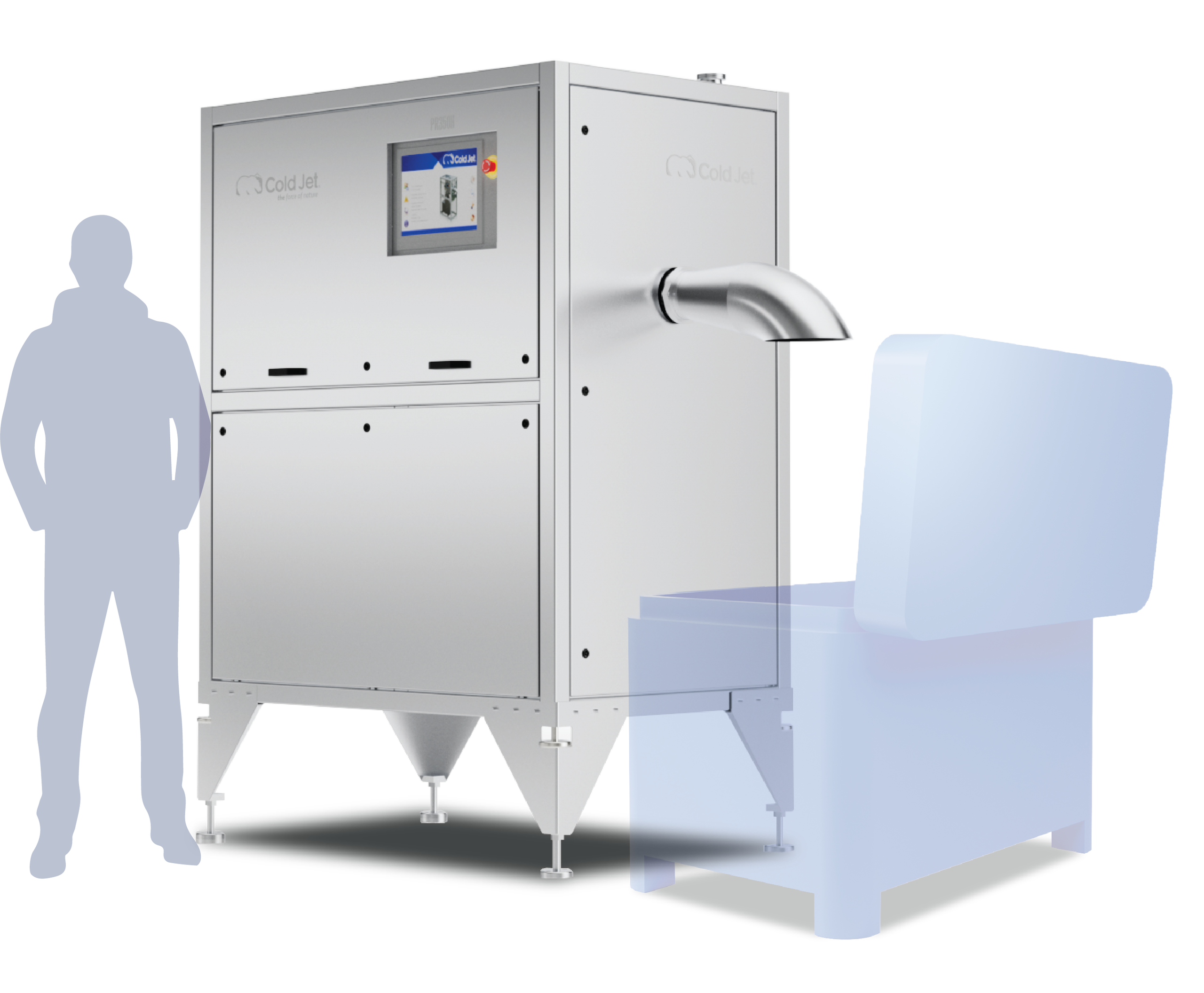
PR350H Dry Ice Pelletizer
A mid-volume pelletizer for flight kitchens taking control of their dry ice supply. The PR350H produces high-quality pellets on demand from the first stroke, and automatic quick die change switches pellet sizes in seconds when your format needs change.
- Up to 772 lbs/hr (350 kg/hr)
- 3, 6, 10, or 16 mm pellets
- Automatic quick die change
- Start-up in under 3 minutes
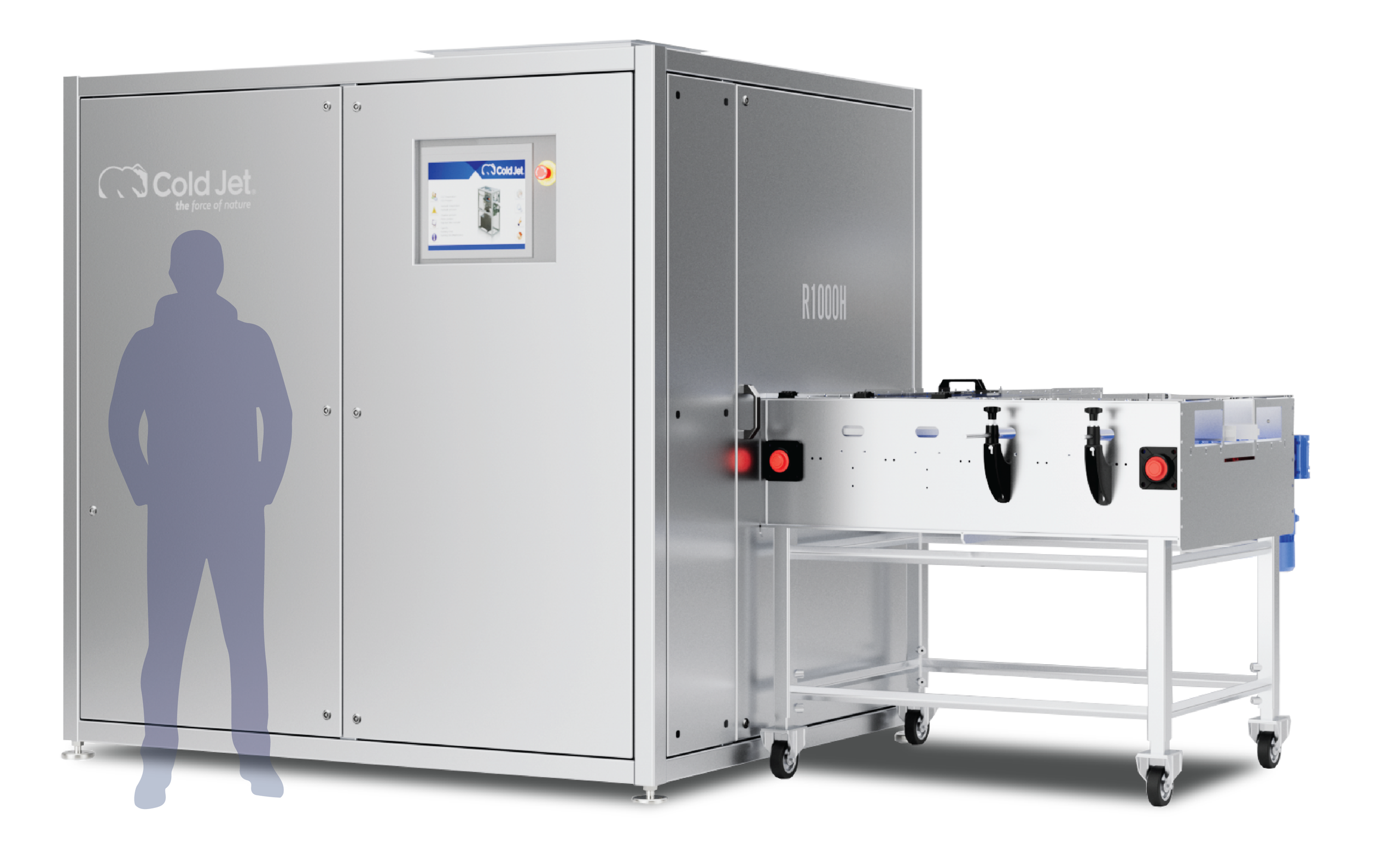
R1000H Reformer
The R1000H converts dry ice pellets into uniform slices, the classic format for airline trolley cassettes and drawers. It accepts the full 3–16 mm pellet range from either pelletizer, and adjustable slice sizes and thicknesses let you match the format your catering carts use.
- Up to 2,204 lbs/hr (1,000 kg/hr), depending on slice format and pellet supply
- Slices from 0.55 to 6.6 lbs
- Format change in under 15 minutes
- Less than 1% slice breakage
Compare Machines
How Do These Three Systems Compare?
Side-by-side specs for the Cold Jet production systems best suited to airline catering, so you can match the right machine to your daily volume, your trolley format, and your available floor space.
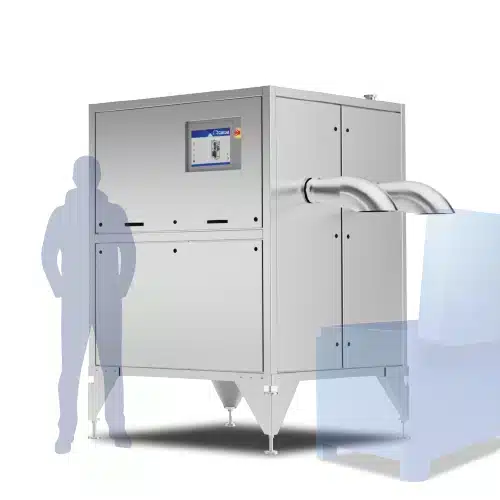
PR750H
High-volume pellets for hub kitchens
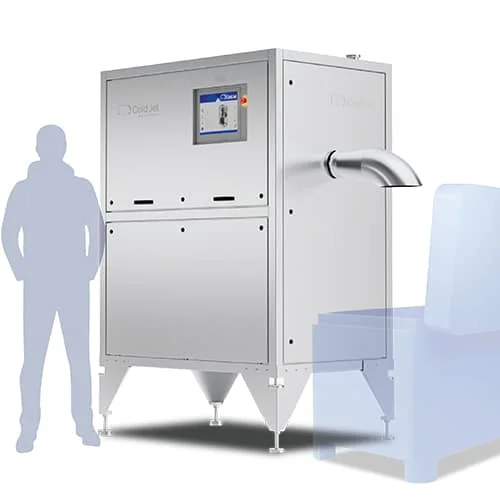
PR350H
Mid-volume pellets on demand
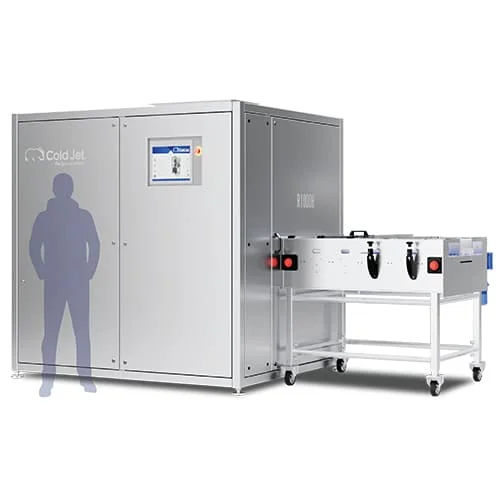
R1000H
Pellet-to-slice reforming for trolleys
| Specification | PR750H | PR350H | R1000H |
|---|---|---|---|
| Machine Controls | |||
| LCO₂ Conversion Technology | Sub-cooling; 12–14% better than market standard | Sub-cooling; 12–14% better than market standard | —(reforms existing pellets) |
| Control System | Industrial PC with 15" touchscreen | Industrial PC with 15" touchscreen | Beckhoff Industrial PC with 15" touchscreen + recipes |
| Line Integration Ready (Yes/No) | Yes(BUS/Ethernet) | Yes(BUS/Ethernet) | Yes(exit conveyor) |
| IoT Enabled via Cold Jet CONNECT® (Yes/No) | Yes | Yes | Yes |
| Start-Up Time | Less than 3 minutes | Less than 3 minutes | Not published |
| Output | |||
| Input | Liquid CO₂ | Liquid CO₂ | Dry ice pellets, 3–16 mm |
| Dry Ice Format Produced | 3, 6, 10, or 16 mm pellets; two sizes at once(complete version) | 3, 6, 10, or 16 mm pellets | High-density slices and mini blocks |
| Maximum Output | 1,653 lbs/hr(750 kg/hr) | 772 lbs/hr(350 kg/hr) | 2,204 lbs/hr (1,000 kg/hr), depending on slice format and pellet supply |
| Slice Thickness Range | Not published | Not published | 5/8 to 3½ in |
| Slice Weight Range | Not published | Not published | 0.55 to 6.6 lbs |
| Format Change | Automatic quick die change, in seconds | Automatic quick die change, in seconds | Quick Change Press Head in under 15 min |
| Installation | |||
| Footprint (L x W x H) | 59 x 59 x 71 in | 59 x 39 x 71 in | 77 x 59 x 80 in |
| Weight | 4,017 lbs(1,822 kg) | 3,340 lbs(1,515 kg) | 5,610 lbs |
“—” indicates a spec Cold Jet has not published for this model, or one that does not apply. Contact a Cold Jet specialist to confirm fit for your flight kitchen.
Why Cold Jet
Why Invest in a Cold Jet Dry Ice Production System
for Airline Catering
If you are moving from purchased dry ice to onsite production, the machine is only part of the decision. What matters over the life of the system is how much liquid CO₂ it takes to make a pound of dry ice, how many formats one system can produce, and how much attention it needs from your team across shifts.
When evaluating this capital investment, consider both the return on investment and the operational benefits specific to a flight kitchen. Cold Jet systems deliver faster ROI and greater value through:
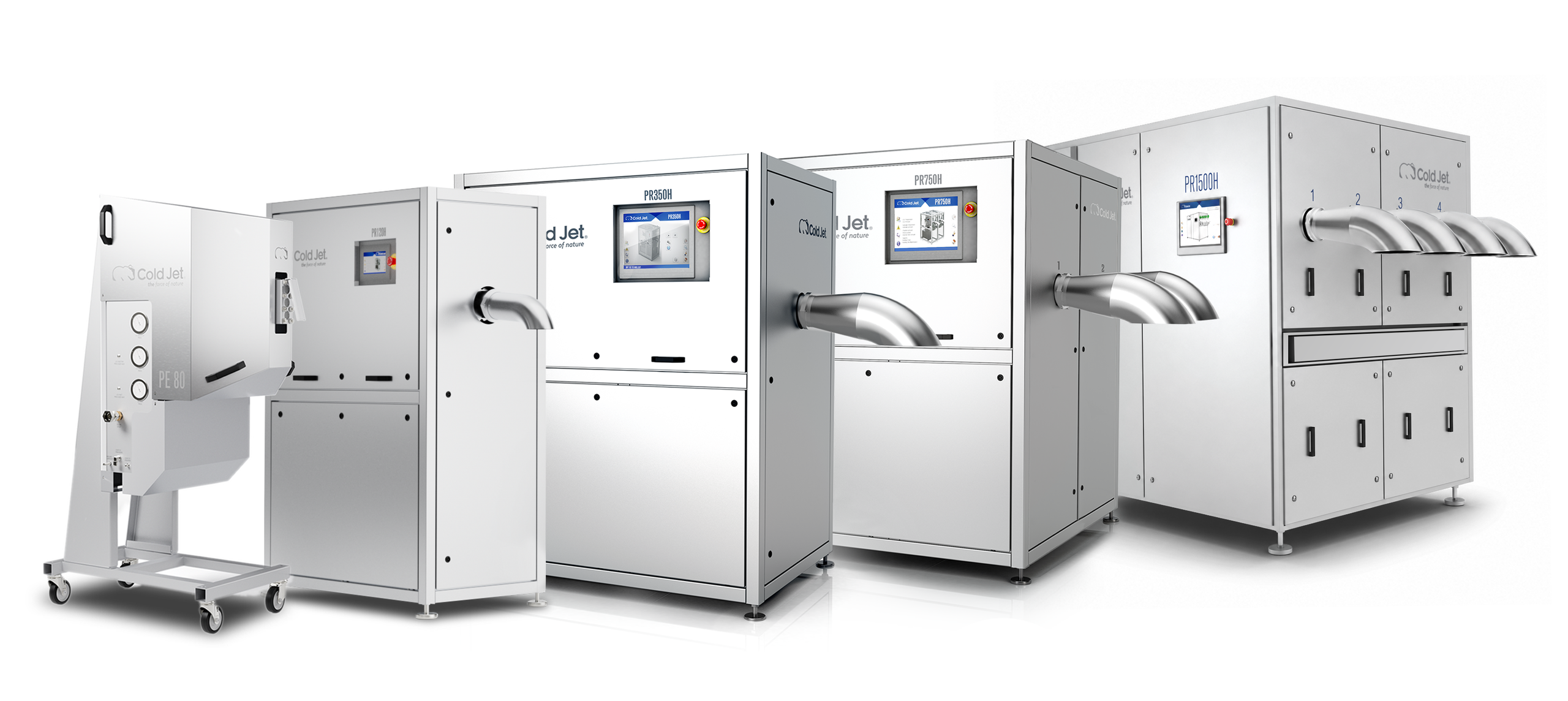
Complete Control of Your Supply
Produce the dry ice you need, in the format your trolleys use, on the schedule your flights actually run. No delivery windows, no minimum orders, and no surplus sublimating in a storage container.
12–14% Better LCO₂ Conversion
Cold Jet’s proprietary sub-cooling technology uses waste gas to pre-cool incoming liquid CO₂, converting it to dry ice 12–14% more efficiently than other systems. Every delivery of liquid CO₂ makes more dry ice for your trolleys, lowering the cost of every catering cycle.
Every Format From One Supplier
Pelletizers change extruder die plates at the push of a button to switch between 3 mm pellets and 10 to 16 mm nuggets. Reformers and direct slice systems press high-density slices sized and weighed to your specification.
Built for Continuous Operation
Cold Jet systems are designed for non-stop production in demanding environments, with fully automated one-button operation, start-up in under five minutes, and moisture-free stainless steel enclosures that keep noise below 75 dB(A).
Cold Jet CONNECT®
Remotely monitor your production system, diagnose issues, and implement corrective action from any location. Problems get addressed before they become a shortage on the loading dock.
Global Install Base and Support
With more than 24,000 machines installed worldwide, regional technicians, and expert consultancy on production operations, Cold Jet supports flight kitchens wherever they operate.
Our Customers & What They Say About Us
Airline caterers around the world rely on Cold Jet
Flight kitchens, inflight caterers, and global catering groups use Cold Jet dry ice production systems to take control of their own cooling supply.
See What Dry Ice Producers Are Saying About Cold Jet Equipment
Our customers control their own dry ice supply with Cold Jet production systems

The Cold Jet dry ice production equipment produces the purest dry ice available.

We are very satisfied from the first contact up to date. The employees at Cold Jet were very professional and helpful. We are finally able to respond to requests for flexibility from our customers and produce according to their dry ice needs. In addition, we are also excited about the quality of the dry ice.
Compliance
Regulatory Standards
We Help You Meet
Onsite production gives you documented control over the dry ice in your food safety and dangerous goods programs.
IATA DGR
Dangerous Goods Regulations
Dry ice is classified as a dangerous good (UN 1845) because it sublimates into CO₂ gas that displaces oxygen. IATA sets the packaging, marking, documentation, and quantity requirements for carrying it aboard an aircraft.
How We Comply
Onsite production gives you exact control over the quantity of dry ice loaded per trolley and per aircraft, which is the figure operators must track and declare. Programmable slice weights and automated dosing make those quantities repeatable and documentable.
ICAO TI
Technical Instructions for the Safe Transport of Dangerous Goods by Air
The ICAO Technical Instructions are the international basis for dangerous goods carriage by air and are adopted by national authorities including the U.S. Department of Transportation and EASA. They govern how much dry ice may be carried and how ventilation must be managed.
How We Comply
Producing dry ice to a known, consistent weight per slice or per dose lets caterers give operators an accurate loaded quantity for every cart, rather than estimating from bags or hand-cut blocks of variable weight.
EPA, FDA, and USDA
Food Contact and Food Safety
Cooling media used around food must be safe for food contact and handled so that they introduce no contaminants into the product or the packaging.
How We Comply
Dry ice is approved by the EPA, FDA, and USDA for use around food. It is non-toxic, tasteless, and odorless, and it sublimates directly to gas, leaving no water and no residue. Producing onsite means you control the liquid CO₂ source and the handling chain from tank to trolley.
HACCP
Hazard Analysis and Critical Control Points
Flight kitchens operate HACCP plans that identify temperature control as a critical control point and require documented, monitored, repeatable procedures at each one.
How We Comply
Onsite production turns dry ice loading into a controlled, measurable step. Slice weight, dose frequency, and production volume are set on the machine and saved as recipes, which produces the consistency and the records a HACCP plan depends on.
OSHA and NIOSH
Oxygen Displacement Hazards
Because CO₂ displaces oxygen, occupational exposure limits apply anywhere dry ice is produced, stored, or handled in volume, including cold rooms, loading areas, and production spaces.
How We Comply
Cold Jet specifies artificial ventilation and a CO₂ PPM monitor as part of the standard site requirements for every installation, and provides installation guidance and operator training covering safe handling of liquid and solid CO₂.