Overview
Summary
Producing dry ice onsite gives blasting operations fresh, high-density 3 mm pellets on demand. Cold Jet pelletizers deliver 12–14% better LCO₂-to-dry ice conversion efficiency than the market standard and produce from 176 to 3,306 lbs per hour. The result is a lower cost per pound, no sublimation loss in transit, less loss in storage, and denser ice that cleans faster at the nozzle.
What is onsite dry ice production for blasting?
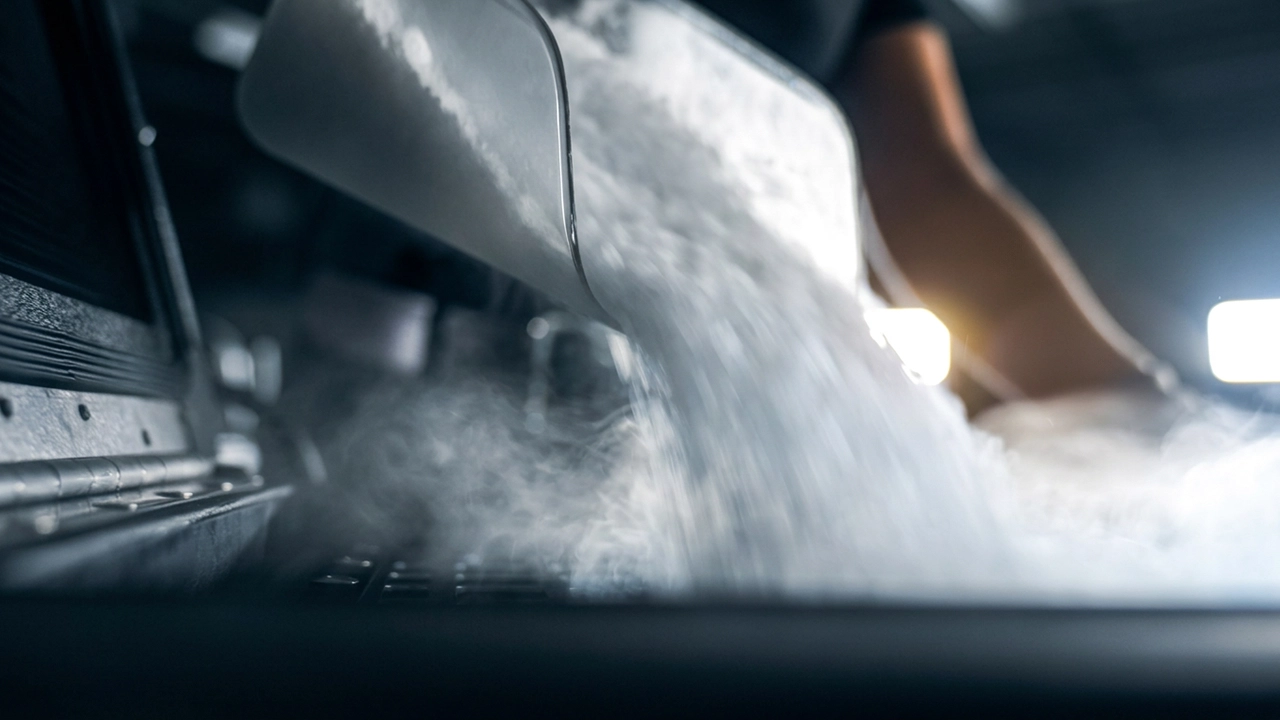
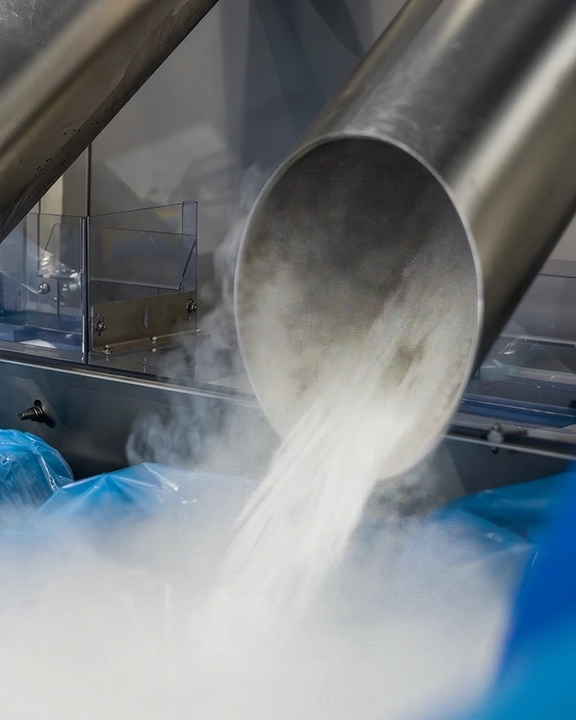
Onsite dry ice production allows facilities to make their own blasting media rather than buying from a supplier. Liquid CO₂ delivered to an onsite tank is piped into a pelletizer, which depressurizes the liquid into gas and CO₂ snow before extruding standard 3 mm solid pellets.
Facilities do this because dry ice sublimates continuously upon creation, causing purchased ice to lose mass and density during transit and storage. Pellets produced an hour before use are denser and deliver more energy to the surface being cleaned.
Onsite production also removes delivery fees, minimum order quantities, and the risk of missed shipments delaying cleaning cycles. Cold Jet pelletizers feature one-button operation, start up in under five minutes, and range from 176 lb per hour for a single blaster up to 3,306 lb per hour for continuous multi-machine operations.
Challenge
Why blasting operations bring dry ice production in house
Facilities that consume large volumes of dry ice in their cleaning process deal with waste, high delivery costs, limited supply flexibility, and lower quality ice. Every one of those problems traces back to the same root cause, which is the gap between when the ice is made and when it is used. Producing dry ice onsite closes that gap. Operators make the volume they need when they need it, which eliminates waste from over ordering and shortfalls from under ordering, and puts consistently high quality media in the hopper on every shift.
12–14%
Better LCO₂ Conversion vs. Market Standard
176 – 3,306 lb/h
Production Range
80 - 1500 kg/hr
3 mm Pellets
Blasting Media
Under 5 Min
Start-Up Time
Benefits
What Are the Benefits of Producing Your Own Dry Ice for Blasting?
Fresh, high density dry ice cleans faster and costs less than delivered ice
Facilities that buy their blasting media pay twice. They pay the invoice price for every pound ordered, and they pay again in sublimation loss, delivery fees, minimum order quantities, and the production hours lost when a shipment is late or short. Ice that sits in a storage container for three days is softer and less dense than ice made an hour ago, and softer ice cleans more slowly.
Producing dry ice onsite removes the middle step. Operators make the exact volume they need, at the moment they need it, at the density their application calls for. Blast times drop because the pellets hit harder. Consumption drops because less ice is wasted in storage. And the cost per pound is set by your liquid CO₂ contract rather than by a delivery schedule you do not control.
 Quality
Fresher, Higher Density Dry Ice
Dry ice begins sublimating the moment it is produced, so purchased ice arrives softer and less dense than it started. Ice made onsite goes into the blaster within hours instead of days. Denser pellets carry more kinetic energy to the surface, which means faster cleaning and less media consumed per job.
 Cost
Lower Cost Per Pound
Onsite production replaces a delivered price per pound with the cost of your liquid CO₂ contract plus power. Delivery fees, fuel surcharges, and minimum order quantities come off the invoice entirely. Cold Jet’s sub-cooling technology delivers 12–14% better LCO₂-to-dry ice conversion efficiency than the market standard, so less LCO₂ is consumed for every pound of blasting media produced.
 Efficiency
Eliminate Sublimation Waste
Ordering ahead means either ordering too much and watching the surplus sublimate away, or ordering too little and stopping work. Producing to demand removes both. You make what the schedule calls for, and nothing sits in a storage container losing mass while it waits.
 Reliability
Control Your Own Supply
A late truck, a holiday schedule, or a regional shortage should not decide when your line gets cleaned. With a pelletizer on site, blasting schedules are set by production needs rather than by a delivery window. Facilities in remote locations or regions with limited dry ice distribution gain the most.
 Environmental
Recycled CO₂, Fewer Delivery Miles
Dry ice is made from recycled CO₂ captured as a byproduct at industrial and biogas facilities, so it adds no new emissions. Producing onsite removes the repeat delivery trips that supplying a high volume blasting operation would otherwise require. Adding a Cold Jet RE-CO2 recovery system captures revert gas during production and recycles it into more pellets.
Applications
Who Should Produce Their Own Dry Ice for Blasting?
Onsite production pays off fastest for operations that blast often, blast on a schedule they set themselves, or blast somewhere a delivery truck cannot easily reach.
Validated For
- 3 mm Blasting Pellets
- 12–14% Better LCO₂ Conversion
- 176 to 3,306 lb/h Capacity
- One Button Operation
- Cold Jet CONNECT® Enabled
Supply Your Own Blasting Operation With Fresh Dry Ice Made Hours Before You Use It
Plants that blast on every shift are the clearest case for onsite production. High, predictable dry ice consumption is exactly what a pelletizer is built to serve, and it is exactly what makes delivered ice expensive.
Produce to the blasting schedule
Match production to what the cleaning schedule actually calls for, shift by shift. There is no ordering ahead, no guessing at next week’s volume, and no surplus sitting in a container sublimating away. Cold Jet pelletizers run on one button operation and reach full production in under five minutes, so an operator can make ice between cleaning cycles.
Clean faster with denser pellets
Cold Jet’s patented Sub Cooling technology produces high density dry ice that holds its shape in storage and hits harder at the nozzle. Denser media does more work per pound, which shortens blast times and lowers total dry ice consumption across the operation.
Take delivery costs off the invoice
Onsite production replaces a delivered price per pound with the cost of bulk liquid CO₂ plus power. Delivery fees, fuel surcharges, minimum order quantities, and rush charges all come off the books. For high volume users, that difference is usually where the payback on the machine comes from.
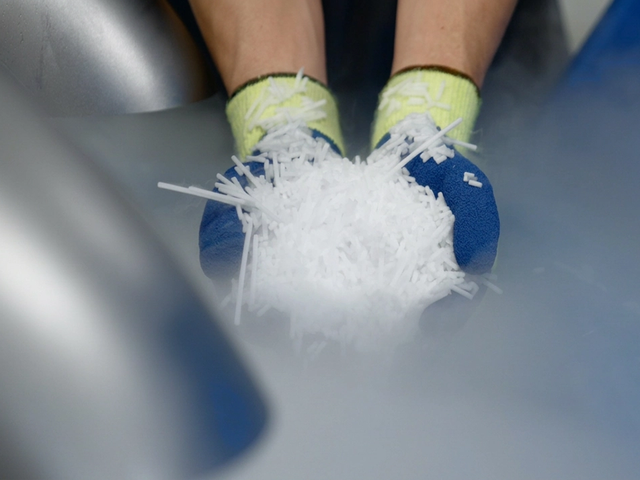
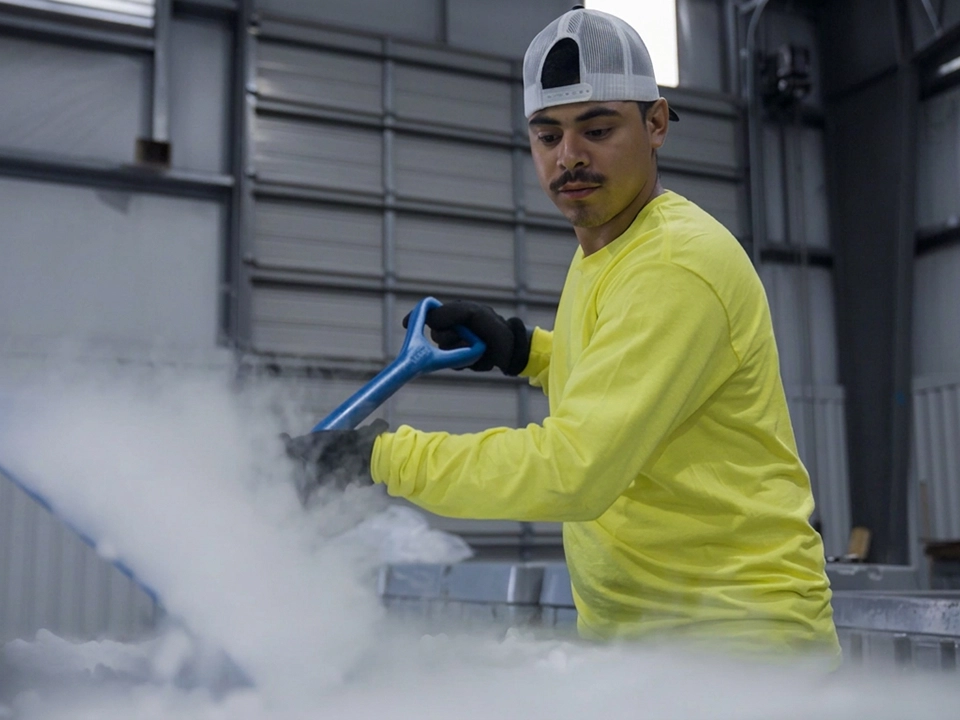
Industries That Blast Daily
- Food & Beverage
- Automotive Manufacturing
- Foundry
- Packaging
- Printing
- Oil & Gas
- Tire Molders
- Rubber Molders
- General Facility Maintenance
- Aerospace & Aviation
Keep Contract Cleaning Fleets and Remote Sites Supplied Without Waiting on a Delivery
Blasting work is not always done next to a loading dock. Contract cleaners, multi site operators, and facilities outside the distribution network all deal with the same constraint, which is that the supplier’s schedule is not their schedule.
Load fresh ice before every job
Contract cleaners running early mornings, nights, and weekends often work outside supplier hours entirely. Producing in house means crews fill their hoppers on the way out rather than planning routes around a distributor, and the ice they carry is hours old instead of days old.
Serve sites the delivery network does not reach
Remote plants, island facilities, and sites far from a distributor pay steeply for long haul freight and still receive ice that has lost significant mass in transit. Local production removes the freight bill and the transit loss at the same time.
Monitor production from anywhere
Cold Jet CONNECT® lets operations teams monitor a pelletizer, diagnose issues, and implement corrective action remotely. For multi site organizations, that means one team can keep production running across several locations without traveling to each machine.
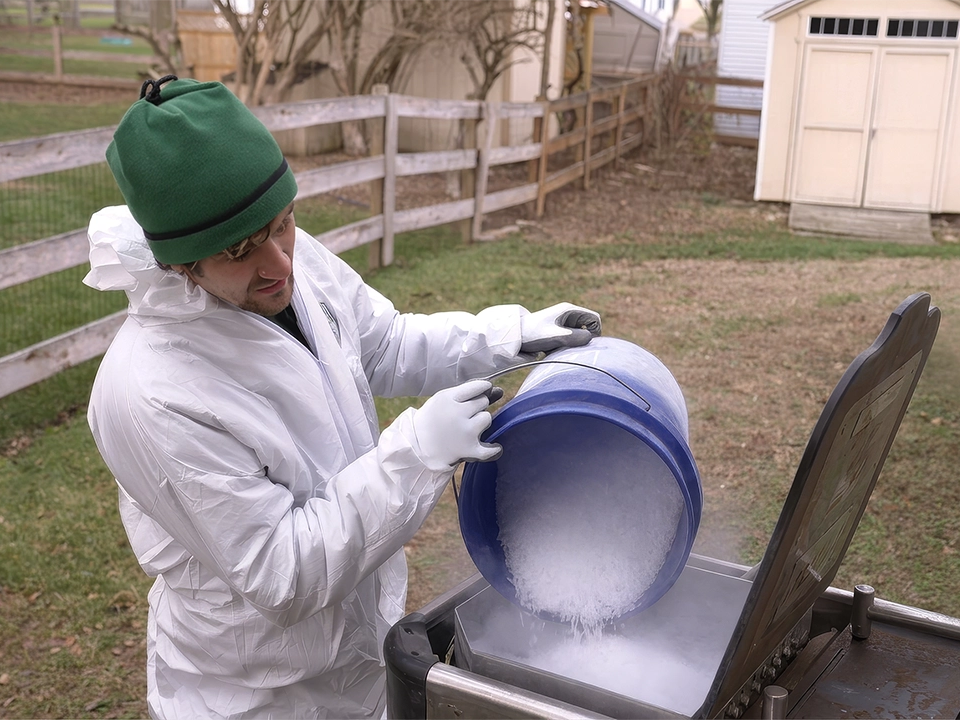
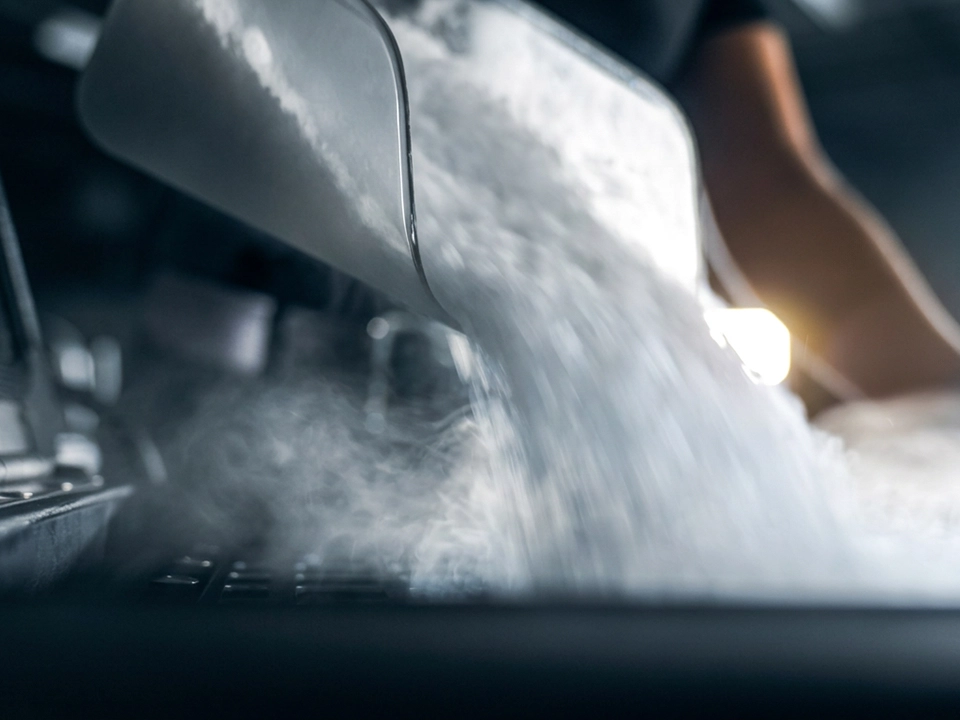
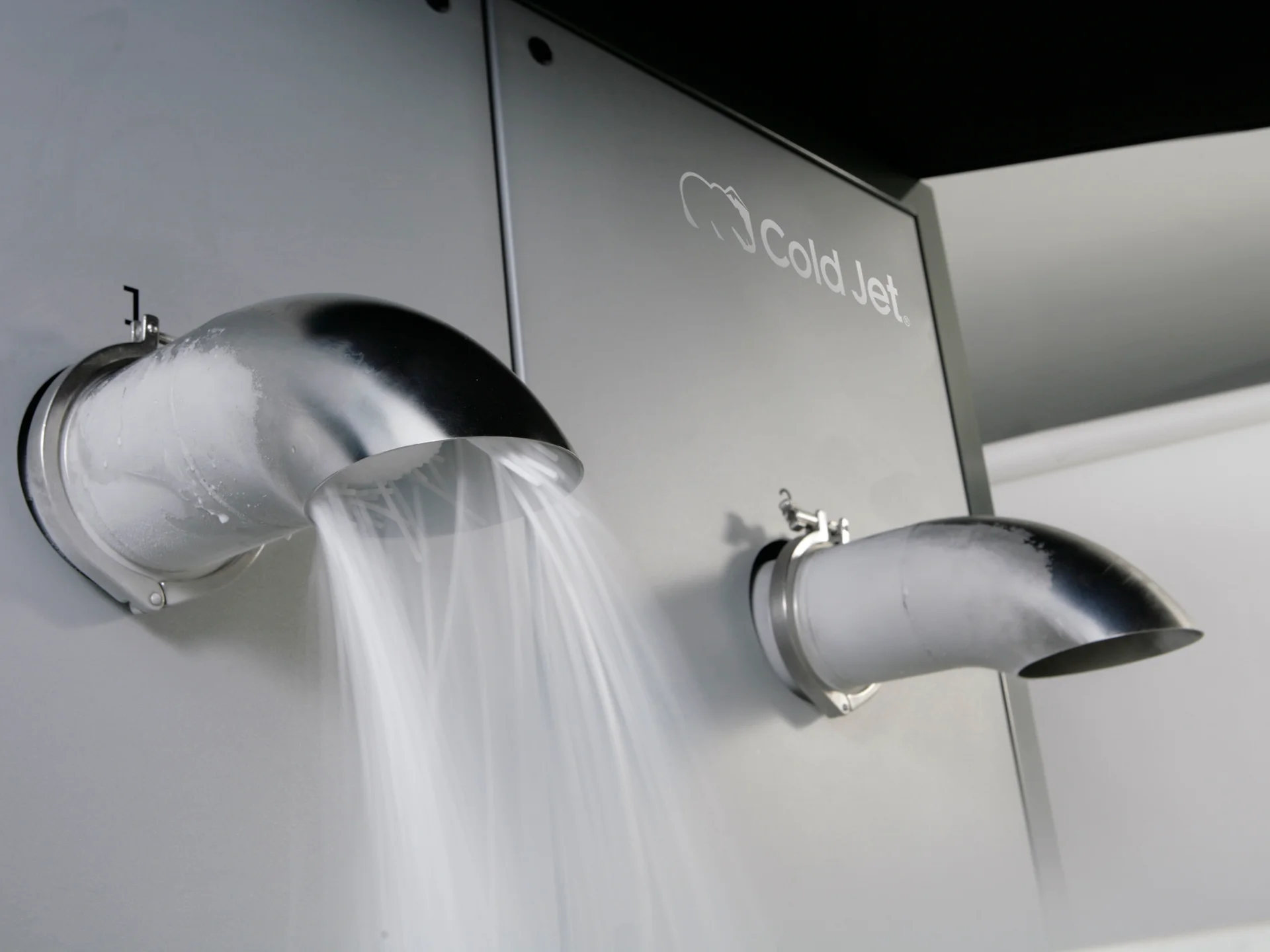
Cold Jet pelletizers are configured with interchangeable extruder plates, so a single machine can produce blasting media and other dry ice formats as your needs change. Available sizes include:
Dry Ice Formats Produced
- 3 mm Pellets (Standard Blasting Media)
- 1.7 mm Pellets
- 2.2 mm Pellets
- 6 mm Pellets
- 8 mm Nuggets
- 10 mm Nuggets
- 16 mm Nuggets
- Custom Die Sizes on Request
Industries
Who Relies on Dry Ice for Blasting?
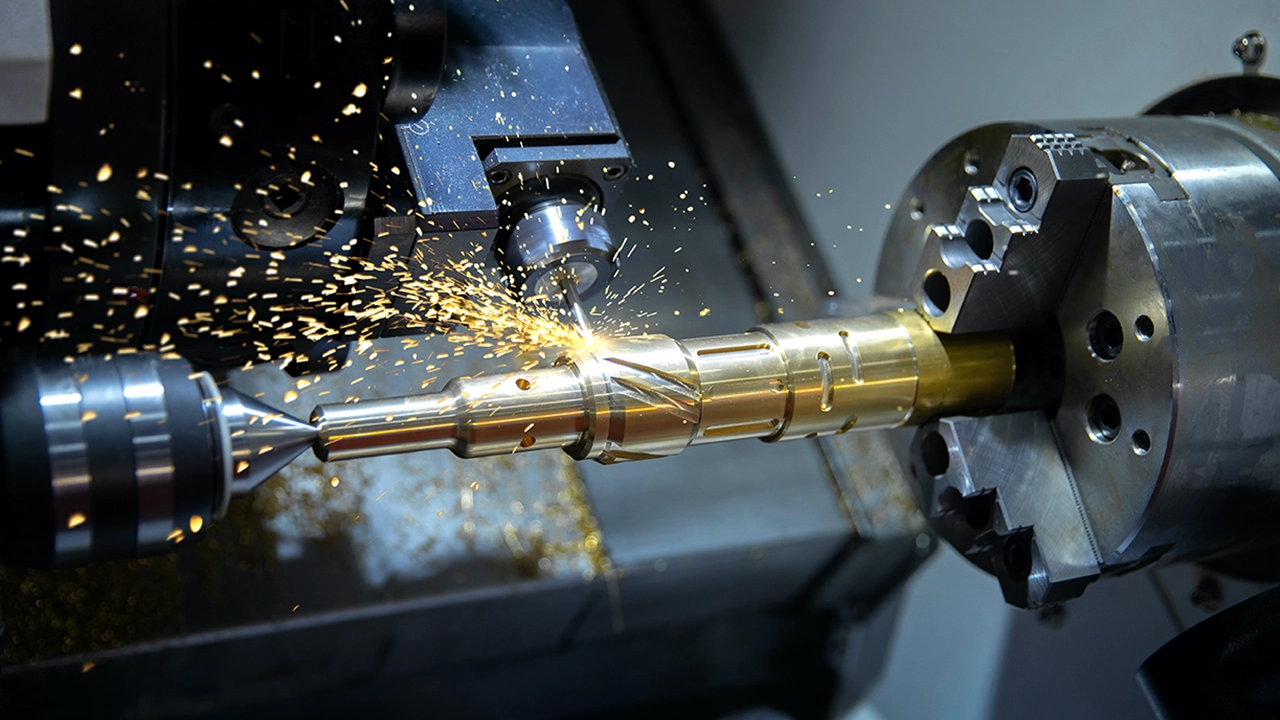
Contract cleaners and manufacturing facilities use dry ice blasting to clean equipment quickly, without water, chemicals, or secondary waste. See how Cold Jet production systems help both produce the fresh 3 mm pellets they need onsite, on their own schedule.
Comparison
How Onsite Production
Compares to Buying Dry Ice
See how making your own blasting media compares to the ways most facilities source dry ice today.
| Criteria | Onsite Production Best | Scheduled Bulk Delivery | Spot or Emergency Purchase | Long-Haul Freight | Outsourced Blasting Service |
|---|---|---|---|---|---|
| Ice Age at Point of Use | Hours old, produced to demand | Days old by end of cycle | Variable, often already stored | Days old plus transit time | Controlled by the contractor |
| Sublimation Loss | Minimal, short storage window | Significant between deliveries | Moderate to significant | Highest, loss across long transit | Not visible to you |
| Supply Reliability | You control the schedule | Depends on carrier and route | Subject to local availability | Exposed to weather and delays | Subject to contractor availability |
| Cost Structure | Bulk LCO₂ plus power, after capital | Per pound plus delivery and minimums | Highest per pound, rush pricing | Per pound plus long-haul freight | Priced per job or per visit |
| Volume Flexibility | Make exactly what the shift needs | Locked to order quantity | Limited to what is in stock | Large minimums to justify freight | Scoped to the contract |
| Blasting Performance | Highest, dense fresh pellets | Declines through the delivery cycle | Inconsistent between purchases | Softer ice, slower cleaning | Outside your control |
What You Need
What Do You Need to Produce Dry Ice Onsite?
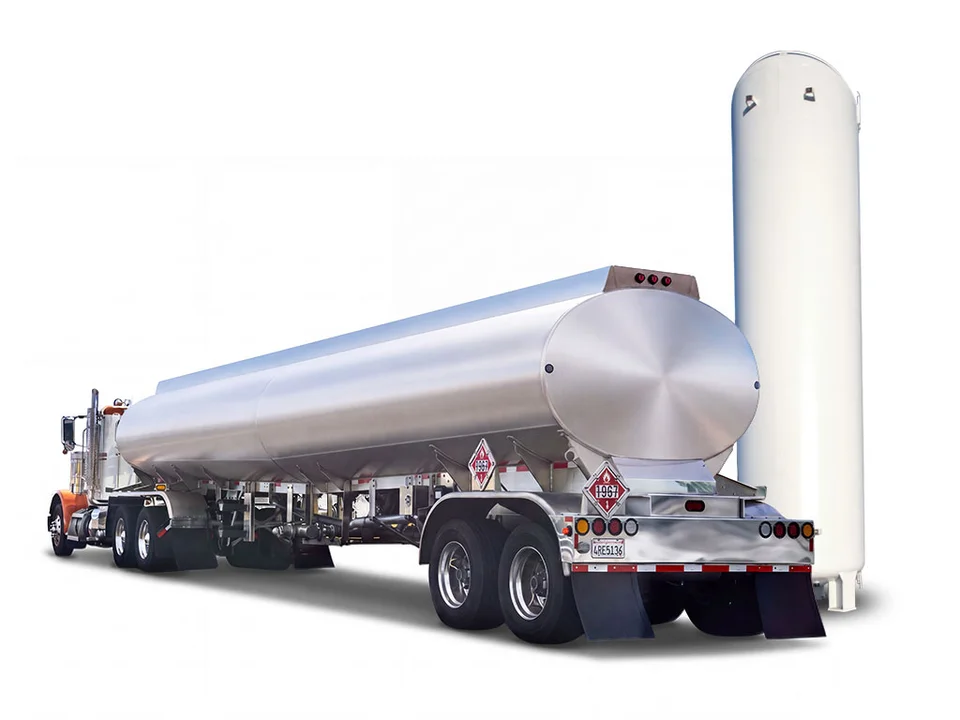
A dry ice production operation is more than the pelletizer. Before the first pellet is made, the following infrastructure needs to be in place:
Step 01
12-14%BETTER LCO₂ CONVERSION
Liquid CO₂ Supply
Dry ice is made from liquid CO₂, so the first requirement is a reliable supply in your region. Most LCO₂ is recovered carbon dioxide, captured as a byproduct at industrial and biogas facilities. Conversion efficiency is the number that matters most to your operating cost, and Cold Jet’s sub-cooling technology delivers 12–14% better LCO₂-to-dry ice conversion than the market standard. If you don’t have an LCO₂ supply in place, Cold Jet can perform a site visit to scope what you would need and what the payback looks like.
- 01. Liquid CO₂ Supply — Dry ice is made from liquid CO₂, so the first requirement is a reliable supply in your region. Most LCO₂ is recovered carbon dioxide, captured as a byproduct at industrial and biogas facilities. Conversion efficiency is the number that matters most to your operating cost, and Cold Jet’s sub-cooling technology delivers 12–14% better LCO₂-to-dry ice conversion than the market standard. If you don’t have an LCO₂ supply in place, Cold Jet can perform a site visit to scope what you would need and what the payback looks like.
- 02. Onsite LCO₂ Storage — An exterior liquid CO₂ reservoir feeds the pelletizer through insulated pipe work. Larger operations use a fixed bulk tank, while lower volume users can run from transportable dewar tanks or micro bulk tanks. Cold Jet can arrange installation and leasing of the tank through trusted affiliates if you do not already have one.
- 03. Site, Foundation, and Utilities — The machine needs a reinforced concrete foundation for stability, three phase electric power, a compressed air line, and enough clear floor space for both the pelletizer and dry ice storage. It should be sited indoors, protected from moisture and the elements. Compressed air should meet ISO 8573-1 Class 3 as a minimum.
- 04. Cold Jet Dry Ice Pelletizer — The pelletizer itself, sized to your consumption. Cold Jet’s low volume PE 80 produces up to 80 kg per hour for facilities taking control of their own supply for the first time, while the PR line scales from 120 kg per hour to 1,500 kg per hour for continuous, multi machine operations. All models run on one button operation and reach production in under five minutes.
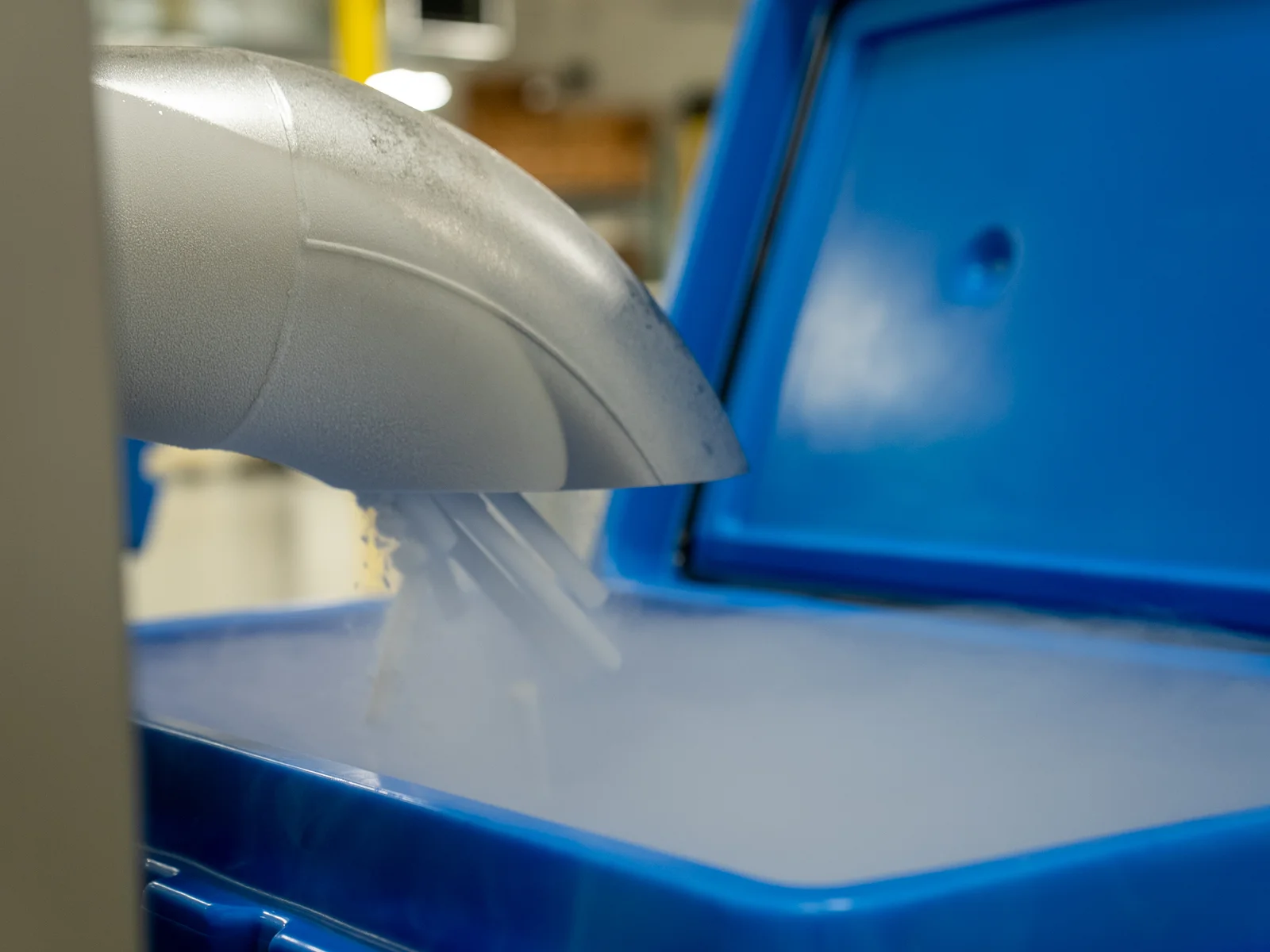
- 05. Dry Ice Storage — Insulated containers hold produced ice between the pelletizer and the blaster and keep sublimation to a minimum. Because you are producing to demand rather than to a delivery schedule, storage requirements are far smaller than for a facility receiving bulk shipments.
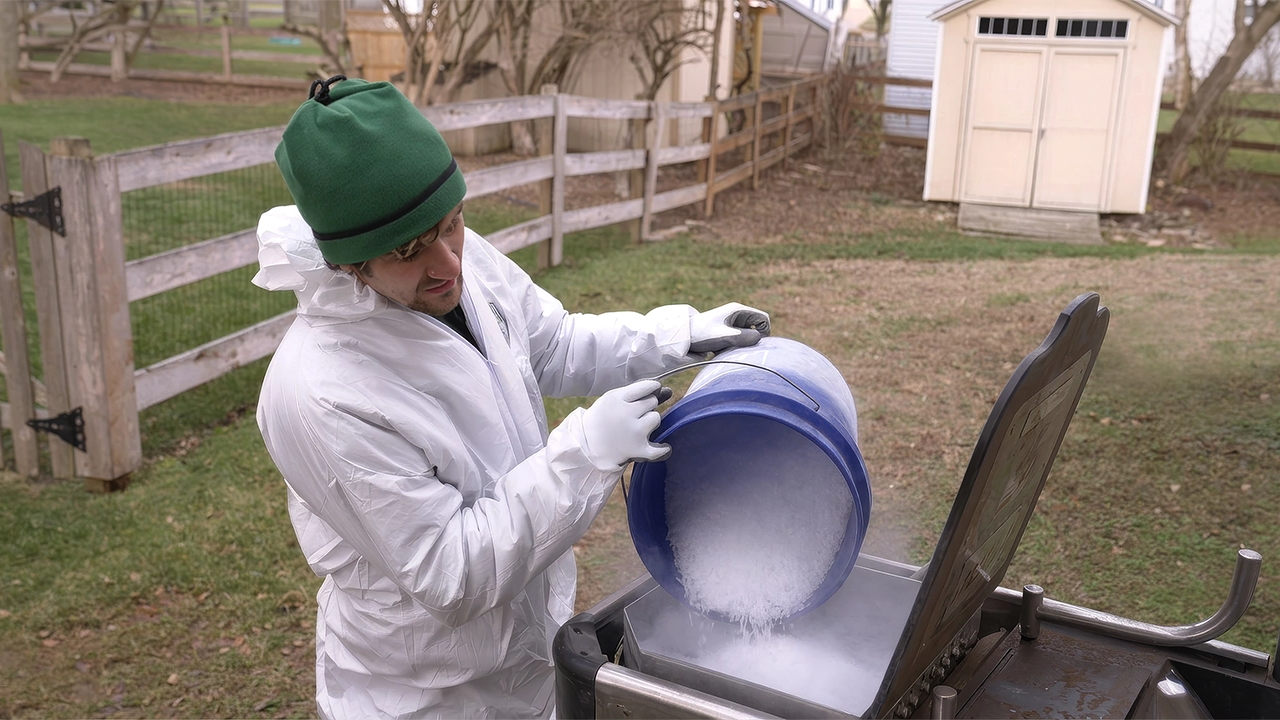
- 06. Ventilation, Monitoring, and PPE — CO₂ is heavier than air and displaces oxygen in enclosed spaces, so the production area requires artificial ventilation to maintain airflow and a CO₂ PPM monitor. Operators handling liquid or solid CO₂ need insulated gloves and eye protection. Cold Jet provides operator training covering safe handling, start up, and routine maintenance.
Equipment
What Is the Best Dry Ice Pelletizer
for Dry Ice Blasting?
Cold Jet builds pelletizers for every scale of blasting operation, from a single blaster running a few shifts a week to large, multi-machine operations. Every model produces the 3 mm pellets that dry ice blasting calls for.
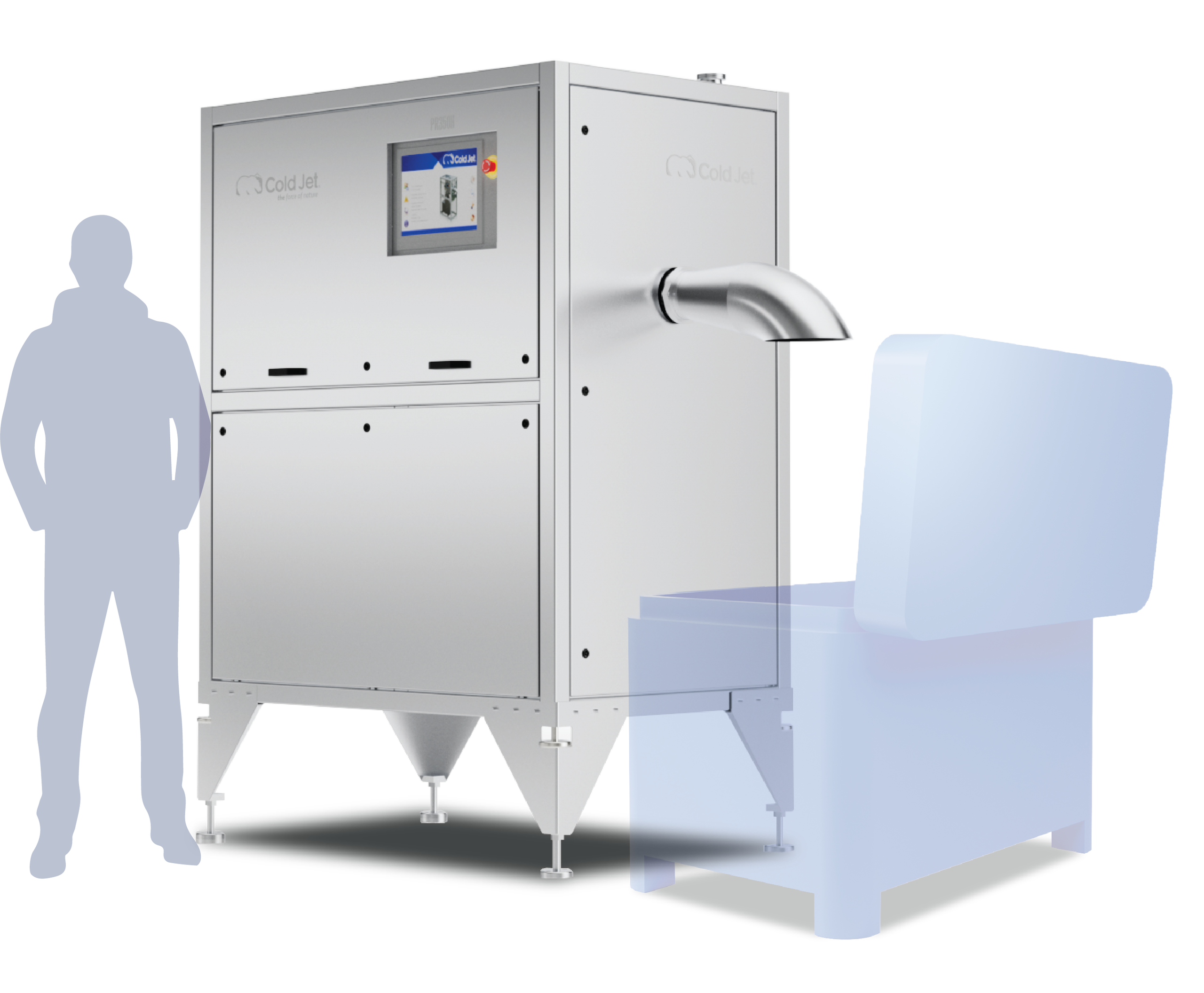
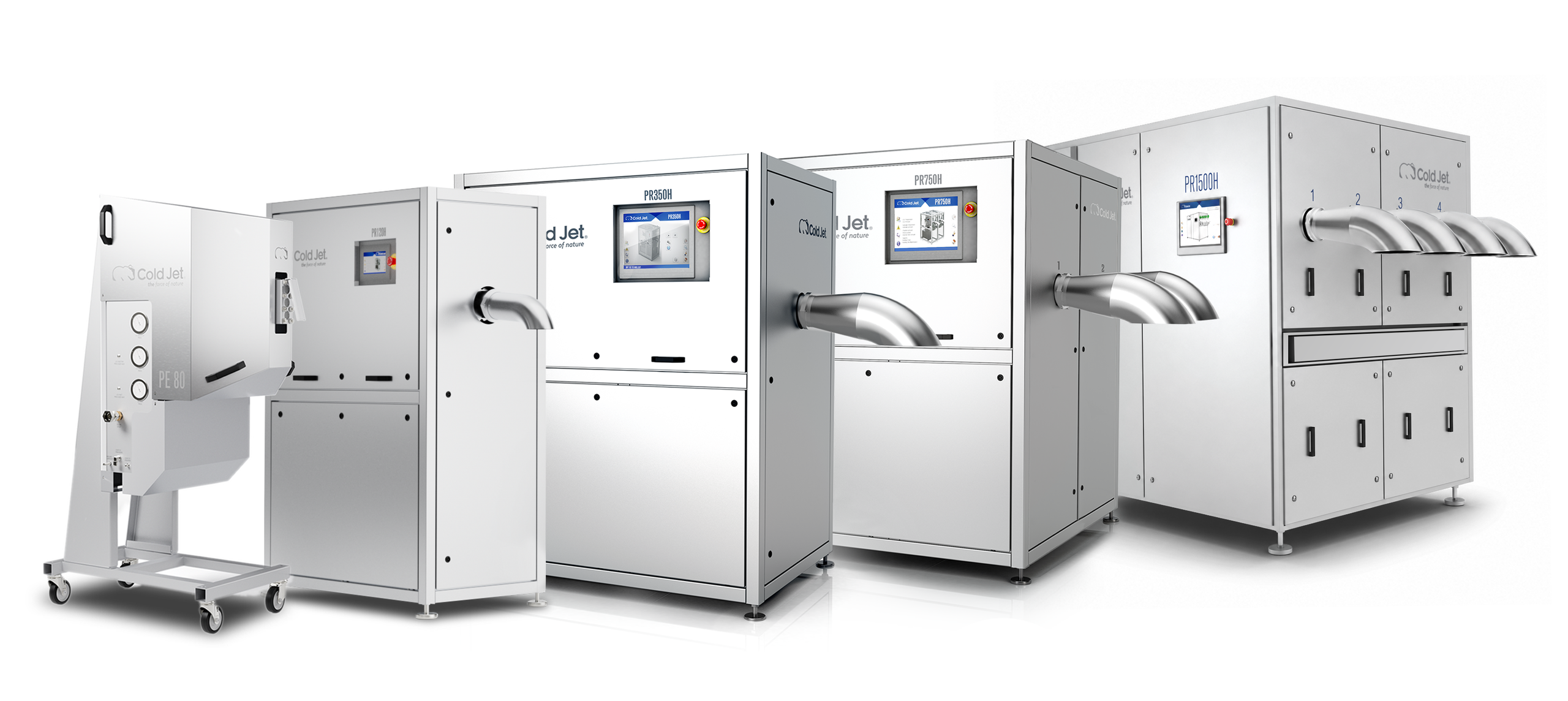
PR350H Pelletizer
Built for high-volume production. The PR350H delivers up to 772 lbs (350 kg) per hour from stroke one using closed-chamber technology, with automatic quick die change performed in seconds. It’s designed for integration into facility control systems for large blasting operations and multi-site programs.
- Up to 772 lbs (350 kg) per hour
- Closed chamber, start-up under 3 minutes
- Automatic quick die change
- Facility control system integration
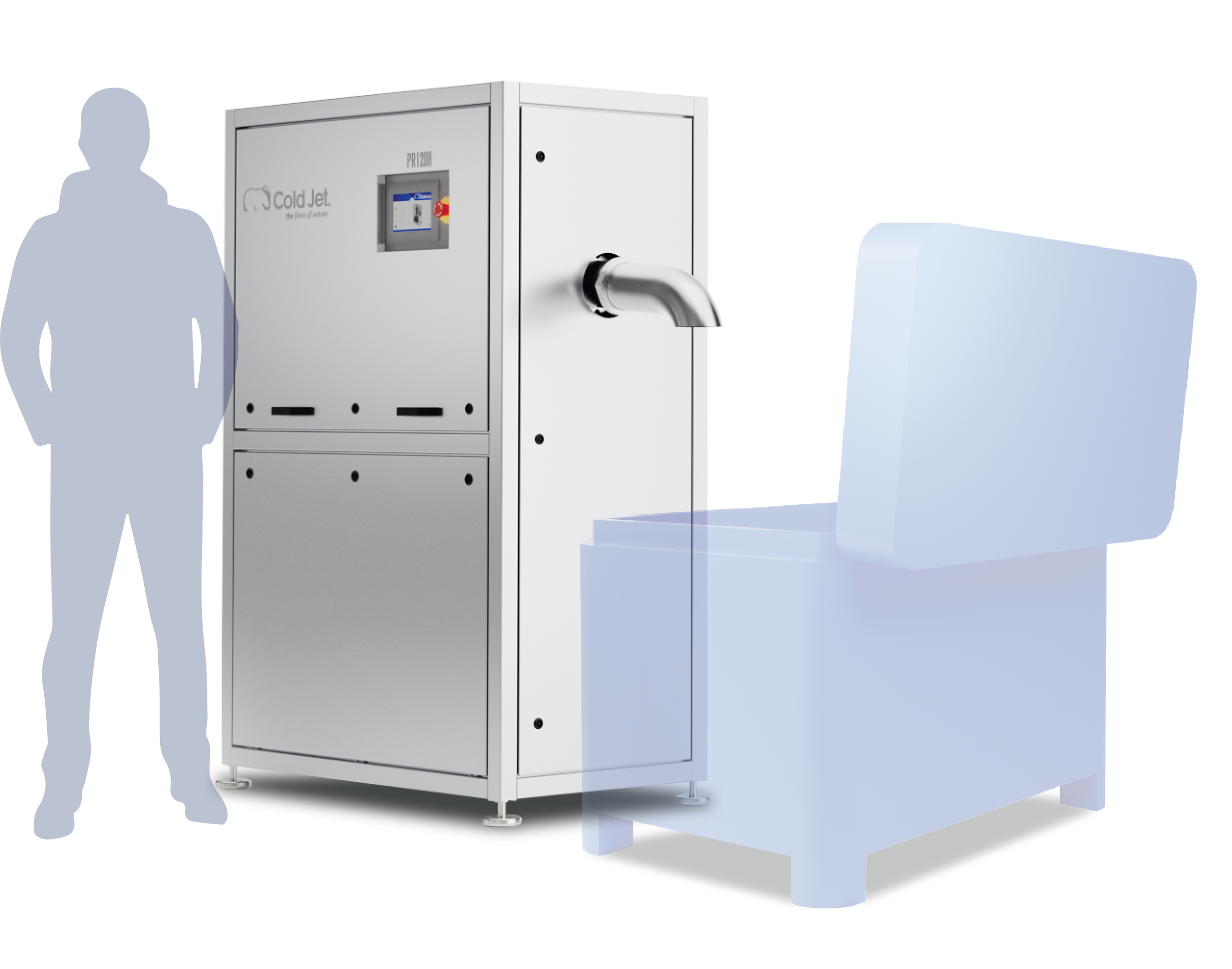
PR120H Pelletizer
High-quality dry ice on demand in a minimal footprint. The PR120H produces up to 265 lbs (120 kg) per hour with fully automated one-button operation and a start-up time of less than five minutes, making it a strong fit for facilities supplying several blasters across multiple shifts.
- Up to 265 lbs (120 kg) per hour
- 12–14% better LCO₂ conversion
- Start-up in under 5 minutes
- 7" touchscreen with Cold Jet CONNECT®
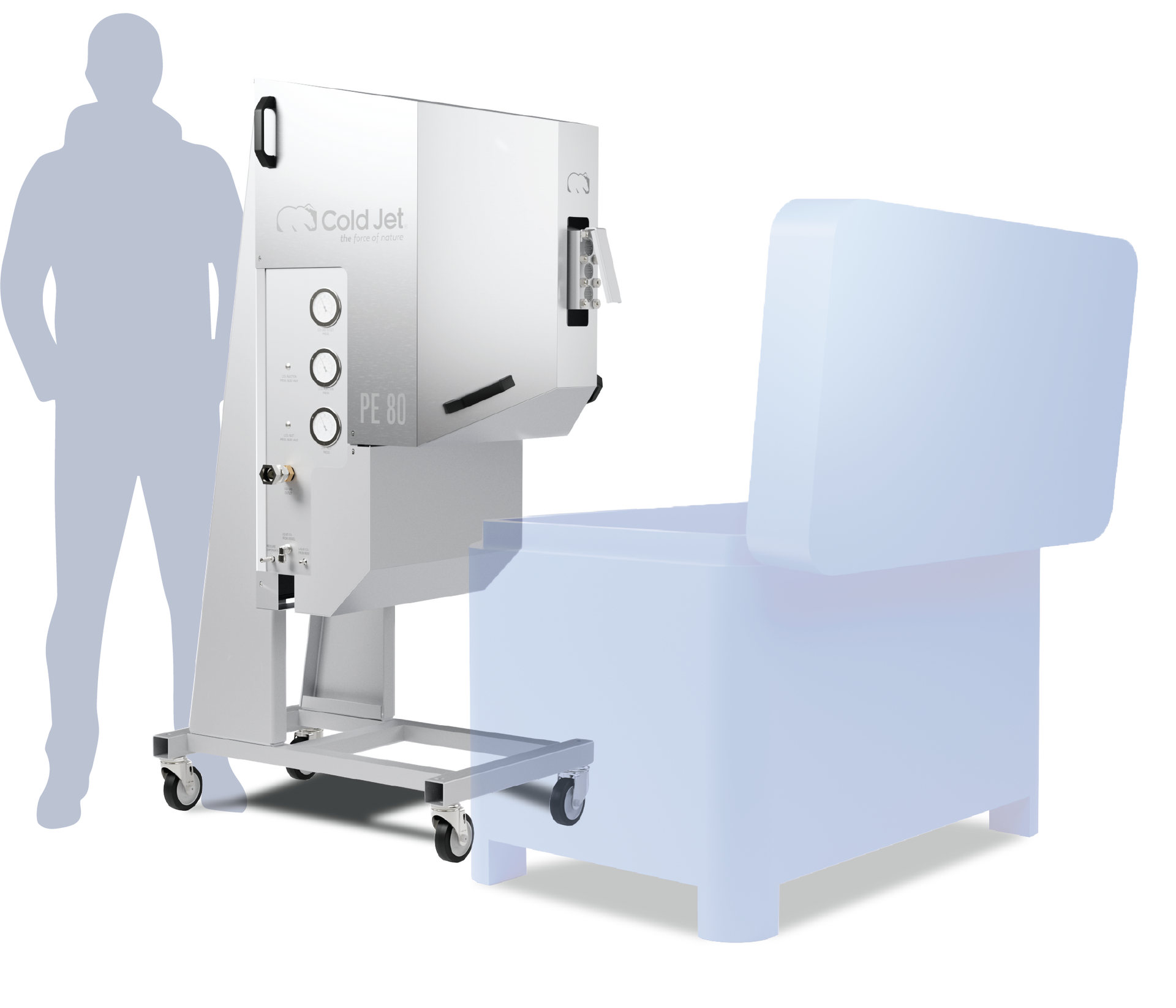
PE 80 Pelletizer
The entry point for taking control of your own dry ice supply. The PE 80 produces up to 176 lbs (80 kg) per hour of blasting media without requiring a major infrastructure upgrade, and it works with fixed tanks, transportable dewars, and micro bulk tanks. It’s built for facilities running one or more blasters that want to stop buying ice.
- Up to 176 lbs (80 kg) per hour
- Pellet sizes 1.7 to 16 mm
- Minimal infrastructure required
- Mobile on casters or wall-recessed
Compare Pelletizers
How Do These Three Pelletizers Compare?
Side-by-side specs for the Cold Jet pelletizers best suited to supplying a dry ice blasting operation, so you can match capacity to your consumption.

PR350H
Continuous high-volume production

PR120H
High quality dry ice on demand
PE 80
Low-volume, low-infrastructure entry point
| Specification | PR350H | PR120H | PE 80 |
|---|---|---|---|
| Machine Controls | |||
| Control Interface | 15" color touch display, multilingual | 7" touch screen panel PC | Simple operator controls |
| Automatic Quick Die Change | Yes, performed in seconds | Not published | Not published |
| Cold Jet CONNECT® | Yes | Yes | Not published |
| Production Capacity | |||
| Blasting Pellet Size | 3 mm(also 6, 10, 16 mm) | 3 mm(also 10, 16 mm) | 3 mm(also 1.7, 2.2, 8, 16 mm) |
| Dry Ice Output (max) | 772 lb/h(350 kg/h) | 265 lb/h(120 kg/h) | 176 lb/h(80 kg/h) |
| Start-Up Time | Under 3 minutes | Under 5 minutes | Minutes |
| Operating Cost | |||
| LCO₂ Conversion (Sub-Cooling) | 12–14% better than market standard | 12–14% better than market standard | Not published |
| Power Consumption | Not published | Not published | Not published |
| Site Requirements | |||
| LCO₂ Supply Options | Not published | Not published | Fixed tanks, dewars, or micro bulk |
| Compressed Air Quality | ISO 8573-1, min Class 3 | ISO 8573-1, min Class 3 | Not published |
| Dimensions (L x W x H) | 59" x 39" x 71" | 45.3" x 25.6" x 68.4" | 23.6" x 39.3" x 61.4" |
| Weight | 3,340 lb(1,515 kg) | 1,552 lb(704 kg) | 447.5 lb(203 kg) |
“—” indicates a spec Cold Jet has not published for this model. Contact a Cold Jet specialist to confirm fit for your blasting operation.
Why Cold Jet
Why Invest in a Cold Jet Pelletizer
for Your Blasting Operation
A pelletizer is a capital purchase that pays back through the price you stop paying per pound of delivered ice. How fast it pays back depends on two things: how efficiently the machine converts liquid CO₂ into solid dry ice, and how much of that dry ice survives to reach the blaster.
Cold Jet builds for both. Our machines deliver the lowest conversion factor on the market and produce the high density pellets that hold their shape in storage and clean harder at the nozzle:
More Efficient LCO₂ Conversion
Our sub-cooling technology delivers 12–14% better LCO₂-to-dry ice conversion efficiency than the market standard. Because LCO₂ is the largest recurring cost in onsite production, that difference compounds on every pound you make.
High Density Dry Ice
Cold Jet pelletizers produce the highest density dry ice available, which means less scrap ice, longer shelf life in storage, and pellets that hit harder at the nozzle. Denser media does more cleaning work per pound.
Built for Continuous Operation
Our machines are designed for non-stop production in demanding environments, with automatic extruder plate changes that minimize downtime between dry ice formats and stainless steel enclosures that keep out moisture and hold noise below 75 dB(A).
One Button Operation
Fully automated operation with start-up in minutes means any trained operator on any shift can run the machine correctly. Facilities running multiple shifts avoid the operator errors and equipment damage that come with less forgiving equipment.
Cold Jet CONNECT®
Remotely monitor production, diagnose issues, and implement corrective action from any location. For operations running dry ice production across multiple sites, this keeps one team in control of every machine.
Expert Consultancy and Custom Solutions
We advise on site requirements, LCO₂ supply, and payback before you buy, and we engineer custom solutions when a standard configuration will not fit, from minor modifications through full customization.
Our Customers & What They Say About Us
Blasting operations around the world produce their own dry ice with Cold Jet
From single site manufacturers to contract cleaning fleets, companies that blast every day are bringing dry ice production in house.
See What Dry Ice Blasting Users Say About Producing Their Own Ice
Our customers clean more effectively with fresh, high density dry ice

The Cold Jet pelletizer is the only one on the market that can produce high-density, premium dry ice and is still very compact. Less scrap ice, a longer shelf life and a higher density equals higher cost savings for our company.
The Cold Jet dry ice production equipment produces the purest dry ice available.
Safety & Standards
Standards and Safe Handling
What Onsite Production Requires
Producing dry ice in your own facility means handling liquid and solid CO₂ on site. These are the standards and practices that govern how it is done safely.
OSHA 29 CFR 1910.1000
Permissible Exposure Limit for CO₂
OSHA sets a permissible exposure limit of 5,000 ppm for carbon dioxide as an eight hour time weighted average. Because CO₂ is heavier than air, it collects in low and enclosed areas.
How We Comply
Dry ice production rooms require artificial ventilation to maintain airflow and a CO₂ PPM monitor with alarms. Cold Jet machines are supplied in moisture free stainless steel enclosures and our team advises on room siting, ventilation, and monitoring during installation.
ISO 8573-1
Compressed Air Purity Classes
ISO 8573-1 classifies compressed air by particulate, water, and oil content. Contaminated air introduced into a production system degrades ice quality and machine reliability.
How We Comply
Cold Jet pelletizers specify ISO 8573-1 Class 3 as a minimum air quality requirement, and that specification is published on every machine spec sheet so your facility can validate its existing air supply before installation.
CE and UL
Machinery and Electrical Certification
Industrial production equipment must carry the machinery and electrical certification required in the market where it is installed, covering electrical safety, guarding, and pressure components.
How We Comply
Cold Jet pelletizers are available in both CE and UL configurations with market specific part numbers and voltage options, so the same platform can be deployed across global sites without a compliance gap.
CGA and EIGA Guidance
Industrial Gas Handling Practice
The Compressed Gas Association and the European Industrial Gases Association publish guidance on bulk CO₂ storage, tank siting, relief venting, pipe work, and personal protective equipment for handling cryogenic liquids.
How We Comply
Cold Jet works with established LCO₂ suppliers and installation affiliates who build to that guidance, covering tank placement, insulated pipe work, and relief routing as part of the site scope rather than as an afterthought.
CCU
Carbon Capture and Utilization
Dry ice is produced from recycled CO₂ captured as a byproduct at industrial and biogas facilities. The gas would otherwise be released as waste, and it sublimates back to the atmosphere after use rather than adding new emissions.
How We Comply
Cold Jet’s low conversion factor means less liquid CO₂ is consumed per pound of dry ice produced. Our RE-CO2 recovery systems go further by capturing revert gas during production and recycling it into additional pellets, which nearly doubles output from the same LCO₂ input.