
The Cold Jet dry ice production equipment produces the purest dry ice available.
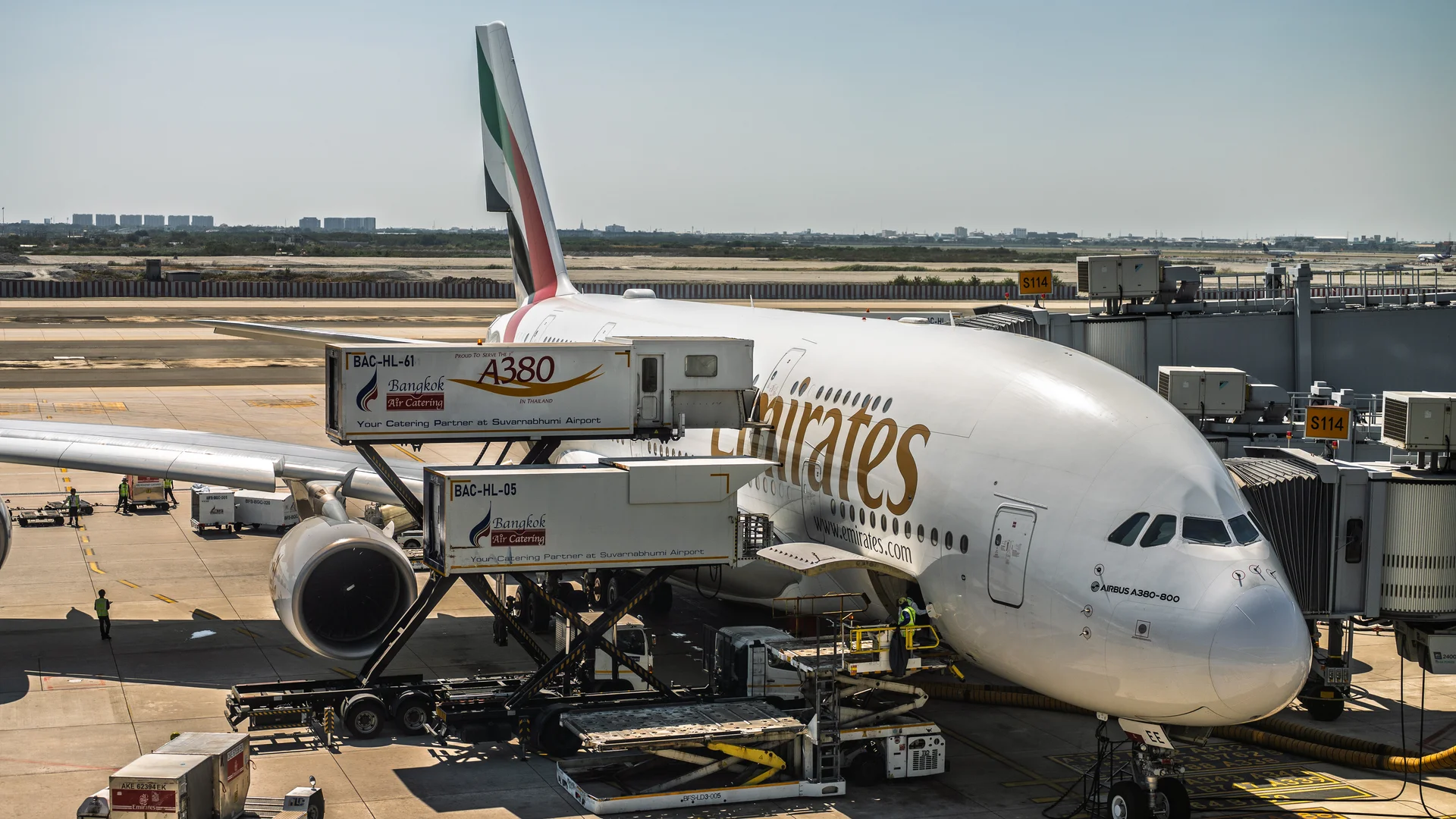
Keep in-flight meals safely chilled from ground kitchen to final service with onsite dry ice production. Fresh, high-density dry ice on demand — with complete control over availability, quality, and cost.
3x
The Refrigeration Power of Water Ice
−109°F
Dry Ice Temperature (−78.5°C)
Zero
Water, Residue, or Dry Ice Waste
Summary
Onsite dry ice production gives airline caterers complete control over dry ice availability, quality, and cost. Fresh, high-density dry ice is produced on demand — in pellets, nuggets, or slices — eliminating delivery costs, storage losses, and the waste caused by over-ordering against unpredictable flight schedules. With 3x the refrigeration power of water ice and clean sublimation that leaves no water or residue, dry ice keeps in-flight meals safely chilled for the entire catering cycle without electricity.
Dry ice production for airline catering is the onsite manufacturing of solid CO2 — in pellet, nugget, or slice form — used to keep in-flight meals and beverages cold from the ground kitchen through onboard service. Aircraft galleys can't rely on heavy, power-hungry compressor refrigeration in every trolley, so caterers place dry ice in a drawer or cassette at the top of each insulated cart. Because cold air is denser than warm air, the chilled air cascades downward and blankets the meals below — keeping contents cold for extended periods without any electricity. A Cold Jet production system lets caterers make exactly the dry ice they need, fresh, right when each catering cycle requires it.

Airline caterers use large quantities of dry ice on a daily basis, and dry ice represents a large percentage of non-food consumable costs. Complex, constantly changing flight schedules lead to chronic over-ordering — and purchased dry ice begins sublimating the moment it leaves the supplier, so much of what's bought is simply lost. Producing dry ice onsite eliminates the waste, the delivery costs, and the risk of running short.
3x
Refrigeration Power vs. Water Ice
Zero
Dry Ice Waste
-109°F
Surface Temperature
Dry Ice Surface Temperature
78.5°C
EPA, FDA & USDA
Food Contact Approval
Onsite dry ice production gives airline caterers complete control over availability, quality, and cost
Purchasing pre-made dry ice ties airline caterers to delivery schedules, minimum orders, and sublimation losses that begin the moment the ice leaves the supplier. Because flight schedules change daily, caterers routinely over-order to avoid running short — and watch the excess sublimate away as pure waste. Producing dry ice onsite eliminates that guesswork. Fresh, high-density dry ice is made on demand, in the exact form and quantity each catering cycle requires.
 Flexibility
Producing dry ice onsite gives airline caterers complete control over availability, quality, and cost. Fresh dry ice is made on demand — so last-minute schedule changes, flight delays, and seasonal peaks no longer mean scrambling for supply or eating the cost of over-ordering. Production scales up or down with each day's catering volume.
 Efficiency
Purchased dry ice starts sublimating in transit and in storage — and unpredictable flight schedules push caterers to over-order as insurance. Onsite production eliminates both problems. You produce exactly what each catering cycle needs, when it's needed, so nothing sits in storage losing mass and nothing is thrown away.
 Performance
At -109°F (-78.5°C), dry ice delivers 3x the refrigeration power of water ice — so caterers hit mandatory food safety temperatures using far less volume and weight, a critical metric in aviation fuel economics. Meals stay reliably chilled from the ground kitchen through onboard service without a single watt of electricity.
 Food Safety
Unlike water ice, dry ice sublimates directly from solid to gas — no melting, no pooling water in trolleys, no soggy packaging, and no spill hazards during turbulence. Dry ice is non-toxic, tasteless, and odorless, so it never alters the flavor or quality of a passenger's meal. It's EPA, FDA, and USDA approved for use around food.
 Cost
Dry ice is one of the largest non-food consumable costs in airline support services. Onsite production eliminates delivery fees, minimum orders, and storage losses. Cold Jet’s sub-cooling technology also converts liquid CO₂ to dry ice 12–14% more efficiently than other systems, so you get more dry ice from every delivery.
Dry ice is the backbone of onboard cooling in commercial aviation. It keeps meals, beverages, and frozen desserts at safe temperatures from the ground kitchen through the final service — without a single watt of electricity.
Aircraft are severely constrained by weight, space, and power. Instead of installing heavy, compressor-based refrigeration in every trolley, airlines harness the thermodynamic properties of dry ice to maintain the cold chain at 35,000 feet.
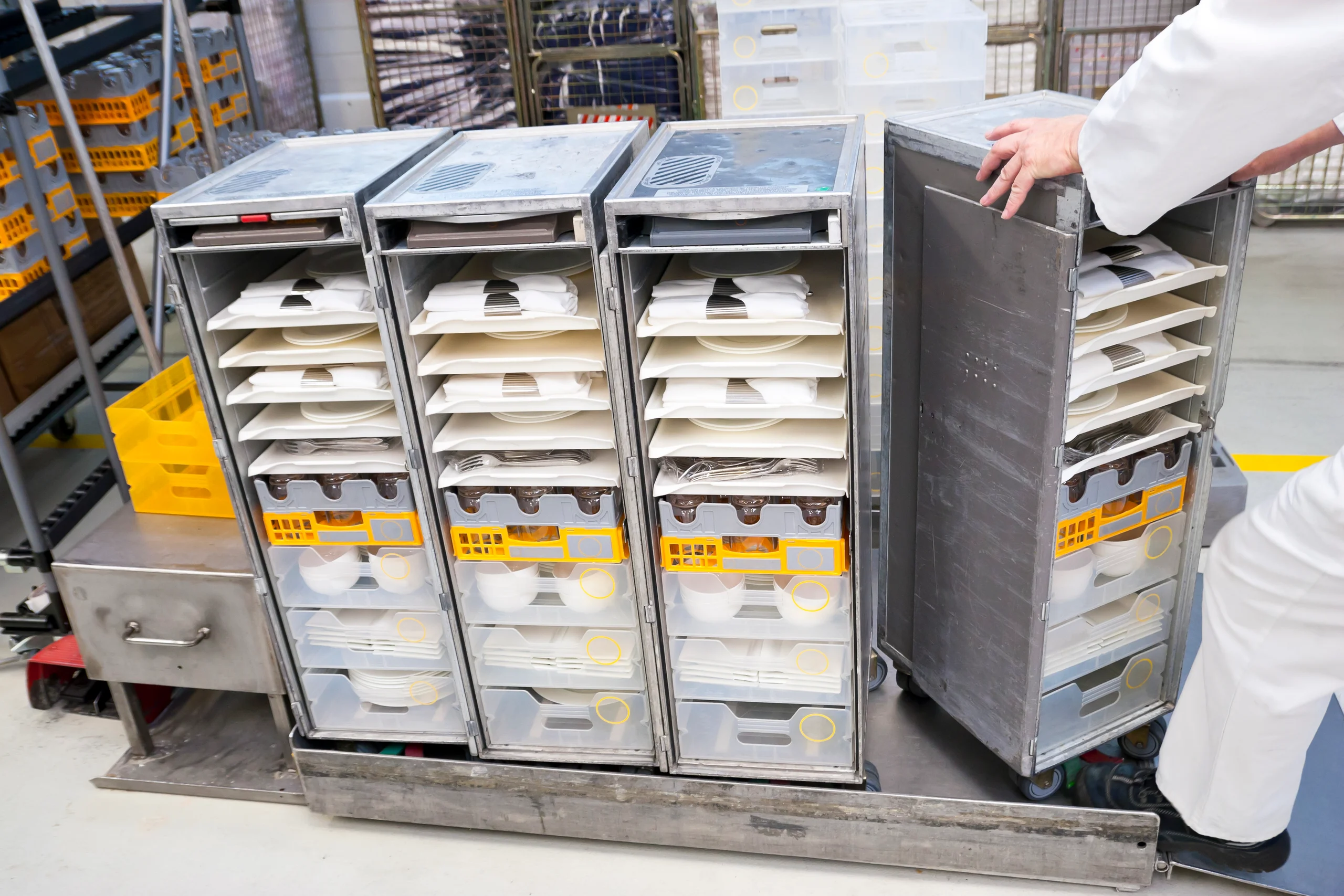
Dry ice slices, blocks, or pellets are loaded into a drawer or cassette at the top of each insulated catering trolley. Because cold air is denser than warm air, the chilled air naturally cascades downward, blanketing the meals and beverages below in a constant layer of cold for the duration of the catering cycle.
Meals are pre-cooled in the ground kitchen, loaded into insulated carts, and must survive tarmac transport, loading, and flight delays before service even begins. Advanced configurations pairing dry ice cassettes with insulated trolley covers can protect chilled contents for 20+ hours — without requiring a single watt of electricity.
Dry ice sublimates directly from solid to gas, so packaging stays completely dry — no soggy meals, no pooling water to manage during turbulence, and no sanitation risk in the cabin. Dry ice is non-toxic, tasteless, and odorless, and never alters the flavor of the meal.


To meet vast daily demand, airline caterers are moving from purchased dry ice to onsite production — streamlining the supply chain and cutting the high consumable costs of pre-made dry ice.
Dry ice begins sublimating the moment it's made — so purchased dry ice arrives lighter than it left the supplier and keeps shrinking in storage. Onsite production means every catering cycle is loaded with fresh, high-density dry ice at full cooling capacity.
Complex scheduling leads to chronic over- or under-ordering of purchased dry ice. With a fully automated Cold Jet production system, caterers produce exactly the quantity each day requires — scaling instantly for delays, cancellations, seasonal peaks, and unexpected demand.
Cold Jet systems produce 3 mm pellets, 10–16 mm nuggets, and slices — and R Series reformers convert pellets into the uniform slices that fit standard trolley cassettes and drawers. One production setup covers every cooling task in the operation.


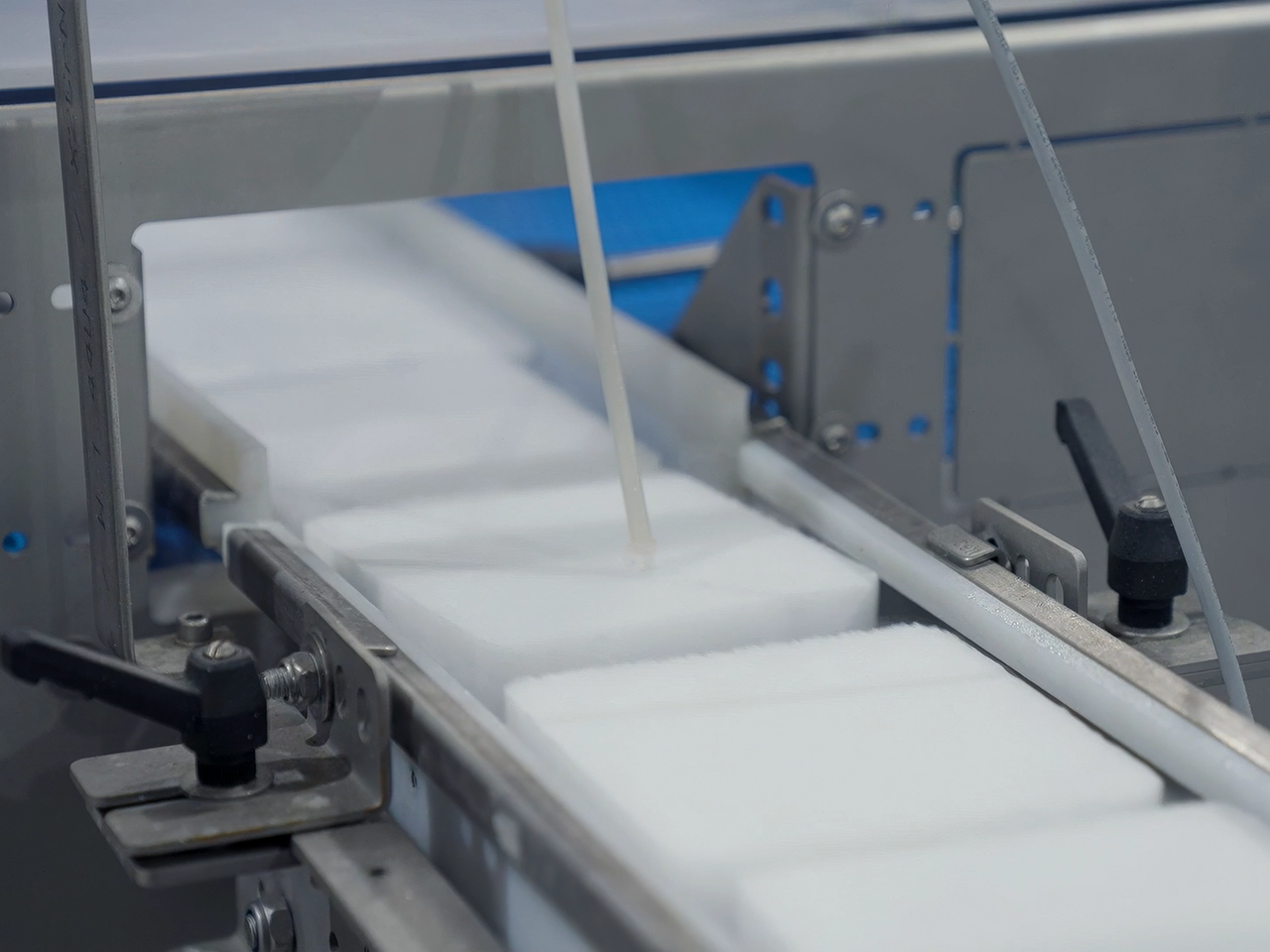
Cold Jet production systems scale from 176 lbs (80 kg) per hour to 3,307 lbs (1,500 kg) per hour, so operations of any size — from a regional catering kitchen to a major hub — can right-size their investment. Fully automated, one-button operation and Cold Jet CONNECT remote monitoring keep production running with minimal labor.
A complete onsite dry ice production setup requires supporting infrastructure beyond the production machine itself. When implementing dry ice production in your catering facility, the following components are essential for an effective operation:
Step 01
CoreProduction System
Dry Ice Production System
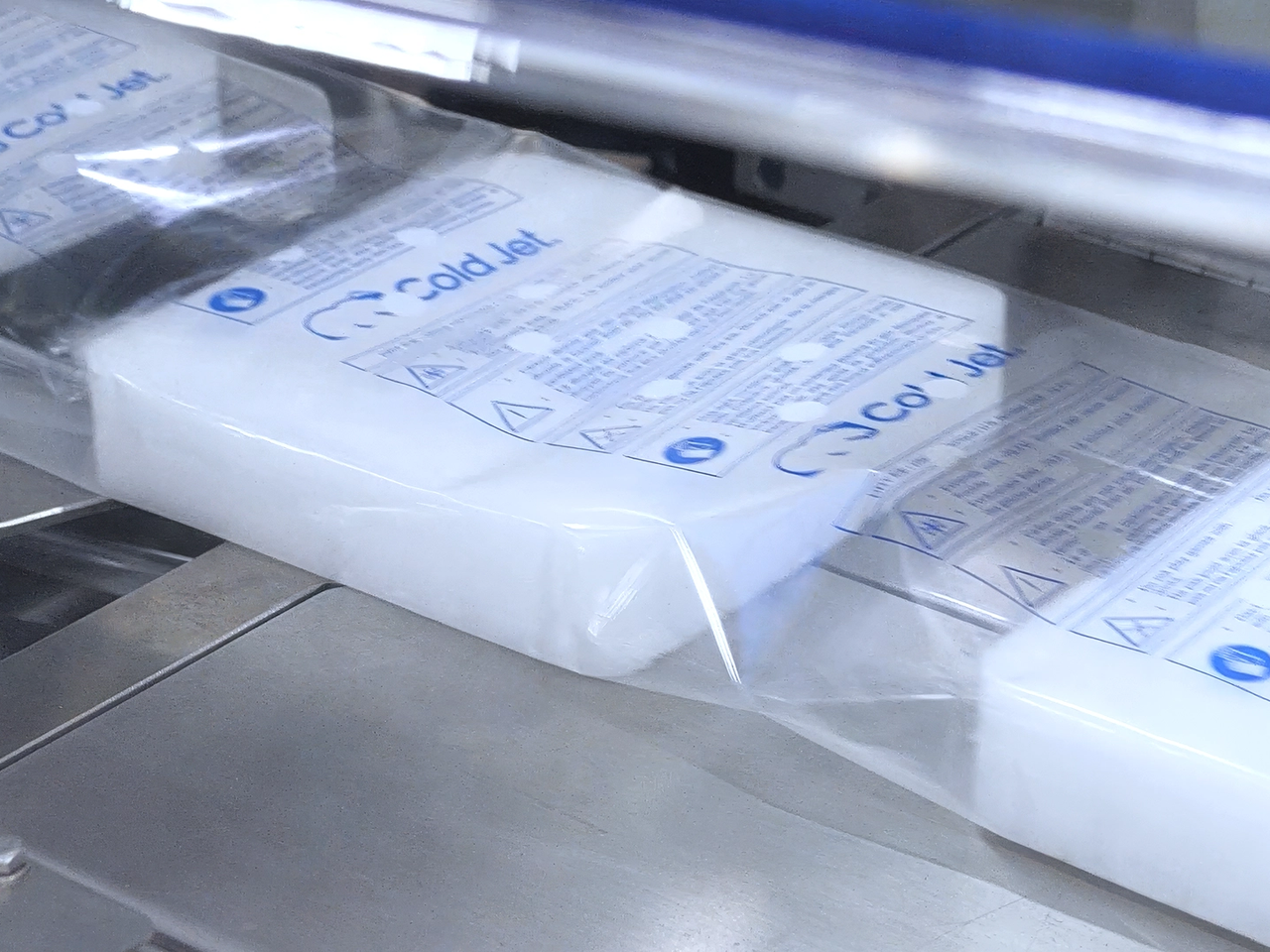
The foundation of onsite production is a reliable, fully automated Cold Jet system sized to your daily catering volume. Pelletizers range from 176 lbs (80 kg) to 3,307 lbs (1,500 kg) per hour, and R Series reformers convert pellets into the slices that fit standard trolley cassettes — so you match the machine to your operation rather than over-buying.
See how onsite dry ice production stacks up against purchased dry ice and traditional cooling methods across the criteria that matter most in airline catering.
| Criteria | Onsite Dry Ice Production Best | Purchased Dry Ice | Water Ice | Gel Packs | Electric Trolley Chillers |
|---|---|---|---|---|---|
| Cooling Power | -109°F — 3x the power of water ice | -109°F, but degrades in transit/storage | 32°F — limited chill depth | Moderate — short duration | Thermostatic, but power-dependent |
| Supply Flexibility | On-demand, matched to flight schedules | Tied to delivery windows and minimums | Readily available | Requires freezing lead time | Fixed equipment per trolley |
| Waste | None — produce only what's needed | Sublimation losses + over-ordering | Meltwater in trolleys and galleys | Disposable plastic waste stream | None, but high energy use |
| Weight Efficiency | Less volume and weight per BTU — sublimates in transit | Same physics, less cooling per pound loaded(aged ice) | Heavy — weight-prohibitive at scale | Heavy relative to cooling delivered | Heaviest — compressor hardware per cart |
| Food Safety | Dry, residue-free — EPA/FDA/USDA approved around food | Dry and food-safe when fresh | Pooling water — sanitation and spill risk | Leak risk if packs rupture | Reliable while powered |
| Ongoing Cost | LCO2 only — no delivery, storage, or waste costs | Purchase + delivery + storage + waste | Low unit cost, high handling cost | Recurring replacement cost | High capital + power + maintenance |
Cold Jet offers a comprehensive range of dry ice production machines for airline catering operations. Our fully automated systems produce high-density pellets, nuggets, and slices sized to your daily catering volume.
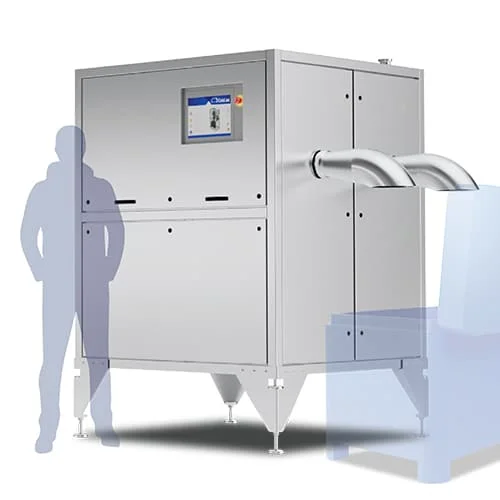
PR750H Dry Ice Pelletizer
The PR750H produces up to 1,653 lbs (750 kg) of dry ice per hour and can make two pellet sizes at once, giving large hub and high-volume catering operations a continuous supply for even the busiest flight schedules.

PR350H Dry Ice Pelletizer
The PR350H produces up to 772 lbs (350 kg) of dry ice per hour, giving mid-size and hub catering operations the volume to cover full daily flight schedules with fresh dry ice.

R1000H Reformer
The R1000H converts dry ice pellets into uniform slices, the classic format for airline trolley cassettes and drawers, at up to 2,204 lbs (1,000 kg) per hour. Adjustable slice sizes and thicknesses let you match the format your catering carts use.
Side-by-side specs for the Cold Jet machines best suited to airline catering, so you can match the right system to your daily dry ice volume and trolley formats.
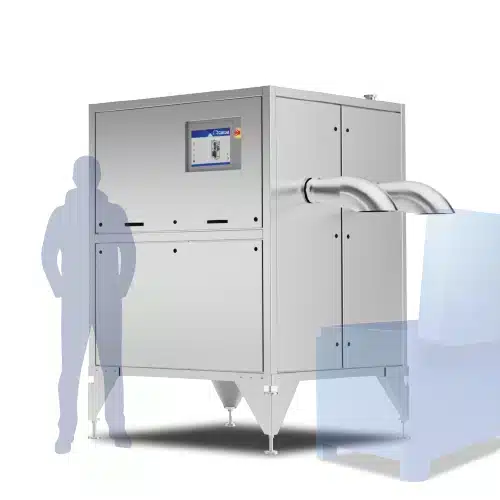
High-volume pelletizer for large hubs
Mid-volume workhorse for hub caterers
Converts pellets to trolley-ready slices
| Specification | PR750H | PR350H | R1000H Reformer |
|---|---|---|---|
| Production | |||
| Role in the Operation | Produces dry ice pellets | Produces dry ice pellets | Reforms pellets into slices |
| Maximum Output | 1,653 lbs/hr(750 kg/hr) | 772 lbs/hr(350 kg/hr) | 2,204 lbs/hr (1,000 kg/hr), depending on slice format and pellet supply |
| Dry Ice Format | 3, 6, 10, or 16 mm pellets; two sizes at once(complete version) | 3, 6, 10, or 16 mm pellets | Slices and mini blocks, 0.55–6.6 lbs; 5/8"–3½" thick |
| Feed / Input | Liquid CO₂(LCO₂) | Liquid CO₂(LCO₂) | Dry ice pellets, 3–16 mm |
| LCO₂ Conversion (Sub-Cooling) | 12–14% better than market standard | 12–14% better than market standard | Not published |
| Machine Controls | |||
| Operation | Fully automated, one-button; 15" touchscreen | Fully automated, one-button; 15" touchscreen | Fully automated; 15" touchscreen with recipe programs |
| Start-Up Time | Less than 3 minutes | Less than 3 minutes | Not published |
| Format Change | Automatic extruder plate change, in seconds | Automatic extruder plate change, in seconds | Quick Change Press Head in under 15 min; automatic thickness adjustment |
| IoT Enabled via Cold Jet CONNECT® | Yes | Yes | Yes |
| Fit | |||
| Ideal Operation Size | Large hub and high-volume catering operations | Mid-size and hub operations | Any operation adding slices for trolley cassettes and drawers |
| Footprint (L x W x H) | 59" x 59" x 71" | 59" x 39" x 71" | 77" x 59" x 80" |
“—” indicates a spec Cold Jet has not published for this model — contact a Cold Jet specialist to confirm fit for your application.
If dry ice is a large share of your non-food consumable spend, investing in a Cold Jet dry ice production system puts availability, quality, and cost back under your control.
When evaluating this capital investment, weigh the return on investment (ROI) against ongoing purchase, delivery, and storage costs — and against the waste created every time flight schedules change and pre-ordered dry ice sublimates unused.
Highest Density, Highest Quality Dry Ice
Cold Jet's patented production technology makes the highest quality, highest density dry ice available — denser ice sublimates more slowly, so trolleys stay colder longer with less dry ice.
The Global Leader in Dry Ice Production
With more than 24,000 machines installed globally, Cold Jet is the pioneer and global leader in dry ice technology — trusted by caterers, food processors, and dry ice producers worldwide.
Lowest LCO2 Conversion Ratio
Our proprietary sub-cooling technology converts liquid CO2 to dry ice at a ratio as low as 2.2:1 — the lowest on the market — so you get more dry ice from every pound of LCO2 you buy.
Fully Automated, Continuous Operation
One-button operation and automatic extruder plate changes keep production simple and downtime minimal — designed for non-stop operation in demanding, around-the-clock catering environments.
Industry Leading Support and Training
Cold Jet offers expert consultancy, site visits, installation, operator training, and 24/7 support — plus Cold Jet CONNECT for remote monitoring, diagnostics, and corrective action from any location.
Customized Engineered Solutions
From minor modifications to fully customized production, dosing, and bagging lines, Cold Jet will design, deliver, and deploy a solution matched to your catering operation's exact dry ice needs.
See What Dry Ice Producers Are Saying About Cold Jet Production Equipment
The Cold Jet dry ice production equipment produces the purest dry ice available.

We are very satisfied from the first contact up to date. The employees at Cold Jet were very professional and helpful. We are finally able to respond to requests for flexibility from our customers and produce according to their dry ice needs. In addition, we are also excited about the quality of the dry ice.
Dry ice is approved for use around food and is safely used across commercial aviation every day. Onsite production with precise dosing helps caterers meet food safety and dangerous goods requirements with confidence.
In-Flight Food Safety
Food served to passengers must be handled with cooling media that are safe for use around food. Dry ice (solid CO₂) is EPA, FDA, and USDA approved for use around food.
Cold Jet systems produce dry ice from food-grade liquid CO₂. Because dry ice is non-toxic, tasteless, and odorless and sublimates completely, it never contaminates or alters the meals it protects.
Hazard Analysis and Critical Control Points: Trolley Temperature Control
Airline catering operations run HACCP-based food safety programs that require perishable foods to be held below critical temperature thresholds throughout the catering cycle.
With 3x the refrigeration power of water ice and consistent, high-density quality, onsite-produced dry ice reliably holds trolley temperatures within safe limits from ground kitchen to final service — with predictable, repeatable dosing per cart.
Dangerous Goods Regulations (UN 1845)
Because dry ice sublimates into CO₂ gas, it is classified as a dangerous good (UN 1845) for air transport. Airlines must track and limit the total quantity of dry ice loaded on each aircraft.
Onsite production with metered dosing lets caterers load precise, documented quantities of dry ice per trolley — supporting the accurate per-aircraft weight declarations that IATA compliance requires.
Aviation Safety Requirements for Dry Ice
The U.S. DOT, EASA, and ICAO regulate dry ice on aircraft because sublimating CO₂ displaces oxygen in confined spaces. Operators must follow quantity limits and ventilation protocols.
Cold Jet provides training on safe dry ice handling and CO₂ awareness, and fresh, high-density dry ice sublimates more slowly than aged product — helping caterers deliver full cooling performance within approved quantity limits.
Safe Production & Handling Practices
Producing and handling dry ice requires proper ventilation, CO₂ monitoring, and PPE to protect workers in the production and trolley-loading areas.
Cold Jet specifies the required safety infrastructure — artificial ventilation and CO₂ PPM monitoring — as part of every installation, and delivers operator training covering PPE and safe handling as standard.
Contact us today to discover how onsite dry ice production can cut costs, eliminate waste, and keep every catering cycle reliably cold.