
Overview
Summary
Dry ice is solid recycled CO₂ at -109 °F (-78.5 °C) with roughly three times the refrigeration power of water ice by weight. It sublimates directly to gas, so it drops product temperature fast on the offal line, the trim line, and in mixers and blenders without adding water, drip loss, or leachate. Producing it on-site with a Cold Jet pelletizer eliminates the 15 to 30 percent typically lost to sublimation between a third-party supplier and your line.
What is dry ice cooling for meat processing?
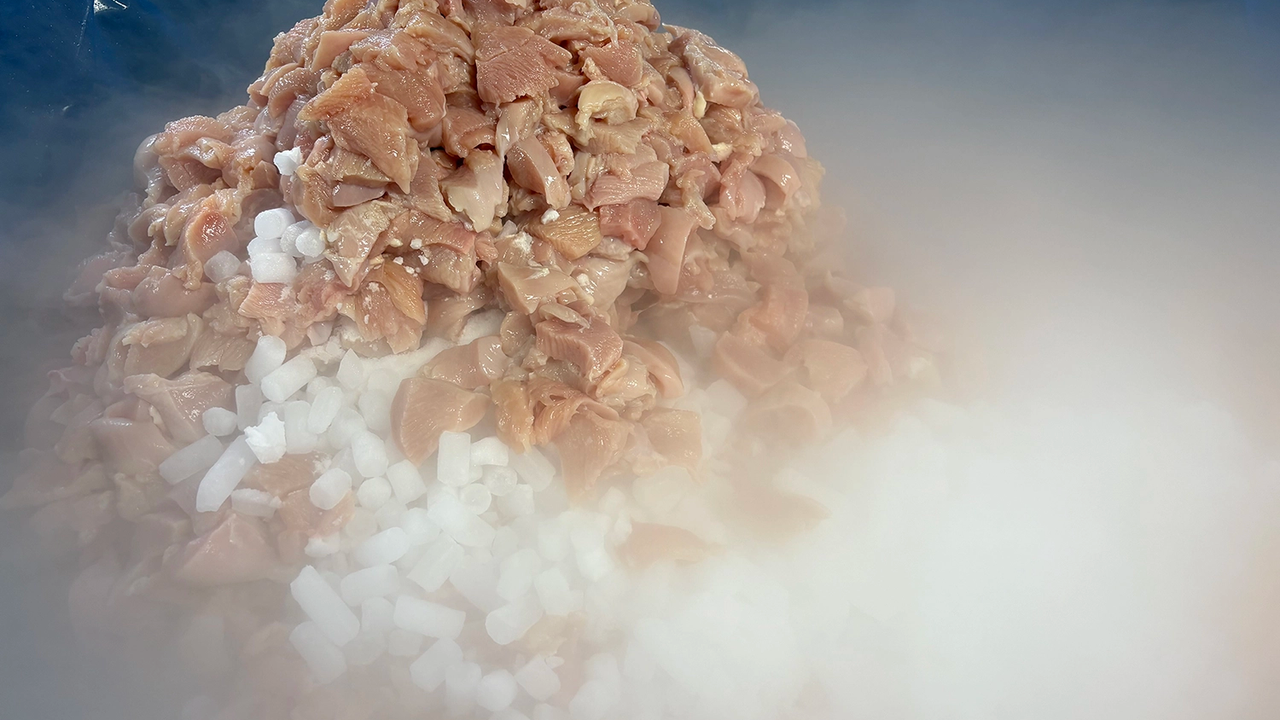
Dry ice cooling for meat processing is the use of solid CO₂ in pellet, nugget, or slice form to hold poultry, beef, and pork at controlled temperatures through processing, packing, and transport. Workers layer pellets or nuggets directly into combos and totes among primals, trim, breasts, thighs, and wings, and dose them into mixers and grinders to offset friction heat. At -109 °F (-78.5 °C), dry ice transfers cold energy far faster than water ice and does it without moisture, which matters because melted ice becomes a leachate that federal food safety frameworks recognize as a primary vector for Listeria monocytogenes biofilm on stainless steel. It also prevents the water pickup that dilutes soluble proteins and degrades taste, texture, and saleable yield. In transport, dry ice provides passive cooling that needs no power and no mechanical unit, and it loses mass steadily through the journey, so a load leaves the plant at its heaviest and gets lighter every hour. Dry ice is recognized as a food-safe cooling medium by the FDA, USDA, and EPA, and it is typically dosed at 5 to 10 lbs per box in shipping applications.

Challenge
Why meat processing needs a cooling medium that does not melt
A carcass leaves the kill floor between 86 °F and 102 °F (30 °C and 39 °C), and mechanical friction in grinding, mixing, and blending puts heat back into product that has already been chilled. Those pockets of heat become the warmest and most microbially active part of a batch. Microbial activity roughly doubles in rate for every 10 °C rise, and in the danger zone between 40 °F and 140 °F some organisms double their population in 20 minutes. Water ice fights that heat but introduces moisture, weight, corrosion, and slip hazards in exchange. Dry ice removes the heat and leaves nothing behind.
−109°F
Dry ice temperature
−78.5°C
LCO₂ to Dry Ice Conversion
12–14% better than other systems
None
Added Water
Passive
Cooling Type
Benefits
What Are the Benefits of Dry Ice in Meat Processing?
Dry ice pulls temperature down fast without adding water to the product, and it sheds weight in transit instead of carrying it.
Meat processors run against the clock. A carcass leaves the kill floor between 86 °F and 102 °F (30 °C and 39 °C), and from that point every operation on the line adds heat back: friction in grinders and mixers, handling on the trim line, dwell time at the packing station. Under HACCP, the critical control points are unforgiving, and in the danger zone between 40 °F and 140 °F some bacteria double their population in as little as 20 minutes.
Water ice is the traditional answer, and it works until it melts. Then it becomes leachate that carries Listeria between products and supports biofilm on stainless steel, water that meat tissue absorbs and that dilutes the soluble proteins driving taste and texture, weight that rides on every freight invoice, and a slip hazard on the floor. Dry ice is solid recycled CO₂ at -109 °F (-78.5 °C) with roughly three times the refrigeration power of water ice by weight. It sublimates directly to gas, so it adds no moisture at any point, and it loses mass steadily in transit, which takes weight off the load rather than adding it.
 Product Quality
No Added Water and No Drip Loss
Dry ice sublimates from solid to gas, so it never leaves the melt water that water ice does. That removes the leachate that carries bacteria between products, the moisture that supports Listeria biofilm on stainless steel, and the water pickup that dilutes soluble proteins and costs you texture, taste, and saleable yield. Product stays cold and dry, and so does the combo.
 Food Safety
Eliminate Hot Spots in Mixing and Grinding
Mechanical friction in mixers, blenders, and grinders creates pockets of heat that become the most microbially active part of a batch, and tightly packed transport containers restrict cold air circulation in the same way. Dry ice mixed directly into the machine offsets friction heat without adding moisture or changing product ratios, and packed among products in a box it distributes cold evenly in every direction.
 Throughput
Rapid Chilling and Freezing
At -109 °F (-78.5 °C) with three times the refrigeration power of water ice by weight, dry ice pulls temperature down fast enough to hold the critical control point through slower stages such as grading, weighing, and packing. Less media does more work in the same tote, which means less handling and more room for product.
 Capacity
Absorb Peak Demand Without New Chiller Capacity
Holiday volumes, production surges, and equipment outages push mechanical chilling past its design capacity at exactly the wrong moment. Dry ice adds cooling on demand with no capital project, which lets a plant cover a surge, work through a chiller failure, or take on a new contract without waiting on new refrigeration infrastructure.
 Operations
Supply You Control, Made On Demand
Dry ice bought from a distributor typically loses 15 to 30 percent of its mass to sublimation before it ever reaches your line, and it arrives on the supplier's schedule rather than yours. Producing on-site removes that ghost waste, removes delivery and shortage risk, and gives you fresh high-density dry ice made when the line calls for it.
 Environmental
Made From Recycled CO₂
Dry ice is produced from recycled CO₂ captured as a byproduct at industrial and biogas facilities, so it does not generate new emissions at the point of use. It also replaces gel packs and phase change materials that end up in landfill or require return logistics, and it reduces reliance on refrigerated vehicles, which use up to 15 percent more fuel and emit 18 percent more nitrogen oxide than standard delivery vehicles.
Applications
Where Is Dry Ice Used in Meat Processing?
Dry ice works at every stage a processor needs cold: rapid chilling on the offal and trim lines, hot spot prevention in mixers, blenders, and grinders, and temperature stability through packing, shipping, and intermodal transport.
Validated For
- USDA FSIS HACCP
- FSMA Sanitary Transportation Rule
- EU Regulation (EC) 853/2004
- IATA PI 954 (UN1845)
- FDA, USDA and EPA Food-Safe Cooling Medium
Hold Poultry, Beef, and Pork at Temperature Through Processing Without Adding Water
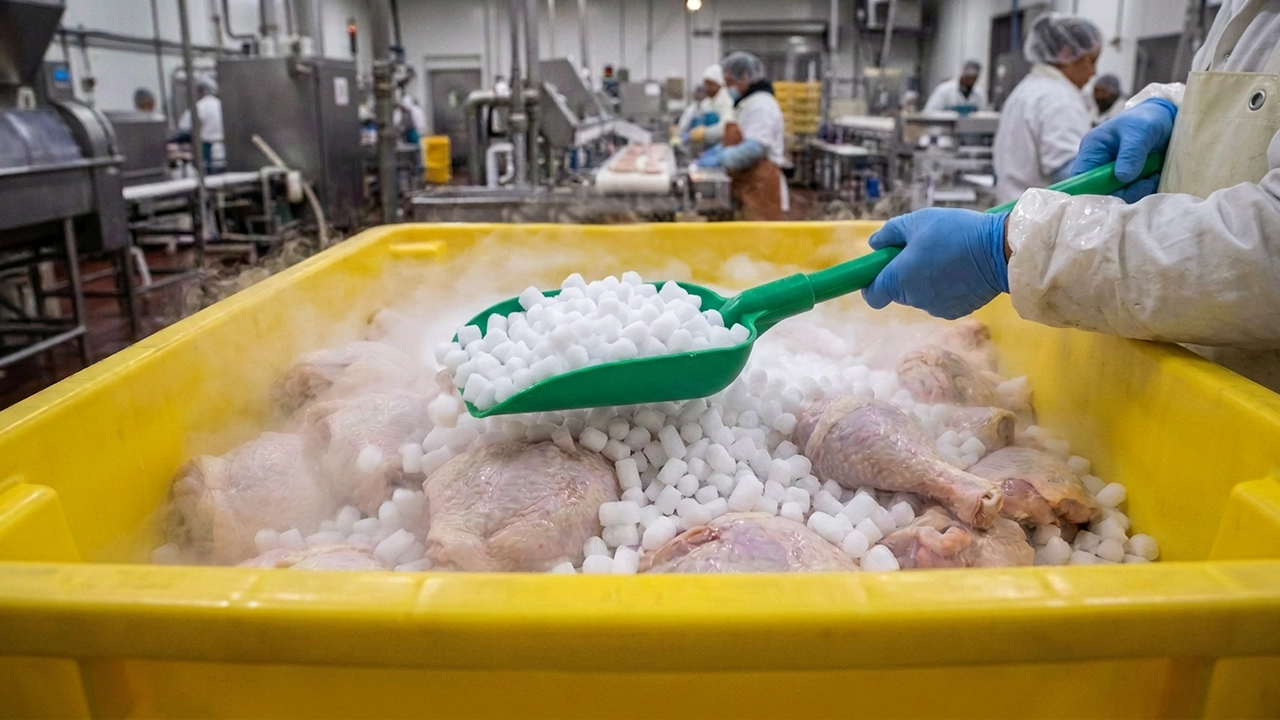
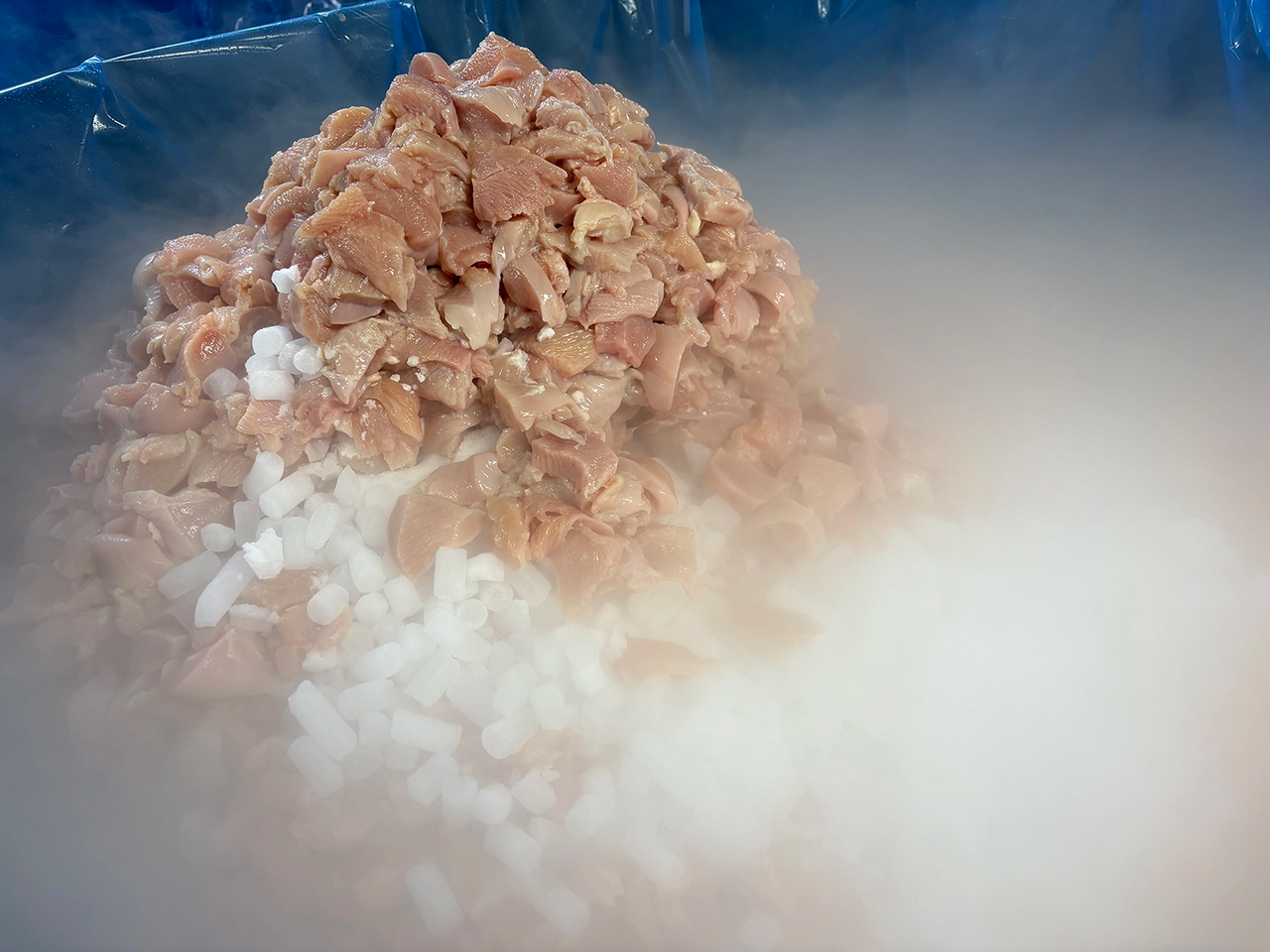
Dry ice pellets and nuggets are layered directly into combos and totes of primals, trim, and portions to pull temperature down fast without adding water to the product.
Rapid chilling on the offal and trim lines
Workers layer dry ice pellets or nuggets among product in combos and totes as it moves down the line. Temperature drops fast and stays down, which holds the critical control point through the slower stages that follow. Because dry ice carries three times the refrigeration power of water ice by weight, less media does more work in the same container and leaves more room for product.
No drip loss and no water pickup
Meat held in water ice can absorb water and lose the soluble proteins that determine taste and texture, and enough degradation makes product unsellable. Dry ice adds no moisture at all, so product keeps its weight and its eating quality. It also removes the melt water that corrodes equipment, contaminates adjacent product, and creates slip hazards on floors and loading docks.
Eliminate hot spots in grinding, mixing, and blending
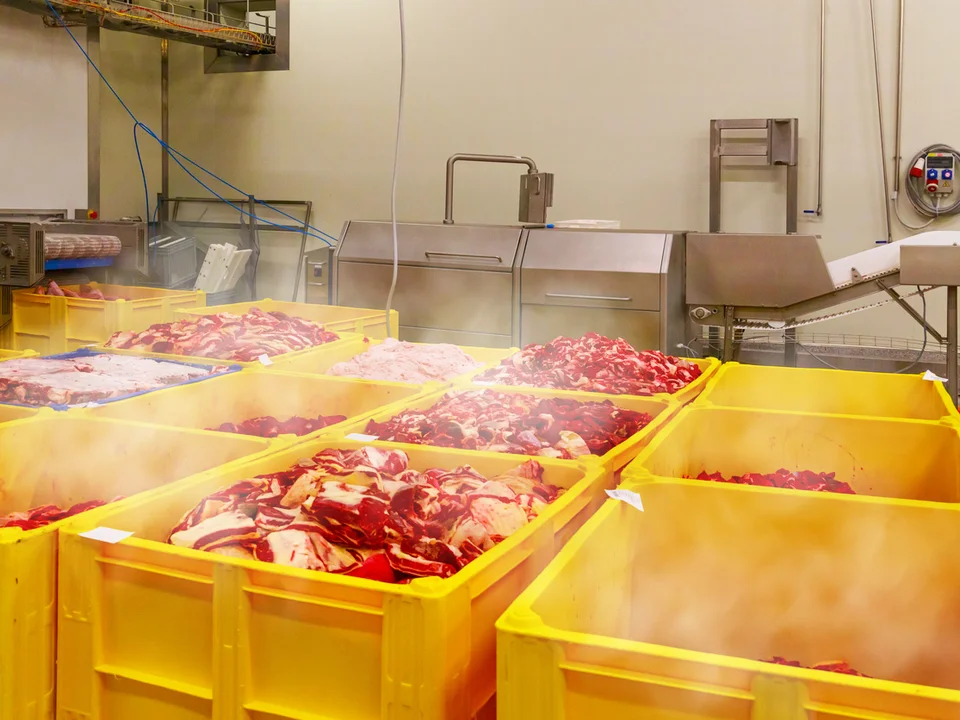
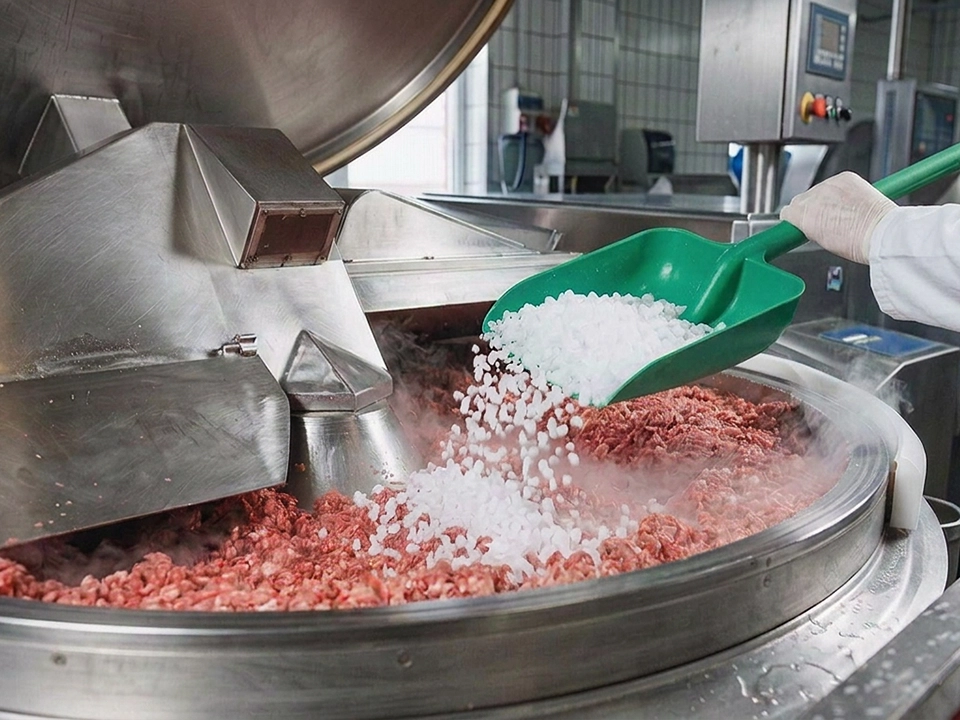
Mechanical friction in grinders, mixers, and blenders creates pockets of heat that become the warmest and most microbially active part of a batch. Dry ice dosed directly into the machine offsets that friction heat without adding water or altering the ratios of the product, which is why processors use it across ground beef, sausage, and further-processed poultry lines.
Process Steps We Cool
- Offal Lines
- Trim Lines
- Mixers and Blenders
- Grinders and Emulsifiers
- Patty Forming and Portioning
- Marination and Tumbling
- Case-Ready Packaging
- Further Processing
- Peak Season Surge Cooling
- Equipment Cleaning by Dry Ice Blasting
Hold Temperature Across Every Lane With Loads That Get Lighter, Not Wetter
Typically dosed at 5 to 10 lbs per box, dry ice holds temperature across road, rail, sea, and air lanes with no power, no melt water, and falling weight.
Size the dose to the lane, not to the box
Dry ice can be dosed precisely to transit time, payload, and packaging, so a 24 hour road move and a 72 hour intercontinental lane each get exactly the cooling they need. Automated dosing systems drop a pre-programmed weight straight into boxes on the conveyor, which makes every carton on the pallet consistent and the dose auditable.
Loads that shed weight in transit
Water is heavy as ice and just as heavy once it melts, and that weight rides on every freight invoice for the whole journey. Dry ice sublimates through transit, so the shipment loses mass as it travels. On high-frequency lanes, the difference in chargeable weight and fuel burn is a recurring line item rather than a one-time saving.
One-way shipping with nothing to return
Gel packs and phase change materials either come back on a return leg or go to landfill, and both options carry cost. Dry ice is a one-way solution: nothing is left in the box, nothing has to be collected, and nothing has to be disposed of at the customer's dock. It also keeps working when a reefer unit fails or a load sits at a terminal.

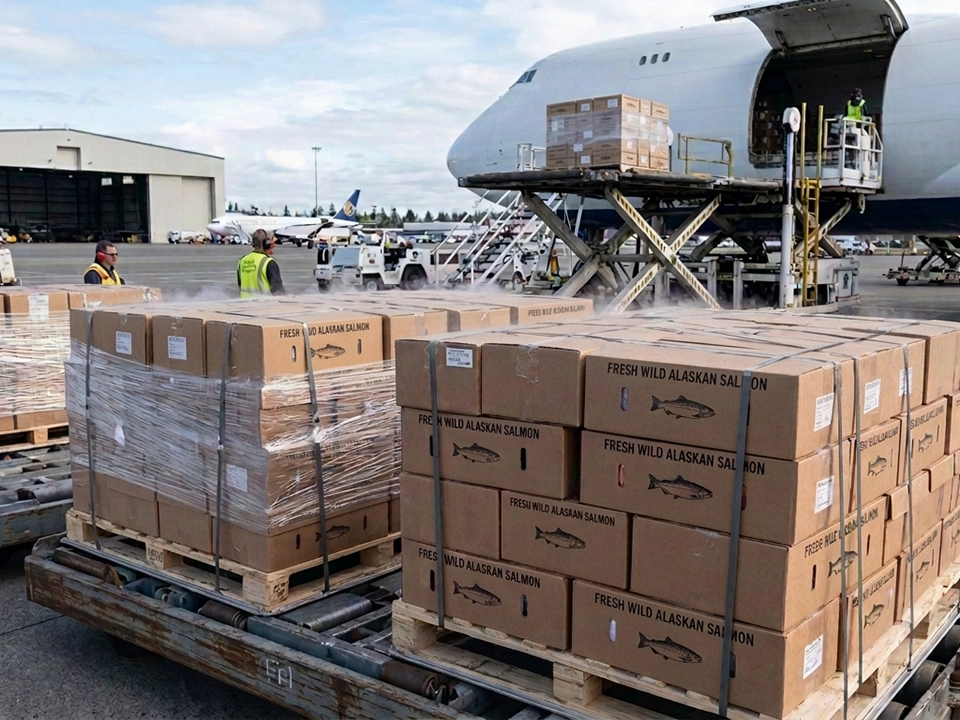
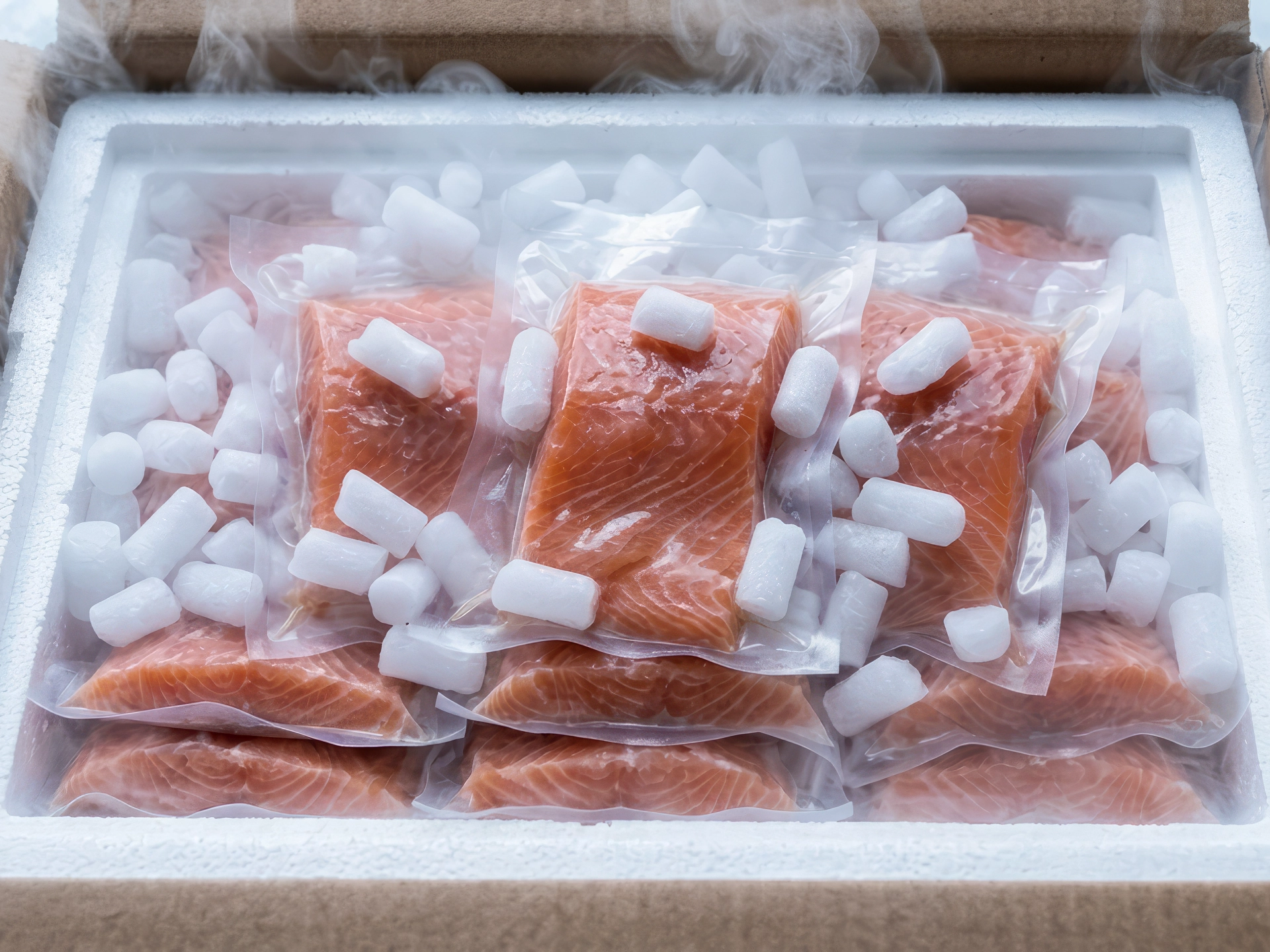
Dry ice suits every stage of the protein cold chain, from a combo of trim moving between plants to a case-ready box going to a retail distribution center. Processors match the format and the dose to the packaging and the lane:
Formats, Packaging, and Lanes
- 3 mm Pellets
- 10 to 16 mm Nuggets
- Dry Ice Slices
- Bagged Pellets and Nuggets
- 5 to 10 lbs per Box Dosing
- Combo Bins and Totes
- Corrugated and EPS Cartons
- Reefer and Intermodal Containers
- Road and Rail Freight
- Air Freight Export Lanes
- Direct-to-Consumer Meat Boxes
Industries
Which Industries Use Dry Ice for Meat and Poultry Chilling?
Dry ice keeps food cold, dry, and safe from processing to packaging. Explore how Cold Jet production systems support the wider food manufacturing and processing industry.
Comparison
How Dry Ice
Compares to Other Cooling Media
See how dry ice compares to water ice, gel packs, phase change materials, mechanical refrigeration, and CO₂ snow across the criteria that matter in meat processing and transport.
| Criteria | Dry Ice Best | Water Ice | Gel Packs & PCMs | Mechanical Refrigeration | CO₂ Snow |
|---|---|---|---|---|---|
| Moisture in the Product | None, sublimates to gas | Melt water, leachate, and water pickup | Condensation on the pack surface | None, but condensate in the unit | None, sublimates to gas |
| Weight Through Transit | Falls steadily as it sublimates | Constant, and the melt water still travels | Constant for the full journey | Unit and fuel weight throughout | Falls, but more media needed per unit of cooling |
| Temperature Held | -109 °F (-78.5 °C), constant until gone | 32 °F (0 °C), rising as it melts | Rises once the phase change is complete | Set point, until the unit or power fails | -109 °F (-78.5 °C), but poor retention |
| LCO₂ Efficiency | 12–14% better LCO₂ conversion than other systems with a Cold Jet pelletizer | Not applicable | Not applicable | Not applicable | Uses ~70% to 2× more LCO₂ than a pelletizer for the same solid CO₂ |
| Waste and Return Logistics | None, one-way with nothing left in the box | Drainage, corrosion, and slip hazards | Return leg or landfill | Container return and repositioning | High exhaust requirements and product scrap |
| Hot Spot Control in Mixing | Dosed directly into the machine | Adds water and alters batch ratios | Not used in-process | Cannot reach friction heat in the batch | Effective, but heavy CO₂ vapor in the room |
What You Need
What Do Meat Processors Need to Produce Dry Ice On-Site?
On-site dry ice production is straightforward for a plant that already handles liquid CO₂. If you run CO₂ snow, CO₂ injection, or modified atmosphere packaging, most of the infrastructure is already in place. A complete system consists of the following:
Step 01
Step 1Liquid CO₂ Supply
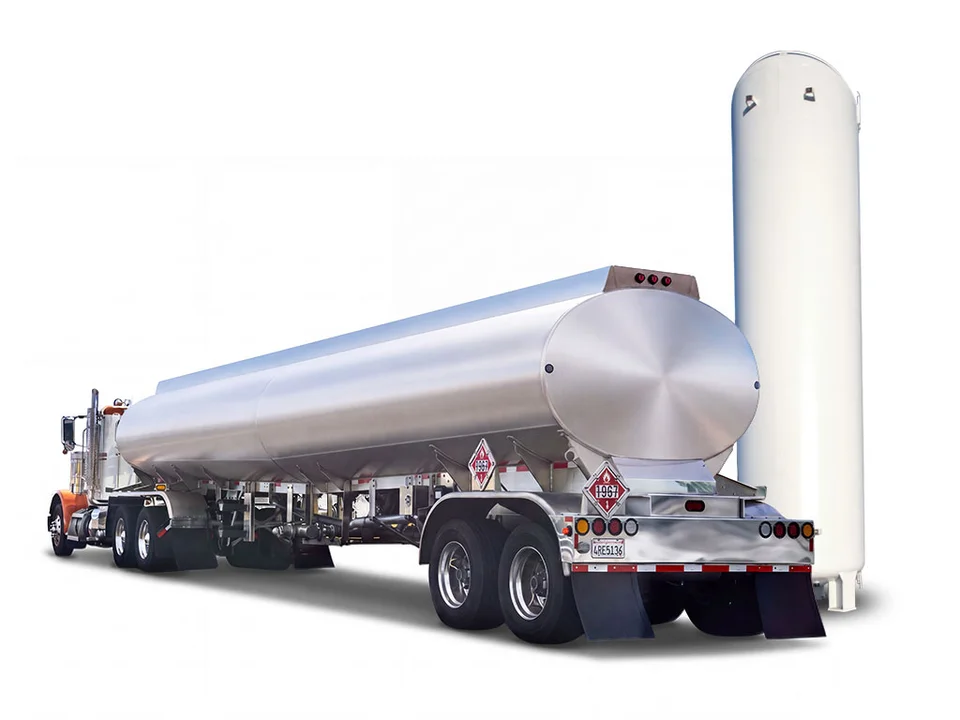
Liquid CO₂ Supply and Storage
Dry ice production starts with a reliable supply of liquid CO₂ and an on-site insulated reservoir sized to your consumption. Plants already running CO₂ snow, CO₂ injection, or modified atmosphere packaging usually have this in place, which makes adding a pelletizer close to plug and play. If you do not have a supply yet, Cold Jet can run a site visit to determine what you would need and arrange installation and leasing through trusted affiliates.
- 01. Liquid CO₂ Supply and Storage — Dry ice production starts with a reliable supply of liquid CO₂ and an on-site insulated reservoir sized to your consumption. Plants already running CO₂ snow, CO₂ injection, or modified atmosphere packaging usually have this in place, which makes adding a pelletizer close to plug and play. If you do not have a supply yet, Cold Jet can run a site visit to determine what you would need and arrange installation and leasing through trusted affiliates.
- 02. Foundation and Insulated Pipework — The CO₂ reservoir sits on a reinforced concrete foundation, and insulated pipework carries liquid CO₂ from the exterior tank to the production system. Keep pipe runs as short and as well insulated as practical to limit flash losses, and note that safety codes require pressure relief between shut-off valves.
- 03. Cold Jet Dry Ice Production System — The pelletizer is the heart of the operation, converting liquid CO₂ into high-density pellets, nuggets, or slices on demand. Size it to peak daily consumption rather than the average, and site it under cover with room for both the machine and dry ice storage. Cold Jet systems run from 176 lbs (80 kg) per hour up to 3,307 lbs (1,500 kg) per hour, with pre-configured production hubs available where floor space is tight.
- 04. Three-Phase Power and Compressed Air — The production system needs a three-phase electrical supply and a compressed air line to actuate system valves. Both are standard in a meat processing facility, and in most cases the existing plant supply is sufficient.
- 05. Ventilation, CO₂ Monitoring, and PPE — CO₂ gas displaces oxygen, so the production area needs artificial ventilation to maintain airflow and wall-mounted CO₂ PPM monitors. Operators handling dry ice need insulated gloves and eye protection to prevent cold burns. Cold Jet provides operator training on safe production, handling, and storage as part of installation.
- 06. Insulated Storage and Automated Dosing (Optional) — Dry ice held in quality insulated bins sublimates at roughly 3 to 5 percent per day, while storing it in a standard commercial freezer accelerates losses badly because of warmer ambient air and moving evaporator fans. For packing operations, automated dosing and bagging systems drop a pre-programmed weight of dry ice straight into boxes, combos, or totes on the line, which cuts manual handling and makes the dose consistent and auditable.
Equipment
What Is the Best Dry Ice Production Machine
for Meat Processing?
Cold Jet builds dry ice production systems sized from single-site processors to industrial multi-market protein hubs, in pellet, nugget, and slice formats, with automated dosing directly into boxes, combos, and totes.
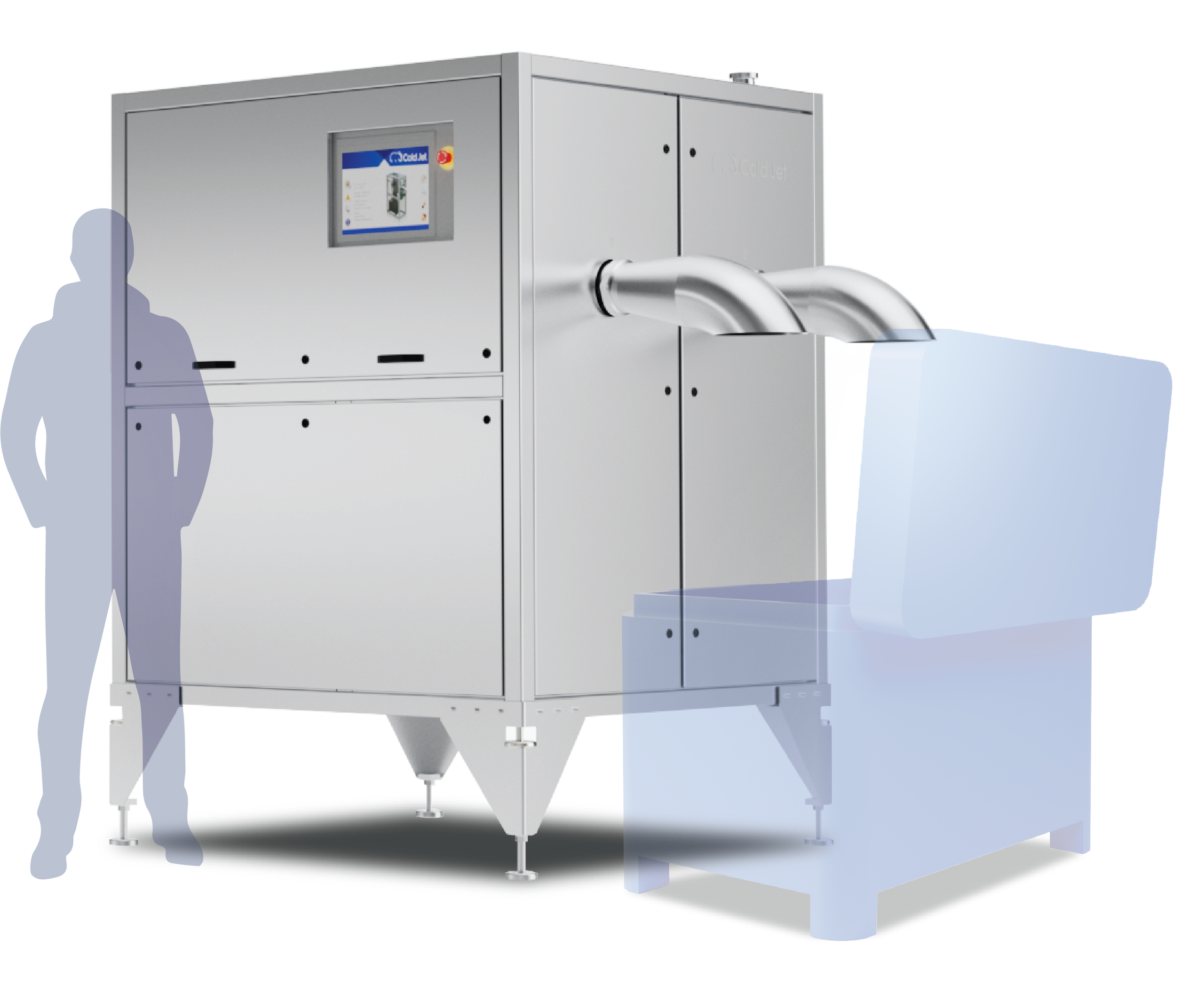
PR750H Dry Ice Pelletizer
The PR750H produces up to 1,653 lbs (750 kg) of dry ice per hour and is built for heavy-duty continuous runtime, which makes it the workhorse for industrial multi-market processing hubs running multiple shifts.
- Up to 1,653 lbs (750 kg) per hour
- Heavy-duty continuous runtime
- Pairs with RE-CO₂ recovery systems
- Ideal for industrial protein hubs
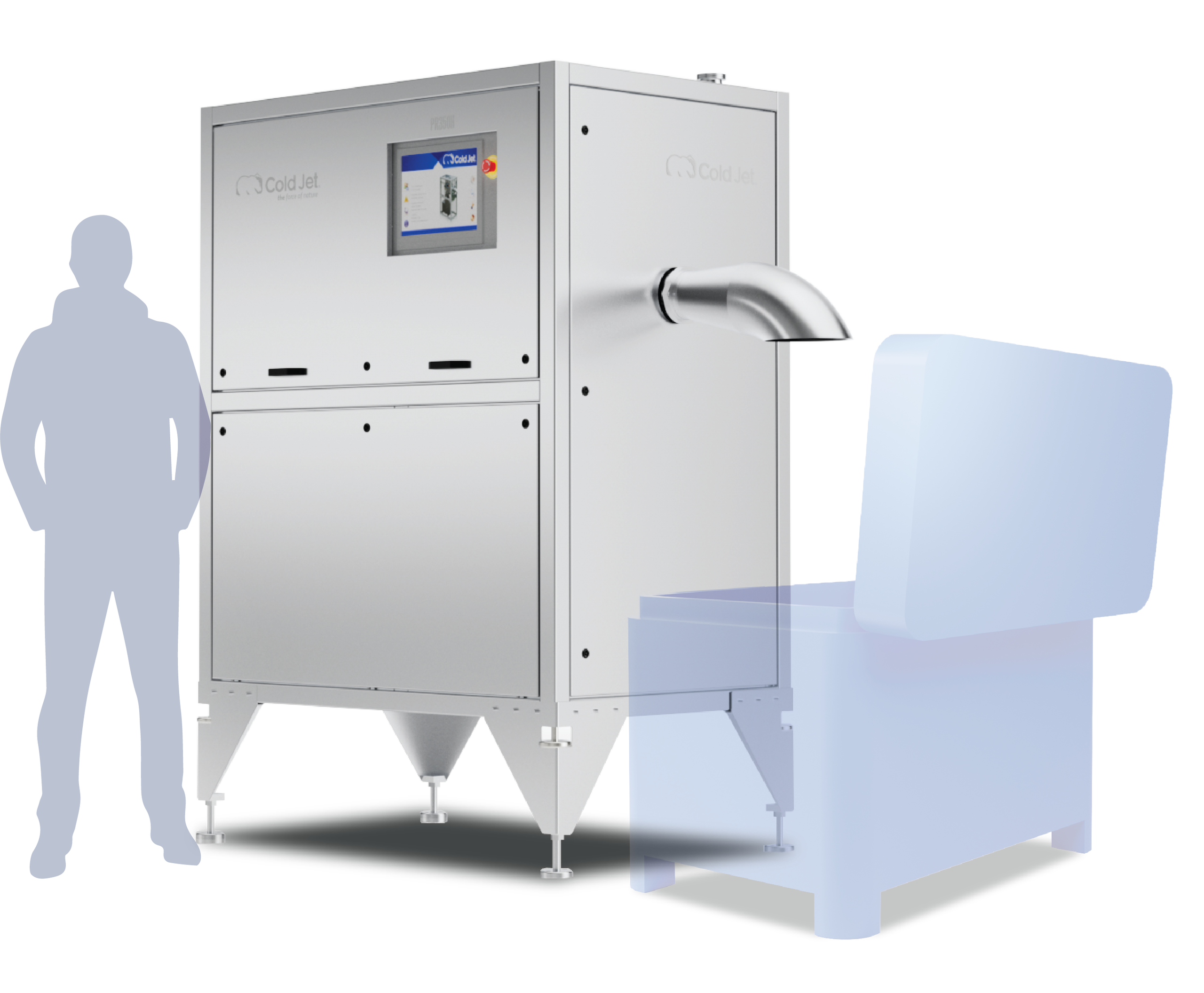
PR350H Dry Ice Pelletizer
The PR350H produces up to 772 lbs (350 kg) of dry ice per hour, enough to cover line chilling and shipping from a single machine at a large processing facility.
- Up to 772 lbs (350 kg) per hour
- 3 mm pellets and 10 to 16 mm nuggets
- Smart automation with digital control interface
- Ideal for large-scale processing facilities
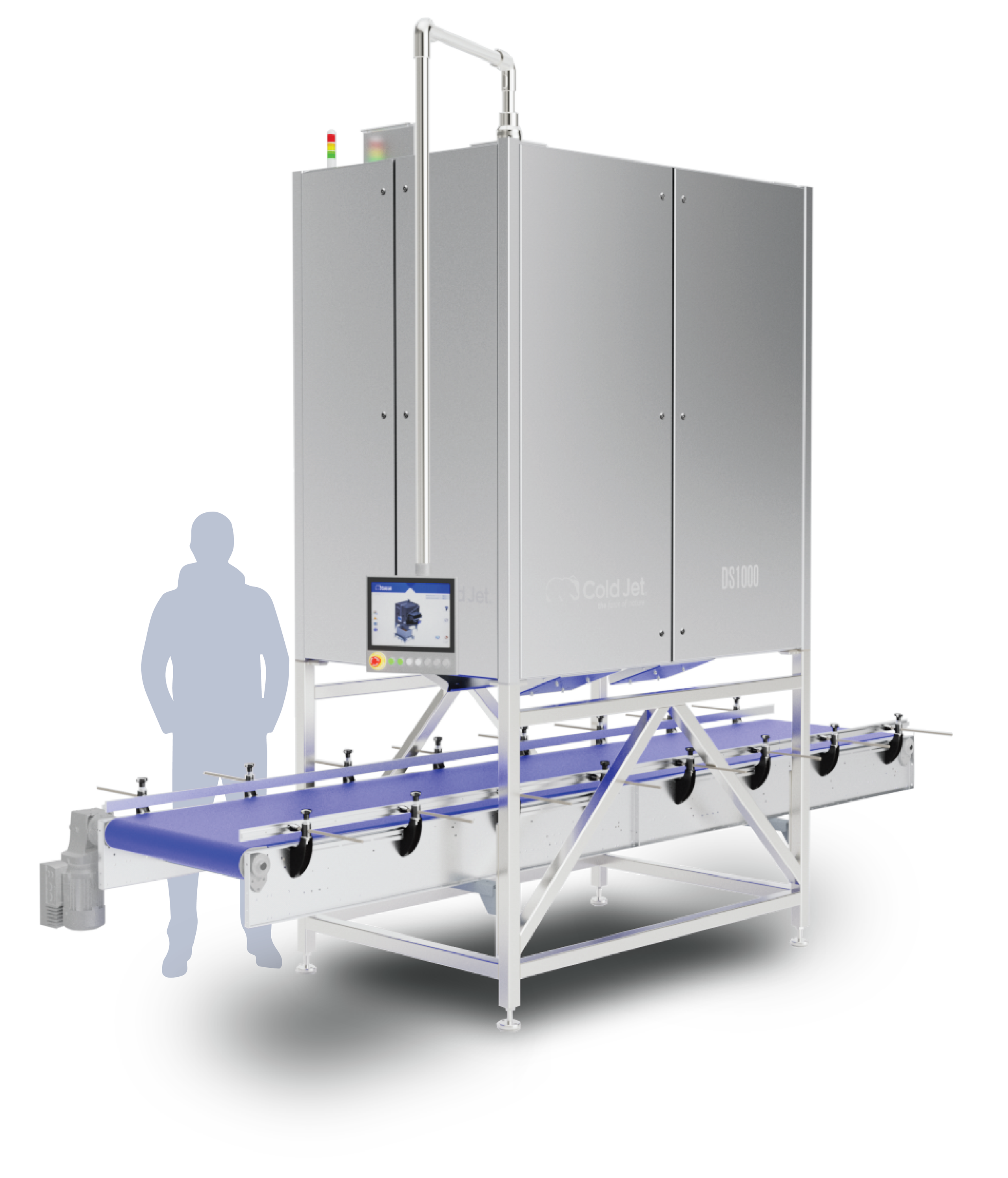
DS1000E Direct Slice System
The DS1000E produces and doses up to 2,204 lbs (1,000 kg) of dry ice slices in a single system, dropping a pre-programmed weight directly into boxes on the conveyor. It is custom-engineered for intermodal food transportation and meat chilling.
- Produce and dose up to 2,204 lbs (1,000 kg)
- Dry ice slices, dosed automatically
- Drops directly into boxes on the line
- Ideal for automated packing lines
Compare Systems
How Do These Three Systems Compare?
Side-by-side specifications for the Cold Jet dry ice production systems best suited to meat processing, so you can match output, format, and dosing to your lines.
PR750H
Industrial multi-market protein hubs
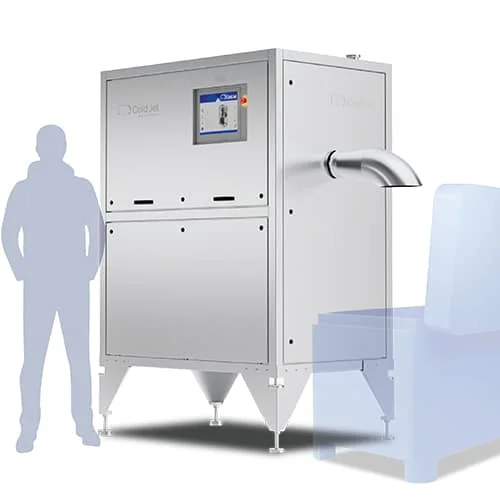
PR350H
Large-scale processing facilities
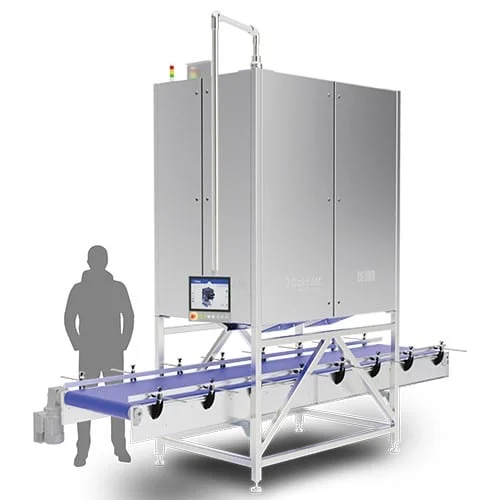
DS1000E
Production and dosing in one system
| Specification | PR750H | PR350H | DS1000E |
|---|---|---|---|
| Production Output | |||
| Best Fit for Meat Processing | High-volume, multi-shift plants chilling during grinding, mixing, and blending | Single-site line chilling and outbound shipping | Automated packing lines dosing slices straight into boxes |
| Production Capacity | Up to 1,653 lbs (750 kg) / hr | Up to 772 lbs (350 kg) / hr | Produce and dose up to 2,204 lbs(1,000 kg) |
| LCO₂ Conversion Efficiency | 12–14% better than other systems | 12–14% better than other systems | Sub-cooling technology |
| Dry Ice Format | 3 & 6 mm pellets, 10 & 16 mm nuggets | 3 & 6 mm pellets, 10 & 16 mm nuggets | 5 × 5 in slices, 0.5–2.2 lbs(0.25–1 kg) |
| Installation & Controls | |||
| Integrated Dosing | Available as an Integrated Dosing System, up to 81 lbs (37 kg) / min | Available as an Integrated Dosing System, up to 37 lbs (17 kg) / min | Built in, doses directly into boxes |
| Automatic Extruder Plate Change | Yes | Yes | Not applicable, slice weight set on the HMI |
| Control System | 15 in touchscreen, one-button operation | 15 in touchscreen, one-button operation | 15 in touchscreen, one-button operation |
| CO₂ Recovery Compatible (RE-CO₂) | ✓ Yes, with two RE-CO2 320V2 units | ✓ Yes, with one RE-CO2 320V2 | Not published |
| Cold Jet CONNECT® | Yes | Yes | Remote access over LAN or internet |
| Continuous Duty Operation | Yes, heavy-duty continuous runtime | Yes | Yes |
“—” indicates a specification Cold Jet has not published for this model. Contact a Cold Jet specialist to confirm fit for your application.
Why Cold Jet
Why Invest in a Cold Jet Dry Ice Production System
for Meat Processing
If you are moving from purchased dry ice, CO₂ snow, or water ice to in-house production, a Cold Jet pelletizer gives you a supply you control and a lower cost per pound of cooling.
When evaluating the investment, look at both the capital case and the operating case for your plant and your lanes. Cold Jet systems deliver faster payback and lower total cost through:
12–14% Better LCO₂ Conversion
Cold Jet’s proprietary sub-cooling technology uses waste gas to pre-cool incoming liquid CO₂, converting it to dry ice 12–14% more efficiently than other systems. At protein-processing volumes, liquid CO₂ is one of the largest operating costs, so that efficiency compounds every shift.
Proven in Protein
Cold Jet equipment already runs the dry ice operations of global food companies including JBS, Cargill, Conagra Brands, Greater Omaha, Danish Crown, HKScan, and Master Good. Our applications engineers have sized systems for kill floors, trim lines, further processing, and shipping operations worldwide.
Production on Demand
One-button operation and fast start-up mean you make dry ice when the line calls for it rather than holding inventory that sublimates while it waits. Automatic extruder plate changes let you switch between pellet and nugget sizes without stopping production.
CO₂ Recovery Built In
Our RE-CO₂ recovery systems capture the revert gas normally vented during production and recycle it into more dry ice, increasing output by up to 70 percent from the same volume of liquid CO₂. Fewer emissions, and a lower cost per pound of cooling.
Uptime and Global Support
A dedicated global service organization of more than 70 experts supports Cold Jet production systems, and Cold Jet CONNECT lets us monitor, diagnose, and act remotely. When a peak season is running, the machine keeps running.
Custom-Engineered Integration
From automated dosing into boxes and combos to bagging systems for last-mile delivery, Cold Jet designs, builds, and installs systems that fit your line rather than asking the line to fit the machine.
Our Customers & What They Say About Us
Meat processors around the world rely on Cold Jet
Cold Jet dry ice production systems already run at global protein companies including JBS, Cargill, Conagra Brands, Greater Omaha, Danish Crown, and HKScan.





Compliance
Food Safety and Cold Chain Standards
We Help You Meet
Dry ice is a food-safe cooling medium recognized by the FDA, USDA, and EPA, and it helps processors hold critical control points across HACCP, FSMA, and EU hygiene requirements without introducing water to the process.
9 CFR Part 417
USDA FSIS HACCP Systems
FSIS requires official meat and poultry establishments to operate a HACCP plan that identifies food safety hazards and controls them at defined critical control points, with temperature control central to nearly every plan.
How We Comply
Dry ice holds a constant -109 °F (-78.5 °C) until fully sublimated, so temperature at the critical control point becomes a function of dose and dwell time rather than of equipment performance. Doses can be pre-programmed and recorded, which supports monitoring and verification records.
FSMA Sanitary Transportation Rule
21 CFR Part 1 Subpart O
The FSMA Sanitary Transportation of Human and Animal Food rule requires vehicles and transportation equipment to maintain the temperatures needed to keep food safe in transit, and requires the process to be documented.
How We Comply
Passive dry ice cooling does not depend on a vehicle's refrigeration unit, so temperature control survives equipment failures, power interruptions, and long dwell times at terminals. There is no melt water to pool on trailer floors or create a cross-contamination route.
Regulation (EC) 853/2004
EU Hygiene Rules for Meat
EU hygiene rules require chilling along a continuous decreasing curve to no more than 7 °C for red meat carcasses, 3 °C for offal, and 4 °C for poultry meat, with those temperatures maintained through cutting, storage, and transport.
How We Comply
Dry ice delivers cooling headroom well beyond those thresholds and can be applied directly at the point where product is handled, which helps hold the curve through cutting, boning, and packing rather than relying on ambient chill alone.
IATA PI 954
Dangerous Goods Regulations, UN1845
Meat shipped by air with dry ice moves as UN1845, Carbon dioxide solid, a Class 9 dangerous good under IATA Packing Instruction 954. Packaging must vent CO₂ gas, net weight must be marked on each package, and the air waybill must carry the required entry.
How We Comply
Cold Jet dosing systems produce a known, recorded net weight of dry ice per package, which is exactly what PI 954 marking and air waybill entries require. Operator limits vary by airline, so confirm allowances with each carrier.
Food-Safe Recycled CO₂
FDA, USDA and EPA Recognized
Cooling media in direct or indirect contact with meat must be safe for food use and must not transfer taint, residue, or contamination to the product. Processors are also under growing pressure to account for the emissions attached to their cooling choices.
How We Comply
Dry ice is non-toxic, tasteless, and odorless, and it sublimates completely, leaving no residue on product or packaging. It is made from recycled CO₂ captured at industrial and biogas facilities, and because that CO₂ is accounted for at the producer level it is not counted again at the point of use.