Summary
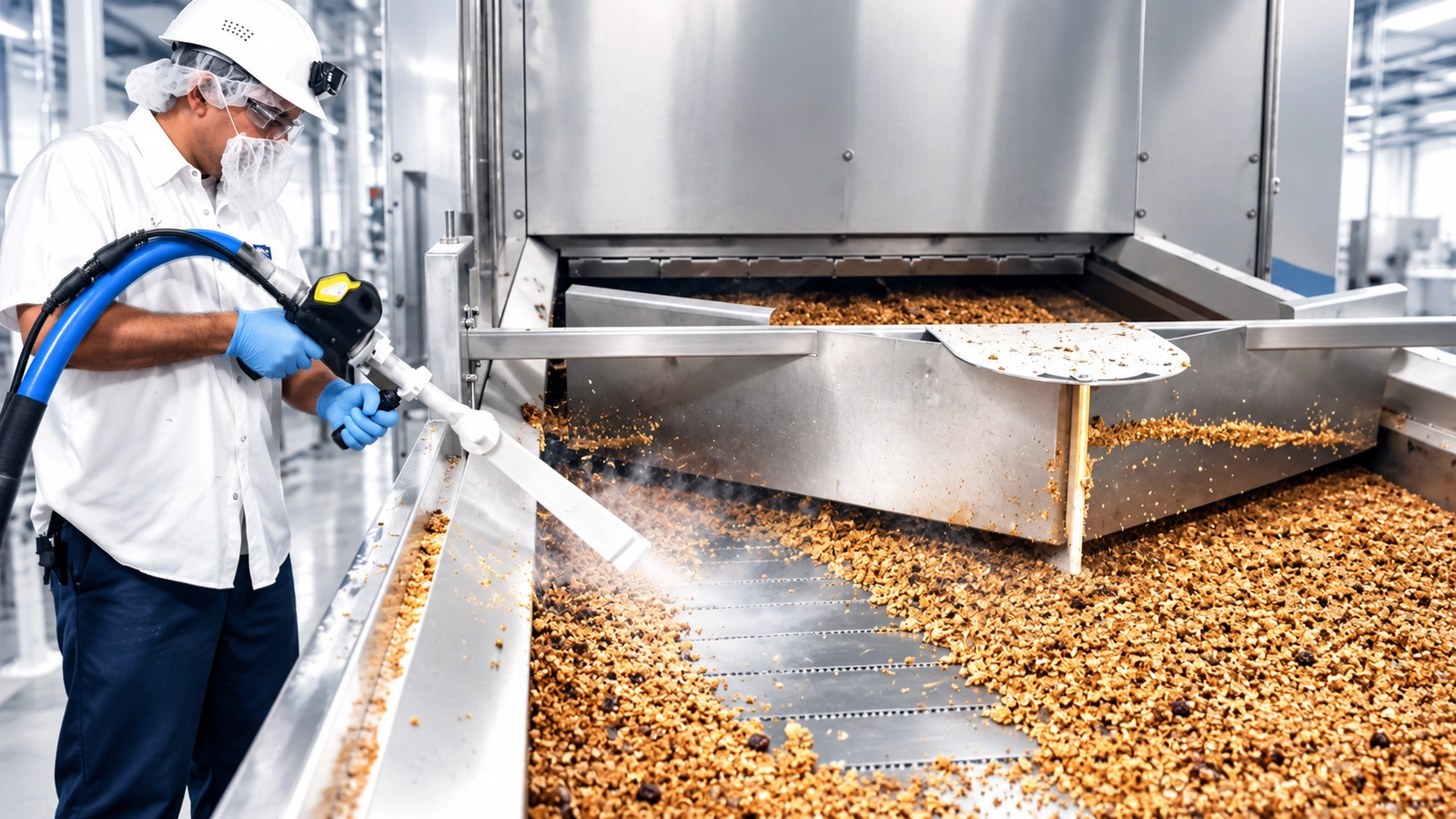
Cold Jet dry ice blasting cleans food and beverage processing equipment in-place, without water, chemicals, or secondary waste. Dry ice is an FDA-approved, non-toxic, food-grade media that removes grease, carbonized residue, proteins, and biofilms while equipment is running – reducing cross-contamination and bacteria counts while maintaining food safety compliance.
What is dry ice blasting used for in food and beverage processing?
Dry ice blasting is a waterless, non-abrasive, non-conductive cleaning method used in food and beverage plants to clean processing and packaging equipment in-place – including mixers, ovens, conveyors, extruders, packagers, and electrical components – often while equipment is still hot and running. Dry ice is an FDA-approved, non-toxic, food-grade media that leaves no water, chemicals, or secondary waste. It removes grease, carbonized residue, proteins, sugar and starch deposits, biofilms, and dairy residues, reducing cross-contamination and delivering log reductions in bacteria counts. Because cleaning happens online with little disassembly or masking, plants dramatically cut downtime, labor, and costs while maintaining hygiene and food safety compliance. It is safe for stainless steel, seals, gaskets, sensors, and motors. Cold Jet has more than 24,000 machines installed globally across bakeries, dairy, meat, beverage, and snack food facilities.
The Downtime and Contamination Risks of Conventional Cleaning
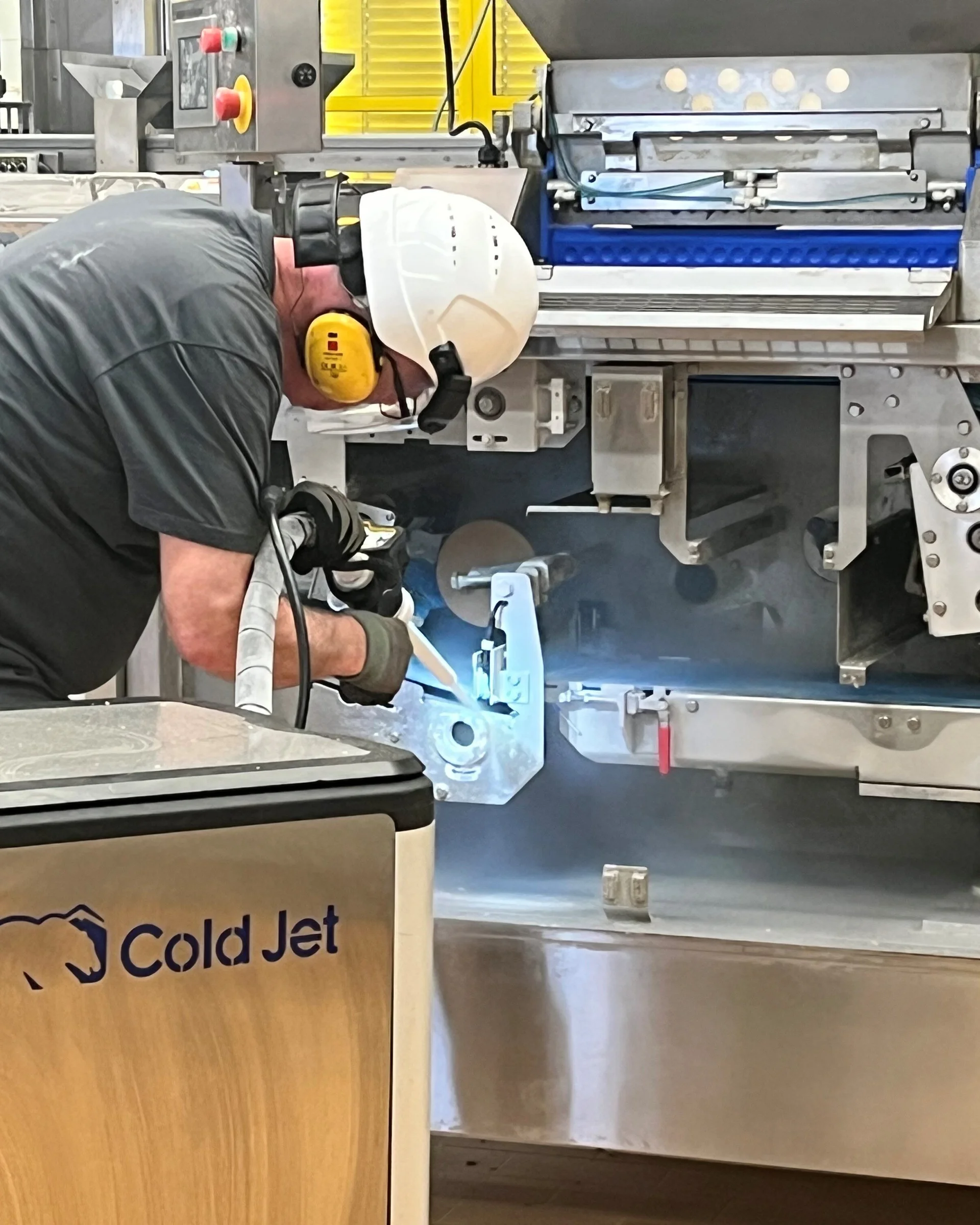
Food processing and packaging equipment accumulates grease, carbonized residue, proteins, bacteria, biofilms, adhesives, and labels that take significant time to clean. These deposits reduce efficiency, compromise product quality, and risk non-compliance with health and safety standards.
Dry ice blasting is the only food-industry cleaning method that is non-destructive, cleans without water or chemicals, produces no secondary waste, and can clean online. The FDA-approved, food-grade media removes contaminants while reducing cross-contamination and bacteria counts, without shutting down the line.
Log Reductions
In Bacteria Counts
Removes
Biofilms Without Chemicals
Non-Abrasive
Won't Scratch Stainless
Online
Clean While Running
Benefits of Dry Ice Blasting for Food and Beverage Plants
Dry ice blasting is a dry cleaning process that does not produce secondary waste or residue
Dry ice cleaning machines offer an effective, dry, sustainable, and non-destructive cleaning process that can be performed in-place, which eliminates or reduces costly shutdown time for cleaning. Hard to reach corners and crevices are easily cleaned with dry ice blasting, resulting in an improved overall clean in your plant.
Not only does dry ice cleaning remove contaminants, but it will also reduce the risk of cross contamination, result in log reductions in bacteria counts, and will remove biofilms without water or chemicals – all while significantly reducing cleaning time, labor, and overall costs. Food grade dry ice approved by FDA for use around food.
 Dry process
Dry Cleaning Process
Dry ice does not produce a secondary waste stream that must be contained, collected, and disposed. Dry ice blasting eliminates the need for water and does not use detergents, solvents, or other chemicals in the food cleaning process. This minimizes containment setup and eliminates the timely and costly task of waste collection and disposal.
 Productivity
Clean Online or In-Place
Dry ice blasting allows food processing equipment to be cleaned while still hot and running, eliminating or drastically reducing the need for disassembly. Production lines can maintain operation during cleaning processes, dramatically reducing costly downtime and labor.
 Safety
Non-toxic and Safe for Employees
Dry ice cleaning is an occupationally safe cleaning solution. Dry ice is non-toxic and safer for employees than traditional cleaning methods. The process eliminates tedious manual cleaning and eliminates exposure to chemicals.
 Safe on Equipment
Non-Abrasive and Non-Conductive Cleaning Process
Dry ice cleaning is safe for sensitive equipment in food processing facilities as it does not damage surfaces, scratch stainless steel components, or wear down seals and gaskets like traditional abrasive cleaning methods. Dry ice is also non-conductive and cleans electronics, sensors, and motors without damage.
 Better Clean
More Effective Cleaning
Dry ice blasting equipment delivers superior cleaning results compared to traditional methods. The process requires less labor while achieving faster and more thorough cleaning outcomes. Unlike conventional techniques, dry ice cleaning will not lead to embedded fouling and leaves no chemical residue or moisture behind, which reduces the risk of corrosion and abrasion. The cleaning process also eliminates micro-organisms, which can lead to coating and paint failure on vital piping and pipelines.
 Sustainability
Supports Sustainability Goals
Dry ice eliminates chemicals and water waste. Dry ice cleaning machines support sustainability goals while maintaining the highest food safety standards with zero secondary waste generation.
What Can Be Cleaned with Dry Ice in Food and Beverage Facilities?
Dry ice blasters consistently outperform traditional methods throughout the entire food manufacturing ecosystem. Our technology delivers exceptional results for beverage production, chocolate and confectionary manufacturing, commercial bakeries, coffee roasters, dairy product manufacturing, frozen food facilities, ingredient and spice manufacturing, meat and poultry processing plants, snack foods manufacturing, and tree nut processors.
- Beverage Production
- Chocolate and Confectionary Manufacturing
- Commercial Bakeries
- Coffee Roasters
- Dairy Product Manufacturing
- Frozen Food Facilities
- Ingredient and Spice Manufacturing
- Meat and Poultry Processing Plants
- Snack Foods Manufacturing
- Tree Nut Processors
Food Processing and Production Equipment
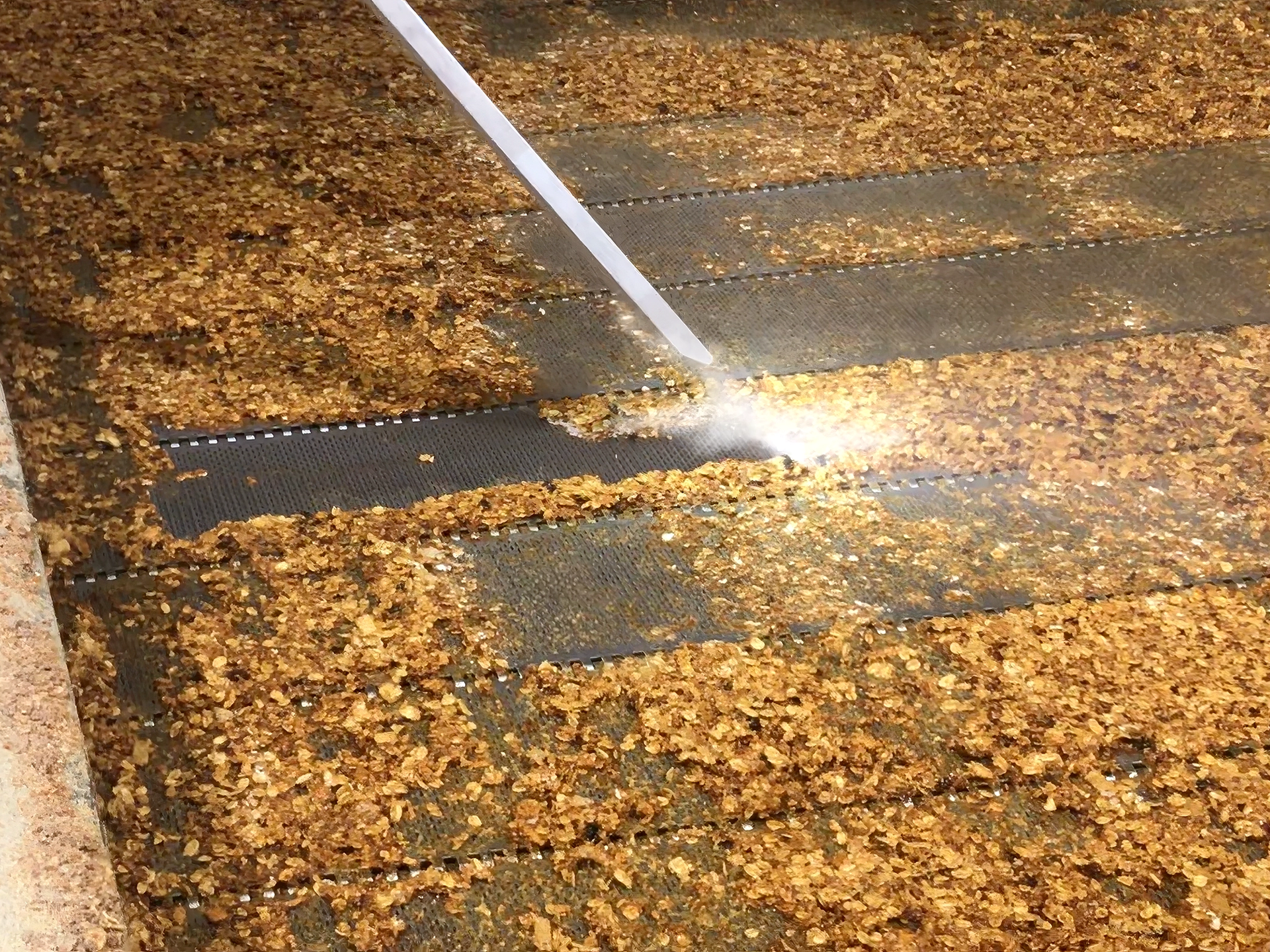
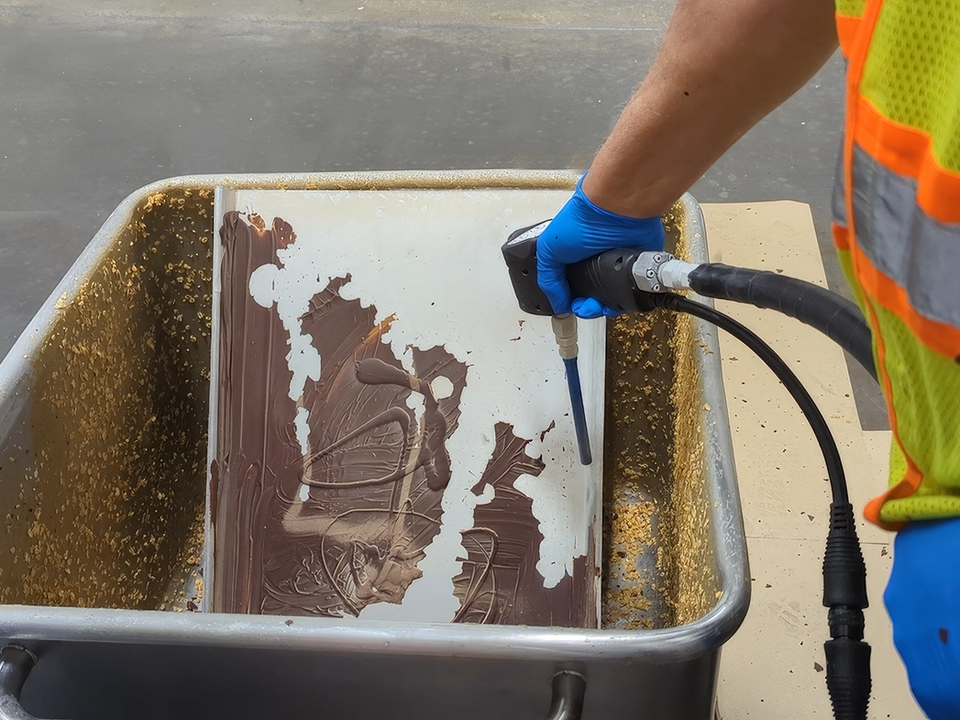
Dry ice blasting thoroughly cleans contamination from food and beverage processing and production equipment in-place, without water or chemicals, and even while the equipment is still hot and running. Because the process is dry and non-abrasive, it is safe for stainless steel surfaces, seals, gaskets, and sensitive electrical components, and it reaches the corners, crevices, and hard-to-access areas that traditional cleaning methods miss.
The dry cleaning process removes a wide range of food processing contaminants, including carbonized food particles, burnt-on food residues, protein buildup, grease and oils, fats and fatty acids, sugar and syrup deposits, caramelized sugar, starch buildup, seasoning residues, caked-on dough and batter, yeast and mold growth, and dairy residues.
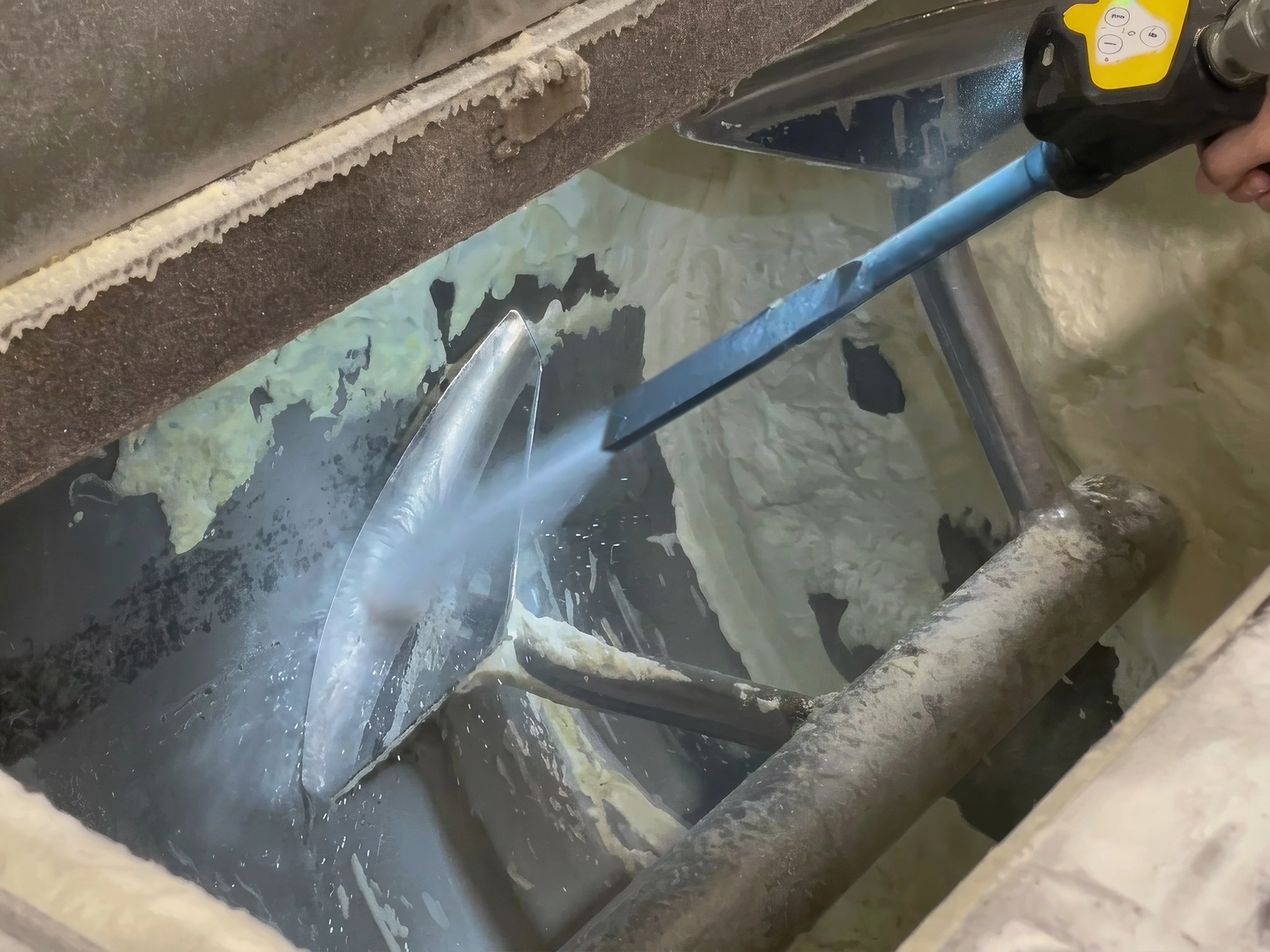
- Mixers and blenders
- Slicers and dividers
- Roasters
- Ovens
- Proofers
- Dryers
- Extruders
- Molds
- Mills
- Load-out bins
- Conveyors and chains
- Electrical components and motors
- Cold storage
- Floors, walls, ceilings, ducts, and pipes
Food Packaging Equipment
Packaging equipment collects adhesives, labels, glue, product dust, and residue that slow lines down, cause jams and misfeeds, and create hygiene risks at the final stage before product leaves the facility. Dry ice blasting removes this buildup in-place, without water, chemicals, or disassembly, so packaging lines can be returned to service quickly. Because dry ice is non-conductive and leaves no secondary waste, it can be used safely around the sensors, motors, and electrical components found on automated packaging lines.
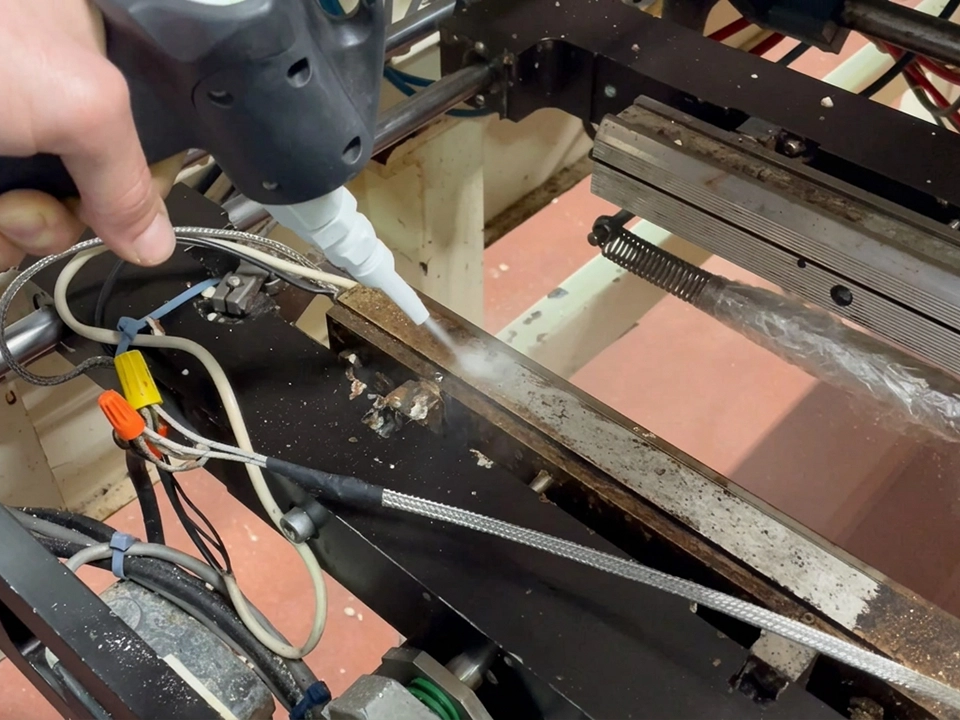
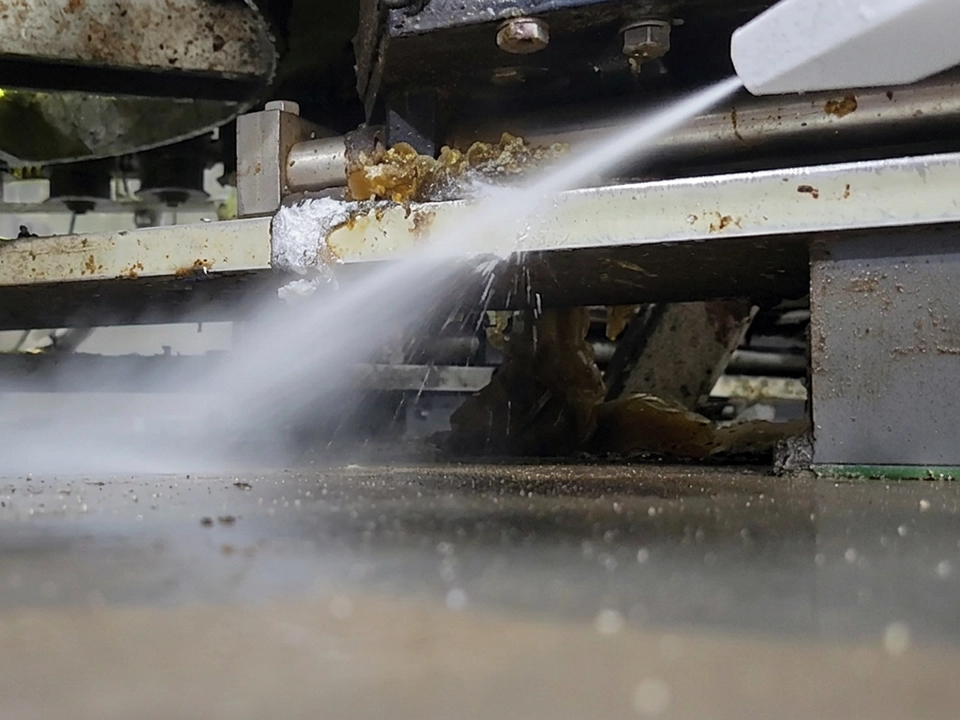
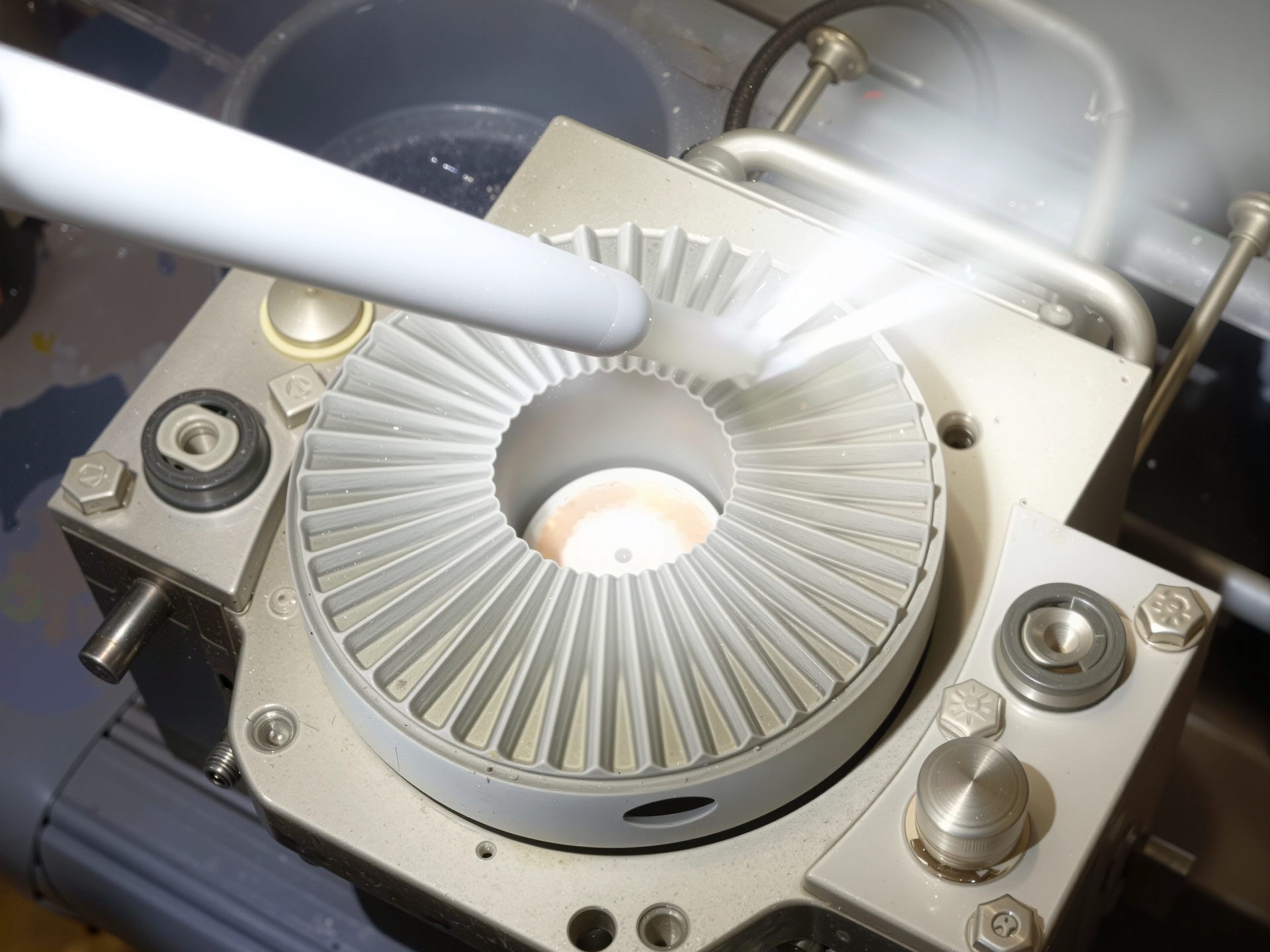
- Radial feeders (Ishida weighers)
- Wrappers and packagers
- Baggers
- Pack-off tables
- Labelers
- Box formers
- Glue applicators
- Palletizers and de-nesters
- Conveyors and chains
- Electrical components and motors
- Floors, walls, ceilings, ducts, and pipes
What Do Food & Beverage Processors Need for Dry Ice Cleaning?
When implementing dry ice blasting for cleaning in food and beverage processing facilities, you will need equipment beyond just the dry ice blasting cleaning machine. The following components are essential for an effective, food-safe cleaning and sanitation program.
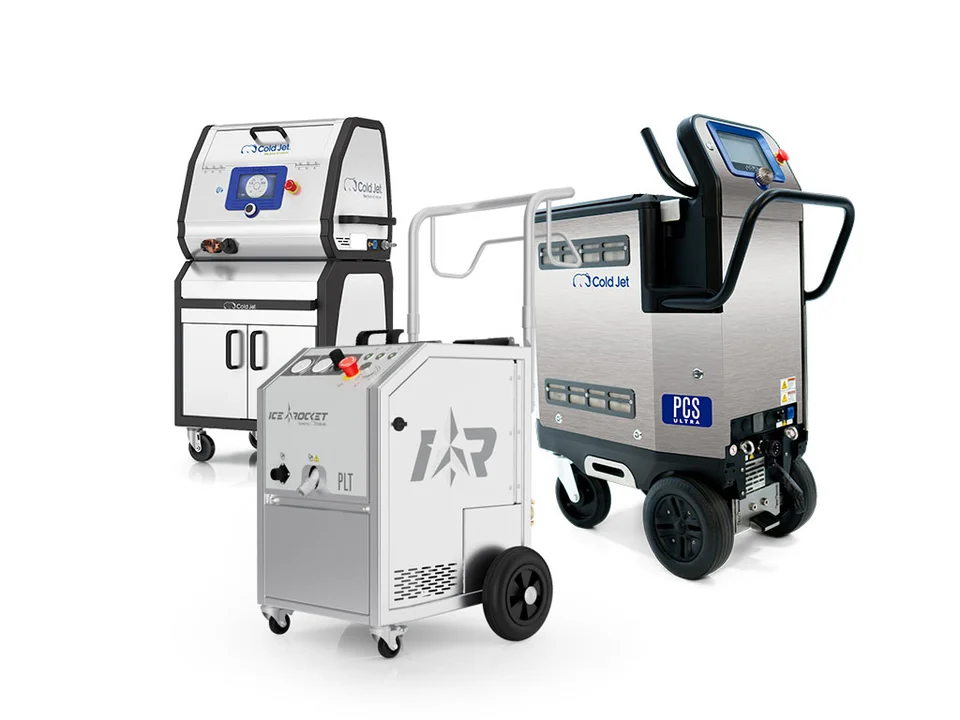
Step 01
Food Grade Dry Ice Blaster
The foundation of your cleaning and sanitation program starts with a reliable and easy to use dry ice blasting system. Cold Jet offers a variety of dry ice blasting cleaning machine models to choose from, including models with features like stainless steel components, smooth surfaces for easy sanitizing, and compliance with food safety standards. The systems will come complete with a blast and air hose, an applicator, and a nozzle that is best suited for your application.
- 01. Food Grade Dry Ice Blaster — The foundation of your cleaning and sanitation program starts with a reliable and easy to use dry ice blasting system. Cold Jet offers a variety of dry ice blasting cleaning machine models to choose from, including models with features like stainless steel components, smooth surfaces for easy sanitizing, and compliance with food safety standards. The systems will come complete with a blast and air hose, an applicator, and a nozzle that is best suited for your application.
- 02. Air Compressor — Compressed air can be supplied from your facility’s existing filtered air system or from a dedicated mobile compressor with appropriate filtration. For food and beverage applications, air quality is critical. Systems should include moisture separation and oil filtration to prevent contamination. Typical food grade dry ice cleaning systems require 100 cfm (2.8 m³/min) at 80 psi (5.5 bar).
- 03. Food Grade Dry Ice Supply — Regular access to food grade dry ice is essential for maintaining continuous cleaning operations. Average consumption is approximately 88 lbs. per hour. Partner with suppliers who can certify their dry ice meets food-contact standards and establish a reliable delivery schedule aligned with your cleaning and sanitation windows.
- 04. Machine and Operator Training — Proper training is essential for cleaning and sanitation teams using dry ice blasting in food environments. Cold Jet offers a training course designed to equip your team with the skills to operate the machine confidently. The course covers essential operation techniques, effective cleaning methods, and important safety guidelines.
- 05. Personal Protective Equipment (PPE) — Food cleaning and sanitation staff should be equipped with food industry appropriate personal protective equipment, including: clean gloves, face shields or safety glasses, and hearing protection.
How Dry Ice Blasting Compares to Alternatives
See how dry ice blasting stacks up against traditional cleaning methods across the criteria that matter most in food and beverage processing.
| Criteria | Dry Ice Blasting Best | Chemical Cleaning | Manual Cleaning | Ultrasonic Cleaning | Pressure Washing |
|---|---|---|---|---|---|
| Secondary Waste | None – sublimates to gas, no residue | High – wastewater and sanitizer runoff | Moderate – used water, chemicals, rags | Moderate – contaminated solution to dispose | High – contaminated wastewater to treat |
| Speed | Fast – cleans online, no disassembly | Slow – wash, rinse, and dry cycles | Slow – labor intensive scrubbing | Moderate – batch immersion cycles | Moderate – plus drying time after |
| Equipment Damage | None – won't scratch steel or seals | Possible – corrosive to some surfaces | High – scrubbing wears surfaces | Possible – limited to immersible parts | Possible – moisture harms electrical |
| Regulatory Compliance | Strong – FDA food-grade, no chemicals | Limited – sanitizer residue and rinse | Inconsistent – operator dependent | Moderate – chemical handling required | Limited – moisture can harbor bacteria |
| Downtime | Minimal – clean while running | High – teardown, wash, dry time | High – disassembly and drying | High – removal and immersion | High – drying time before restart |
| Environmental Impact | Low – no water/chemicals, reclaimed CO₂ | High – wastewater and chemical disposal | Moderate – water and chemical use | Moderate – chemical solutions and water | High – high water use and wastewater |
What is the best machine for dry ice blasting in a food and beverage facility?
Cold Jet offers a comprehensive range of dry ice blasting machines for food and beverage processing environments. Our user-friendly machines effectively clean processing equipment without disassembly, helping you minimize downtime while ensuring food safety compliance.
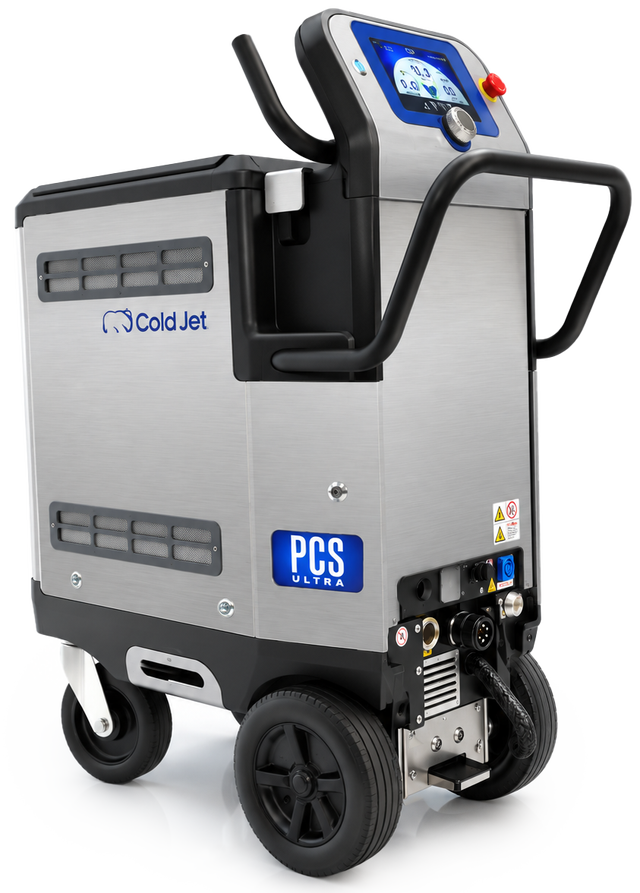
Aero2® PCS® ULTRA
The Aero 2 PCS ULTRA is a versatile machine for a variety of applications in Food and Beverage facilities, from gentle cleaning with MicroParticle dry ice to aggressive cleaning of larger surfaces with 3 mm dry ice granules.
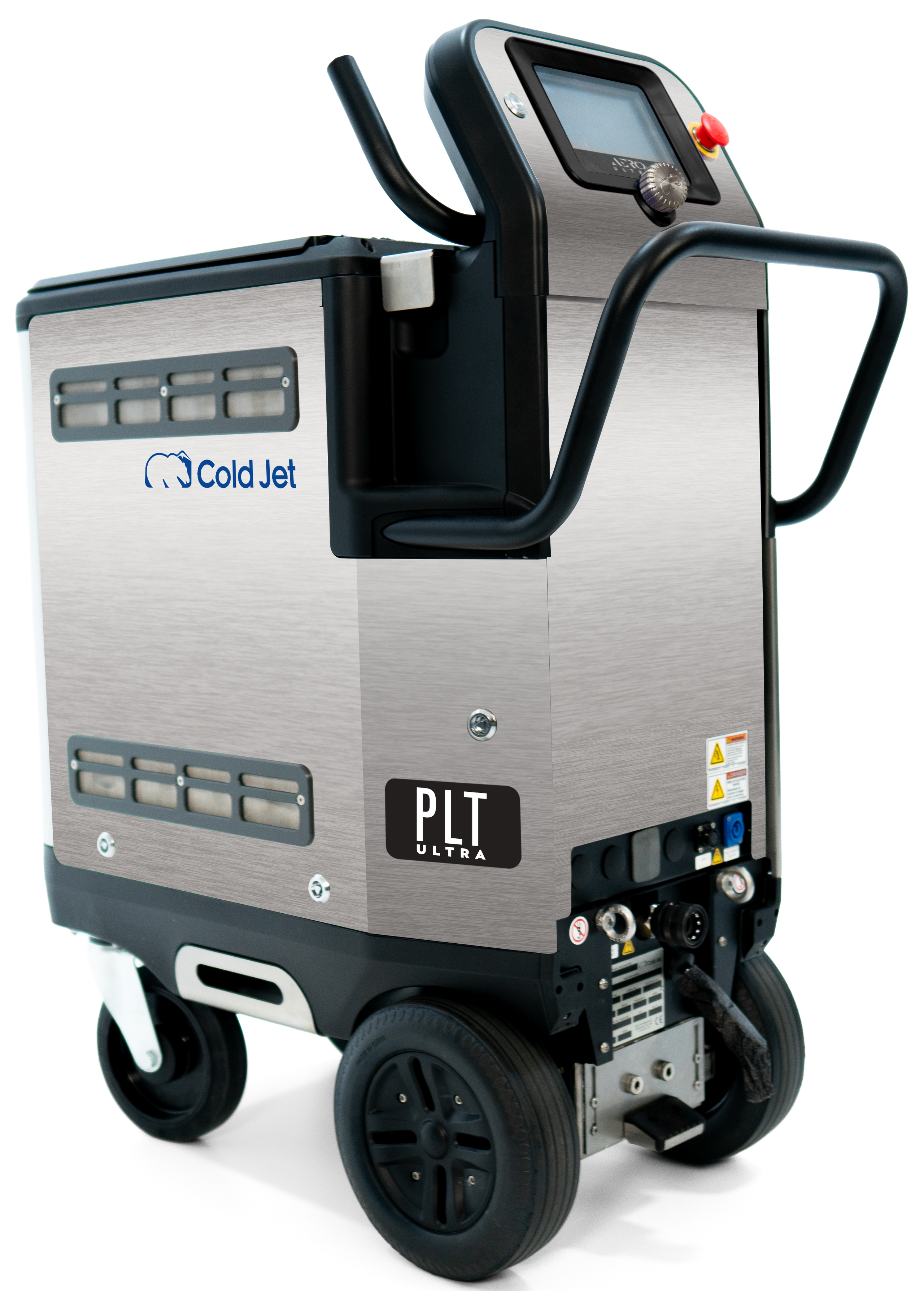
Aero2® PLT® ULTRA
The Aero2 PLT ULTRA offers greater power to tackle even the most stubborn contaminants in food and beverage plants, thanks to its innovative air system for a consistently powerful, pulse-free blast.
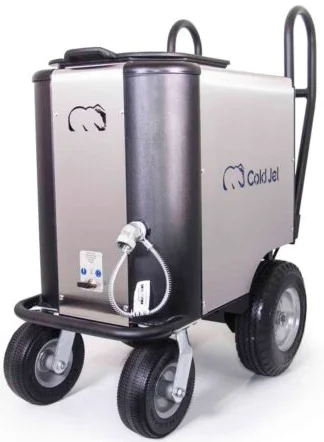
Aero® 40FP
The Aero 40FP is a durable and powerful machine for heavy-duty work. It has superior performance when cleaning in the toughest food and beverage environments.
Which Dry Ice Blaster Fits Your Food Processing Line?
Compare the Cold Jet dry ice blasters food and beverage producers rely on, so you can match each machine to your equipment, sanitation schedule, and dry cleaning needs.
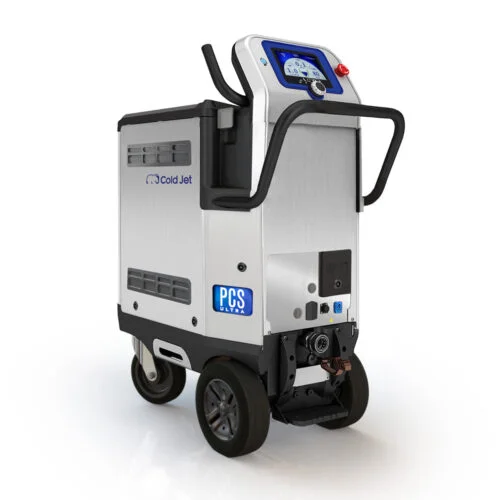
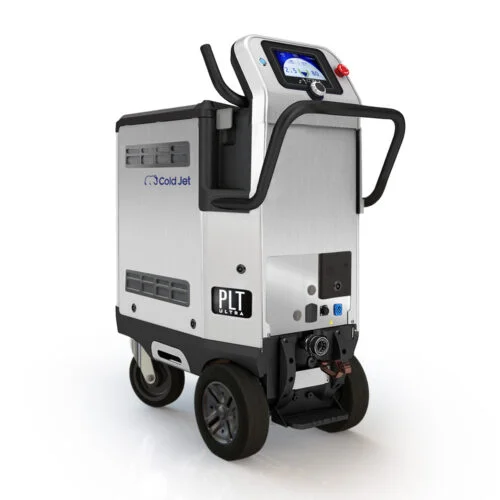
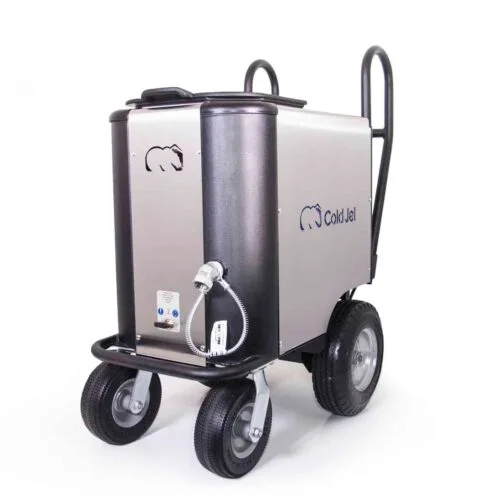
| Specification | Aero2® PCS® ULTRA | Aero2® PLT® ULTRA | Aero® 40FP |
|---|---|---|---|
| Particle Control | Variable(0.3mm to 3.0mm, 28 sizes) | Standard(3mm) | Standard(3mm) |
| Controls | Digital(7" LCD, Recipes, IoT) | Digital(7" LCD, Recipes, IoT) | Analog / Standard |
| Feeder Technology | Two-Stage + Defrost Cycle | Two-Stage + Defrost Cycle | Advanced Radial Feeder |
| Application Intensity | Versatile(Precision to Aggressive) | Highly Aggressive / High Power | Moderate to Aggressive |
| Automation & Integration Capable | Yes | Yes | No |
| Hopper Capacity | 60 lbs(27 kg) | 60 lbs(27 kg) | 40 lbs(18 kg) |
Why Invest in Cold Jet Machines to Clean in Food and Beverage Plants?
When evaluating this capital investment, consider both the return on investment (ROI) and operational benefits specific to your food processing facility. Cold Jet machines deliver faster ROI and greater value.
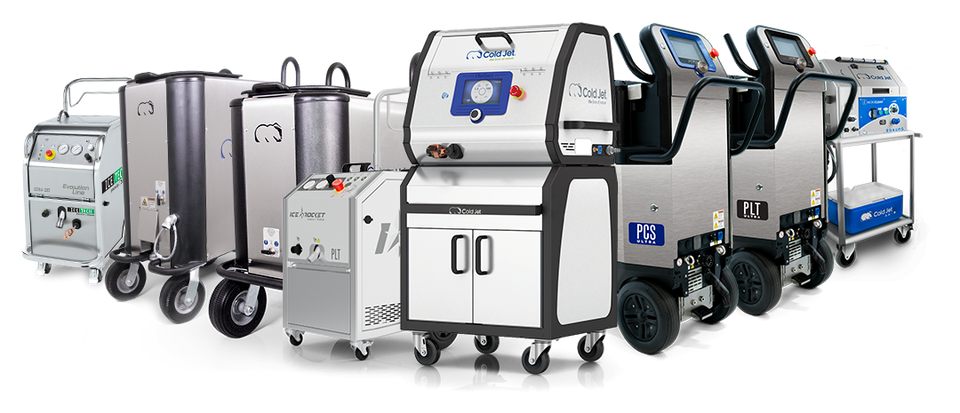
Food Safe, Compliant Cleaning Technology
Our machines are engineered for food grade environments and have a significantly longer machine life than competitors.
Industry Leading Reliability
With more than 24,000 machines installed globally, we’ve established ourselves as the trusted solution for food industry cleaning challenges.
Lower Operating Costs
Our machines use significantly less dry ice, compressed air, and electricity than competitors, reducing your daily operational expenses while maintaining superior cleaning results.
Industry Leading Support and Training
Our regional technicians understand the unique requirements of your food manufacturing environment and are always within reach. We provide not only service, but also professional operation training.
Application Specific Accessories
Our comprehensive range of nozzles, applicators, blast hoses, and other accessories allow you to customize cleaning approaches for different processing equipment.
Thousands of Food and Beverage customers around the world rely on Cold Jet
With a global install base of 24,000+ that consists of companies large and small, Cold Jet delivers real value to the Food Industry.




Meeting Food Safety Standards
Dry ice blasting helps food and beverage processors meet hygiene, food safety, and sustainability requirements without water or chemicals.
Food-Grade Cleaning Media
Cleaning media used around food must not compromise product taste, quality, or safety, and must meet food-contact requirements.
Dry ice is an FDA-approved, non-toxic, colorless, tasteless, and odorless food-grade media that cleans without introducing water, chemicals, or residue.
Bacteria & Biofilm Control
Food safety programs require controlling harmful bacteria, biofilms, and cross-contamination on processing and packaging equipment.
Dry ice blasting removes biofilms and helps support log reductions in bacteria counts without water or chemicals, reducing the risk of cross-contamination.
Sustainability & Water Use
Processors increasingly need to reduce water use, chemical waste, and disposal to meet sustainability and environmental goals.
Dry ice blasting eliminates water and chemicals and generates no secondary waste stream, supporting sustainability goals while maintaining food safety.