What You'll Learn
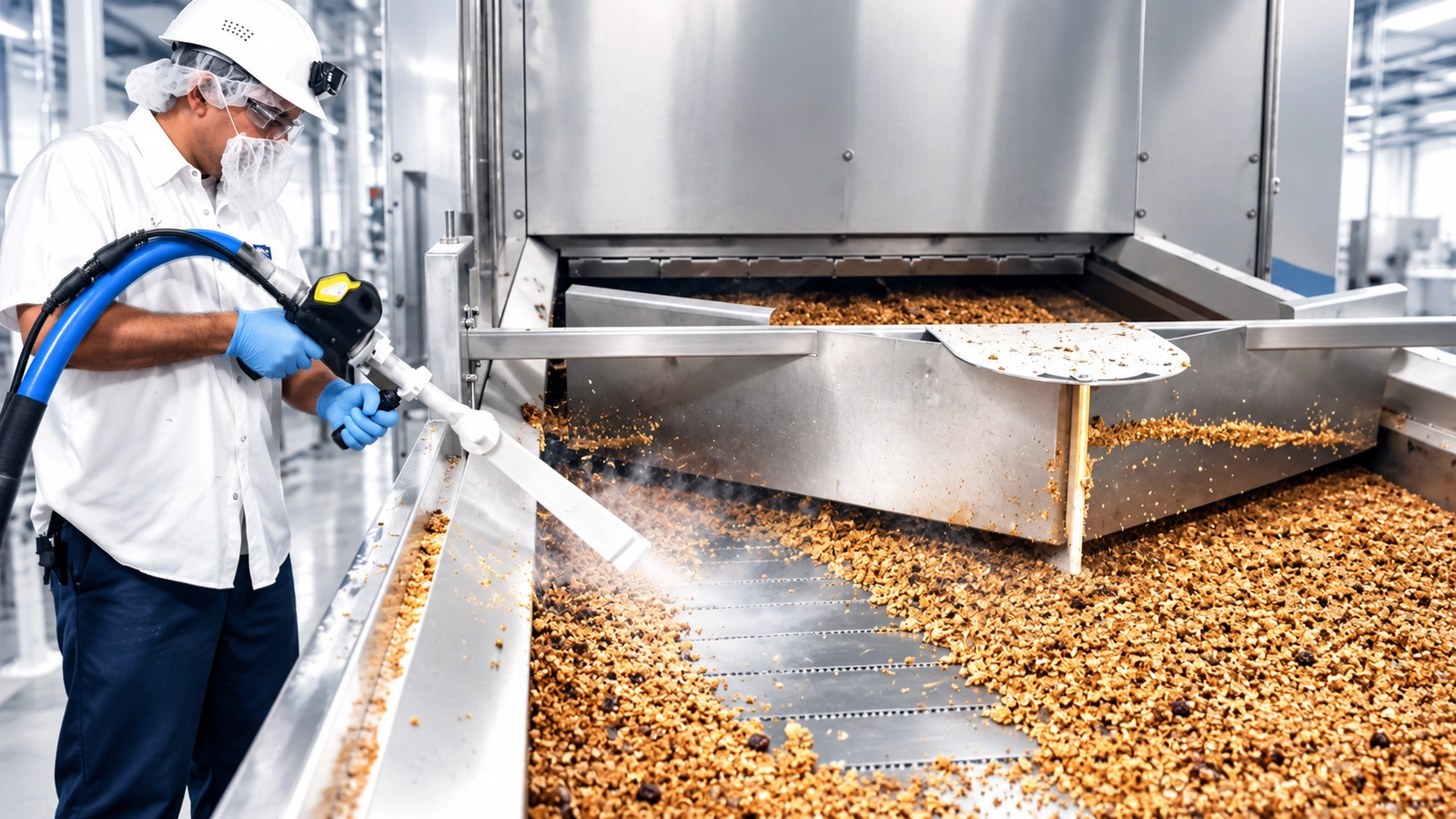
How dry ice cleaning works and delivers cleaning results without water, chemicals or secondary waste
How dry ice cleaning improves food safety compliance and reduces labor, water and energy costs
How cleaning equipment online, even while hot and running, eliminates costly shutdowns
How dry ice blasting significantly reduces cleaning time compared to traditional methods
Real-world applications in food and beverage facilities, and what equipment your plant needs to implement dry ice blasting
Who Should Watch
Common roles & teams
Sanitation Managers
Food-safe, water-free, and chemical-free cleaning validated for food contact surfaces.
Operations Managers
Reduce planned or unplanned downtime and clean equipment in-place without disassembly.
EHS / Safety Managers
Cut chemical exposure, VOCs, and repetitive-motion injury risk for crews.
- Sanitation Managers
- Operations Managers
- EHS / Safety Managers
How Dry Ice Blasting Compares to Alternatives
See how dry ice blasting stacks up against traditional cleaning methods across the criteria that matter most in food and beverage processing.
| Criteria | Dry Ice Blasting Best | Chemical Cleaning | Manual Cleaning | Ultrasonic Cleaning | Pressure Washing |
|---|---|---|---|---|---|
| Secondary Waste | None – sublimates to gas, no residue | High – wastewater and sanitizer runoff | Moderate – used water, chemicals, rags | Moderate – contaminated solution to dispose | High – contaminated wastewater to treat |
| Speed | Fast – cleans online, no disassembly | Slow – wash, rinse, and dry cycles | Slow – labor intensive scrubbing | Moderate – batch immersion cycles | Moderate – plus drying time after |
| Equipment Damage | None – won't scratch steel or seals | Possible – corrosive to some surfaces | High – scrubbing wears surfaces | Possible – limited to immersible parts | Possible – moisture harms electrical |
| Regulatory Compliance | Strong – FDA food-grade, no chemicals | Limited – sanitizer residue and rinse | Inconsistent – operator dependent | Moderate – chemical handling required | Limited – moisture can harbor bacteria |
| Downtime | Minimal – clean while running | High – teardown, wash, dry time | High – disassembly and drying | High – removal and immersion | High – drying time before restart |
| Environmental Impact | Low – no water/chemicals, reclaimed CO₂ | High – wastewater and chemical disposal | Moderate – water and chemical use | Moderate – chemical solutions and water | High – high water use and wastewater |