

What is Dry Ice Blasting?
We get that question a lot. Dry ice blasting is also known as dry ice cleaning, which is why we also get the question, “Why would you clean dry ice?”
Most folk’s experience with dry ice is limited to using it for food preservation over long trips or using it to make a fog like effect in Halloween decorations. Yet, dry ice has a number of commercial and industrial applications. Dry ice cleaning, or dry ice blasting, is one of the most common uses for dry ice in industrial and manufacturing settings.
Dry ice blasting, also called dry ice cleaning, is an environmentally responsible cleaning and surface preparation technique. Dry ice blasting uses solid carbon dioxide (CO2) pellets or MicroParticles, which are blasted at supersonic speeds and sublimate on impact, lifting dirt and contaminants off the underlying substrate. Dry ice cleaning is non-abrasive, non-conductive, non-toxic, and non-flammable.
It is similar to sand, bead and soda blasting in that it prepares and cleans surfaces using a media accelerated in a pressurized air stream. It differs in that dry ice cleaning uses solid carbon dioxide (CO2) pellets or MicroParticles, which are blasted at supersonic speeds and sublimate on impact, lifting dirt and contaminants off the underlying substrate.
Properties of Dry Ice Blasting
The dry ice cleaning process has unique characteristics that differentiate it from other cleaning methods and other media blasting methods.
Dry Ice Blasting vs. Alternative Cleaning Methods
*Blasting media is not initially toxic, but the cleaning process creates toxic secondary waste
- Abrasive
- No
- Secondary Waste
- No
- Environmentally Responsible
- Yes
- Toxic
- No
- Electrically Conductive
- No
- Abrasive
- Yes
- Secondary Waste
- Yes
- Environmentally Responsible
- No
- Toxic
- *
- Electrically Conductive
- No
- Abrasive
- Yes
- Secondary Waste
- Yes
- Environmentally Responsible
- No
- Toxic
- *
- Electrically Conductive
- No
- Abrasive
- No
- Secondary Waste
- Yes
- Environmentally Responsible
- No
- Toxic
- *
- Electrically Conductive
- Yes
- Abrasive
- No
- Secondary Waste
- Yes
- Environmentally Responsible
- No
- Toxic
- Yes
- Electrically Conductive
- N/A
- Abrasive
- Yes
- Secondary Waste
- No
- Environmentally Responsible
- N/A
- Toxic
- N/A
- Electrically Conductive
- N/A
Advantages of Dry Ice Blasting
Dry ice cleaning offers a non-toxic, environmentally friendly alternative to traditional cleaning methods that creates no secondary waste in the cleaning process. It can also reduce time and labor costs when compared to other methods.
The Dry Ice Cleaning Method is:
- Non-abrasive
- Non-conductive
- Non-flammable
- Non-toxic
- Environmentally responsible
The dry ice blasting process does not create secondary waste. The dry ice sublimates, or phase transitions from solid CO2 to gaseous CO2, when it impacts the surface being cleaned. This eliminates the secondary waste stream that is created with other media blasting techniques. The only remaining waste products are the dislodged contaminants, which can be vacuumed or swept away.
Industries/Applications That Use Dry Ice Blasting
Our dry ice blasting equipment features unparalleled technology and can be used in a variety of industries such as:
Dry ice blasting can be used for applications like:
The Dry Ice Blasting System
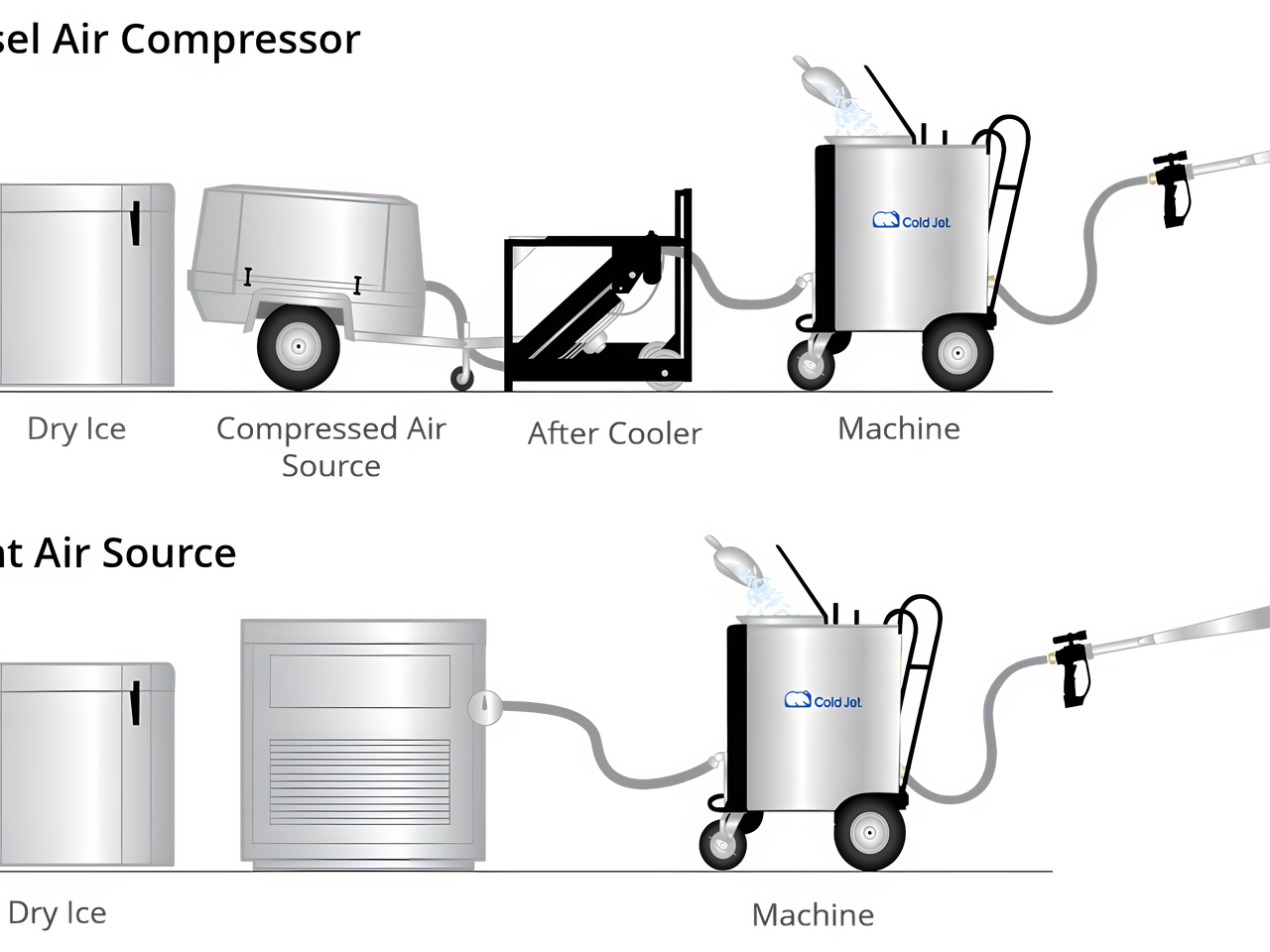
Along with your dry ice blasting machine, the systems will come complete with a blast and air hose, an applicator and a nozzle that is best suited for your application.
The only other items needed to operate the system are:
- Compressed air source (either plant air or an air compressor)
- Electric power source
- Dry ice supply
An after-cooler may be useful if you are using a portable diesel compressor as your air source. An after-cooler provides assurance that no moisture will be introduced into dry ice blasting system. This is primarily dependent on humidity levels.
Types of Dry Ice Media Used for Dry Ice Blasting
The size and density of the dry ice particle greatly affects the resulting clean. Different sized particles are used for different cleaning applications.
There are two types of media used in the process:
- Dry ice pellets
- Dry ice MicroParticles
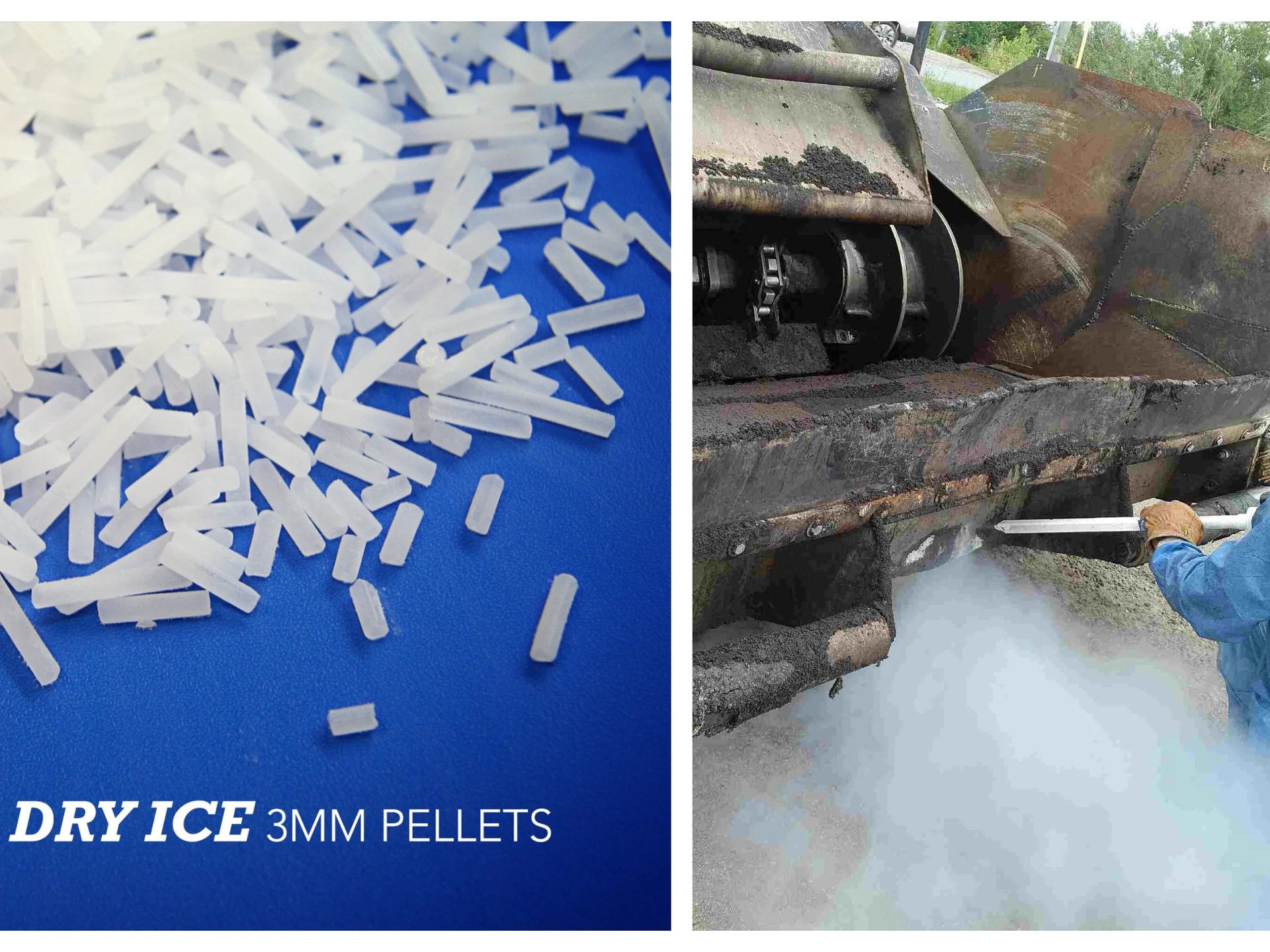
1. Dry Ice Pellets
- 3mm in size (roughly rice sized)
- Used for a more aggressive clean, getting rid of the most stubborn contaminants
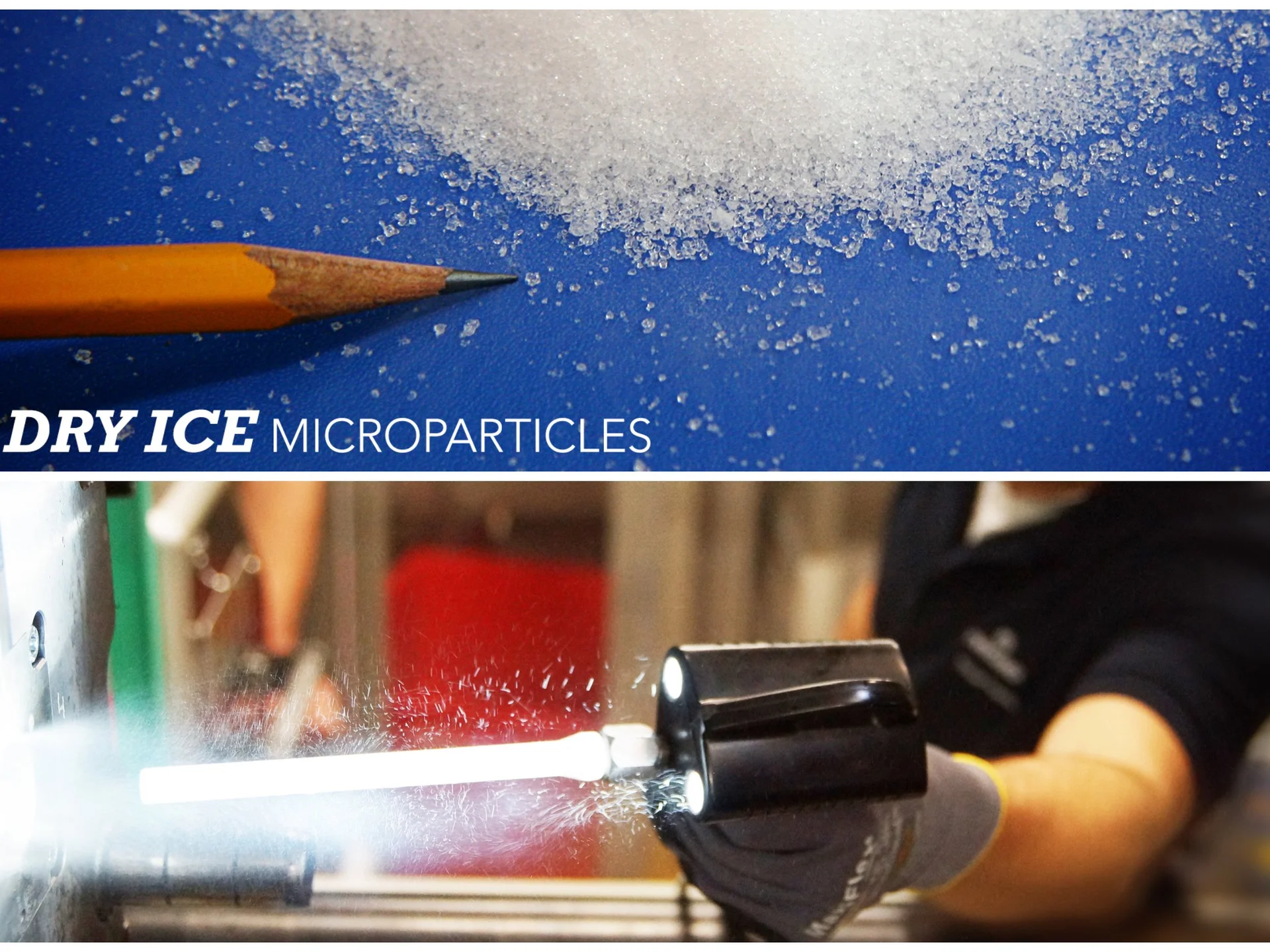
2. Dry Ice MicroParticles
- Sugar-sized particles
- Used to clean delicate and sensitive surfaces
- Less aggressive than pellets
- More media strikes the surface per second
- Increased coverage area
- More particle strikes per square inch
- Less air power is needed to accelerate dry ice (less noise)
You can also check out our short presentation to learn more!