B-17 Flying Fortress Gets a Full Restoration
The Mighty Eighth Air Force Museum in Savannah, Georgia memorializes the 8th Air Force, a military unit started after the infamous attack on Pearl Harbor.
Among the museum’s many exhibits is a B-17G Flying Fortress aircraft, which along with the B-24 was the most widely flown aircraft by the Mighty 8th. The aircraft came to the museum in early 2009 from the National Air and Space Museum in Washington D.C. after years of service in a variety of occupations.
Built near the end of World War II, the B-17 soon became obsolete and the plane was put into storage by the military.
After the war, the B-17 experienced an exciting journey:
- Bomber in World War II
- Put into storage
- Used for aircraft maintenance class
- Flew missions over the Arctic to map icebergs
- Used for firebombing missions
- Traded to the National Air and Space Museum
- Acquired by the Mighty Eighth Air Force Museum
“We had been searching for more than a decade for a B-17 to display in our museum, and were extremely excited to get one that we could call our own. When the B-17 came to our museum, it was airworthy, but was unadorned and unarmed, and had been through many years of difficult service. We knew restoring the aircraft after its years of service over the ocean, fighting fires, and sitting idle was going to be a massive project.
”
After being acquired, the museum placed the B-17 in its Combat gallery, allowing visitors to watch as four crews of volunteers began the process of stripping, cleaning and reassembling the aircraft.
“[The plane was] filthy. You can only imagine the wear and tear that 30 years of arduous service can have on everything from the engine and wheel wells to the interior of the plane. We had to get the plane down to the bare bones so that we could begin the process of repainting it olive drab and adorning it with the original equipment that made it the Flying Fortress.
”
Power Washing Was Inadequate
After removing the electrical instruments and other equipment from the interior, including two 1,200 gallon tanks used for firebombing, the restoration crew acquired a power washer to help clean and restore the plane.
Unfortunately, the power washer was messy and could not adequately remove the layers of paint, grease and grime that had accumulated over the years. The museum then bought a steam cleaner, and while the results were better than the power washer, it created an extremely hot and messy work environment and did not produce the results that the crew was hoping for.
“The power washer and steam cleaner were all we had, and because we were cleaning it inside, we knew we could not use some of the more explosive blasting methods such as crushed walnut shells or plastic beads.
”
Dry Ice Blasting Was the Ideal Solution
With the cleaning project stalled, Skipper and McLaughlin decided to visit the National Museum of the U.S. Air Force at Wright-Patterson Air Force Base in Dayton, Ohio where crews were restoring the most famous B-17, the Memphis Belle. Workers at Wright-Patterson were using a Cold Jet dry ice blasting system to successfully clean a small section of the interior of the aircraft.
“We figured if dry ice blasting worked for the Memphis Belle, then it would work for our B-17. We contacted Cold Jet, and the company was more than happy to help us with our project.
”
Dry ice blasting uses recycled CO2 in the form of non-abrasive dry ice pellets or blocks for a variety of cleaning applications. The dry ice media, blasted using pressurized air at user-controlled speeds, sublimates upon impact with the surface being cleaned, lifting away dirt and contaminants without leaving behind any secondary waste.
Learn more about dry ice blasting
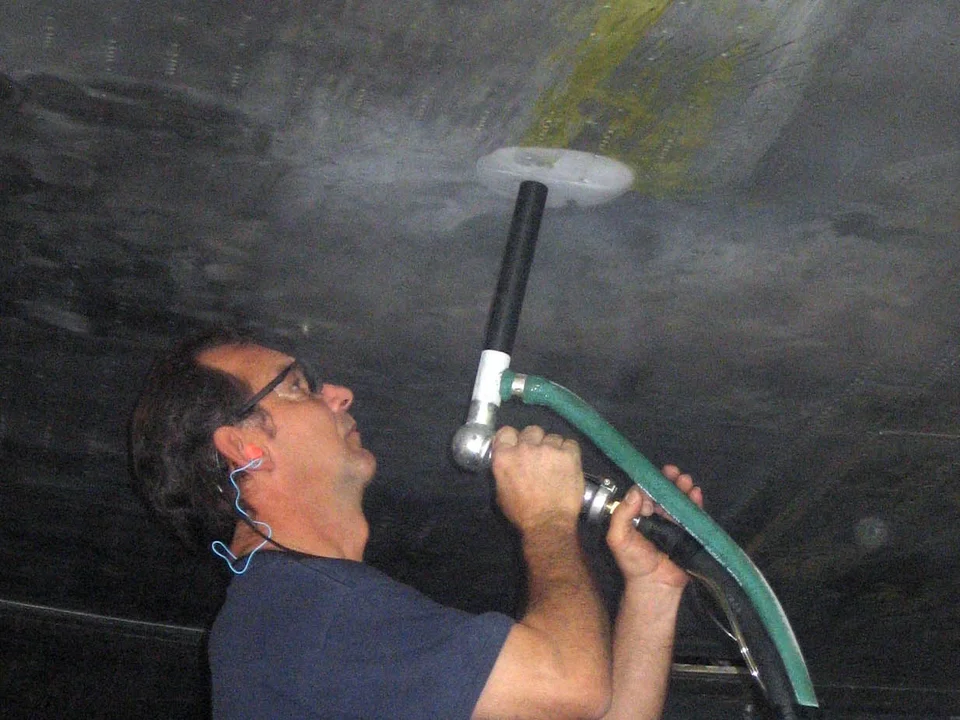
The Mighty Eighth’s restoration crew started to use a dry ice blasting system to remove years of build-up and grease from the wings and the engine coverings. Throughout the month, the crew used the dry ice blasting system to clean the plane’s four engines and wheel wells, and remove bubbled and chipped paint from the fuselage and portions of the interior, which has helped well-used parts to “look like new” and prepare the plane for its new paint job.
In addition to the B-17, the museum’s volunteer crew also used the dry ice blasting system to clean a red 1941 Ford fire truck, which is being restored to the way it looked while in operation at Chatham Airfield during World War II.
Learn about dry ice blasting for historical restoration
“When we started to use Cold Jet’s system, our efficiency levels dramatically increased. With a power washer and steam cleaner, we ran into a number of challenges that were quickly overcome with the dry ice blasting process. People have been fascinated by the B-17’s restoration process, and we have received numerous inquiries from people across the country who are restoring planes. The process has tremendous value in cleaning and restoration projects, and we appreciate Cold Jet’s efforts in helping us bring back to life this valuable piece of history.
”